2026 Energy Industry Trends: The Hidden Tensions of Renewables, AI, and Cybersecurity
The 2026 energy landscape is defined by a record 507 GW of global renewable capacity—outpacing fossil fuels for the first time—yet grid stability, AI-driven data center demand, and a 156% surge in cyberattacks are creating new fault lines. California's 89 hours of solar curtailment and Texas wind output plunging 85% during extreme weather expose the fragility of underinvested grids. Meanwhile, data centers now consume 4% of US electricity, projected to reach 9% by 2030, intensifying competition for clean power. Upstream innovations like BECCS offer long-term negative emissions potential, but near-term pressures from local employment demands and drilling automation reshape operational strategies. This article dives into the economic logic tying these trends together, revealing a systemic shift where reliability, security, and AI's insatiable appetite redefine energy markets.
Omar Hassan
Editorial Analyst
2026 Energy Industry Trends: Renewables, AI, and Cybersecurity Collide
The global energy industry entered 2026 with a milestone that would have seemed unthinkable a decade ago: renewable capacity additions reached 507 gigawatts globally in 2025, surpassing fossil fuel additions for the first time. Yet beneath this headline lies a more complicated reality. Grid instability, the explosive growth of AI-driven data centers, and a 156% surge in cyberattacks on energy infrastructure are creating new fault lines that threaten to undermine the very progress the renewable boom represents. This article examines the economic and operational tensions shaping the 2026 energy landscape.
The Record Renewable Surge and Its Hidden Costs
Global renewable capacity additions hit 507 GW in 2025, marking the first year that clean energy installations outpaced new fossil fuel capacity. Solar and wind accounted for the vast majority, with China, the United States, and Europe leading deployment. This structural shift in the generation mix signals that the energy transition is no longer a future ambition but a present reality. However, the economic logic of capacity growth without corresponding infrastructure resilience has created a paradox: more renewable generation does not automatically translate into reliable, affordable power.
Grid stability emerged as the defining challenge of 2025–2026. California logged 89 hours of solar curtailment during spring and autumn months when midday solar output exceeded demand, forcing operators to idle thousands of megawatts of clean capacity. In Texas, the state’s independent grid faced rolling blackouts when wind output dropped 85% during an extreme weather event in February 2026, exposing the vulnerability of a system that relies heavily on intermittent resources without adequate backup or storage. These events are not anomalies; they are symptoms of chronic underinvestment in transmission, storage, and grid flexibility.
The economic consequences are stark. Curtailment represents wasted capital—solar farms that sit idle during peak production hours still incur fixed costs, while ratepayers bear the burden of backup generation. Meanwhile, transmission bottlenecks prevent surplus renewable power from reaching high-demand regions. In the Midwest, wind farms frequently face negative pricing during high-wind periods, while East Coast markets pay premium prices for gas-fired generation. The 2026 energy industry trends highlight a critical lesson: without modernizing the grid, adding more renewable capacity only increases fragility.
[IMAGE: Split image showing rows of solar panels under bright sun with a curtailment warning overlay on the left; a dark city skyline with a power outage and transmission towers faintly lit on the right.]
AI’s Electric Appetite: Data Centers as New Demand Drivers
While the grid struggles to absorb renewable output, a new and insatiable source of electricity demand is reshaping energy markets: data centers powering artificial intelligence. Data centers now consume 4% of total US electricity, and projections from the US Energy Information Administration indicate that share could reach 9% by 2030—equivalent to the entire residential sector of several states combined. The rapid scaling of AI training and inference workloads, particularly for large language models and generative AI applications, is driving this surge.
This creates a paradoxical tension. Renewable growth aims to decarbonize the power sector, but AI-related loads are so heavy and location-constrained that they risk absorbing green capacity that was intended for broader grid decarbonization. Hyperscale data center operators are signing power purchase agreements for solar and wind projects across the country, often outbidding utilities and industrial customers. In Virginia’s “Data Center Alley,” demand has already strained local transmission networks, leading to interconnection delays and higher costs for other ratepayers.
Yet the tension also presents an opportunity. Regions with high renewable curtailment—like California, where solar oversupply regularly forces curtailment—could become attractive hubs for data center development if paired with battery storage. The economic logic is simple: instead of wasting excess solar generation, data centers can absorb it during peak production hours and draw from storage during evening and night periods. Such a model could turn a grid problem into a competitive advantage, but only if policy frameworks and infrastructure investments catch up. In 2026, we are seeing early experiments: Google and Microsoft have announced plans to colocate AI training facilities near large solar farms with dedicated battery systems. The success of these projects will determine whether the energy industry can satisfy AI’s appetite without derailing decarbonization.
[IMAGE: Graphic showing a server rack with energy consumption arrows, overlaying a map of the US with data center hotspots and renewable generation zones.]
Cyberattacks: The New Frontier of Energy Security
As the grid becomes more distributed and digitized, it also becomes more vulnerable. Cyberattacks on energy infrastructure increased 156% year-over-year in 2025, with attackers moving from perimeter threats—such as phishing and ransomware on corporate networks—to operational technology compromises that can physically disrupt power generation and transmission. The 2026 energy industry trends underscore that cybersecurity is no longer a peripheral IT concern; it is a core operational risk.
The rise in renewable assets expands the attack surface dramatically. Solar farms, wind turbines, and battery storage systems are often located in remote areas with limited physical security and rely on SCADA (supervisory control and data acquisition) systems that were not designed with modern cyber threats in mind. A coordinated attack on solar inverters—the devices that convert DC power to AC and communicate with grid operators—could destabilize voltage and frequency across a region. Similarly, compromising wind farm control systems could disable hundreds of turbines simultaneously, creating a sudden loss of generation that triggers blackouts.
The energy industry innovation in cybersecurity is accelerating, but unevenly. Large utilities and grid operators are investing in network segmentation, real-time threat detection, and incident response plans. However, smaller renewable project developers often lack the resources to implement robust security measures. Regulatory bodies are beginning to step in: the North American Electric Reliability Corporation (NERC) introduced new critical infrastructure protection standards for inverter-based resources in 2025, but compliance deadlines extend into 2027. The gap between threat evolution and defensive deployment remains the industry’s most pressing security challenge.
[IMAGE: Abstract visualization of a network map with glowing nodes representing energy assets, red arrows indicating attack paths, and a cybersecurity shield icon at center.]
Upstream Innovations: BECCS and Drilling Automation
While headlines focus on generation and demand, innovation in upstream energy technologies is quietly reshaping operational strategies. Bioenergy with carbon capture and storage (BECCS) has emerged as a promising pathway for negative emissions—locking away CO₂ that was absorbed by biomass during growth. In 2026, several commercial-scale BECCS projects are operating in the United States and Europe, primarily at ethanol plants and biomass power stations. The economic logic is compelling: BECCS can generate dispatchable electricity while permanently removing carbon, earning revenue from both the power market and carbon credits. Long-term projections suggest BECCS could remove up to 10 gigatonnes of CO₂ annually by mid-century, but near-term constraints—high capital costs, biomass supply chains, and transport infrastructure for captured CO₂—limit its current impact.
At the same time, drilling automation is transforming the oil and gas sector. Automated drilling systems using AI and real-time subsurface data have reduced drilling times by 30–40% in some basins, lowering costs and improving safety. This innovation is driven by local employment demands: in regions like the Permian Basin, labor shortages have pushed operators to adopt automation to maintain production levels. The tension between efficiency and employment is a recurring theme in 2026 energy industry trends. While automation reduces operational costs, it also reduces the need for manual labor, creating political friction in communities that depend on oil and gas jobs. Operators are increasingly investing in training programs to reskill workers for higher-value roles in data analytics and equipment maintenance.
[IMAGE: Panoramic view of a BECCS facility with biomass storage silos and CO₂ pipelines, next to a drilling rig with digital monitoring screens showing AI-driven automation data.]
The Economic Interconnections: Reliability, Security, and Demand
The threads of renewable growth, AI demand, cybersecurity, and upstream innovation are not separate stories—they are interwoven by a single economic logic. Reliability, security, and demand are now competing for the same limited resources: investment capital, grid capacity, and regulatory attention. The 2026 energy industry trends reveal a systemic shift where the old paradigm—build more generation to meet demand—no longer applies. Instead, the question is: how do we build a system that is simultaneously clean, reliable, secure, and capable of powering the digital economy?
The answer lies in integrated planning. Transmission upgrades, battery storage deployment, and cybersecurity hardening must proceed in lockstep with renewable additions. Data center siting decisions must account for grid constraints and curtailment patterns rather than simply chasing low electricity prices. Policymakers need to create incentives for distributed storage and demand response that can buffer the variability of both renewables and AI loads.
In the US, electricity consumption is projected to grow 2–3% annually through 2030, reversing two decades of flat demand. Most of that growth comes from data centers and electrification of transportation and industry. Meeting this demand without exacerbating grid instability or carbon emissions will require unprecedented coordination between utilities, tech companies, regulators, and investors. The 2026 energy landscape is a stress test for that coordination—and the results so far are mixed.
Conclusion: The Hidden Tensions Ahead
The record 507 GW of renewable capacity in 2025 is a genuine achievement, but it is also a warning. Without a grid that can handle the variability, without a cybersecurity framework that can protect distributed assets, and without a strategy to manage the explosive demand from AI, the energy transition will stall. The hidden tensions of renewables, AI, and cybersecurity are not side effects—they are the central challenge of the next decade.
For industry leaders, the path forward requires embracing complexity. The old linear approach—add capacity, sell electrons, manage risk reactively—is obsolete. The new model demands systemic thinking: every solar farm should be planned alongside storage and cyber defenses; every data center should be integrated with renewable curtailment solutions; every automation investment should account for workforce transitions. The companies and countries that navigate these tensions successfully will define the energy markets of 2030 and beyond.
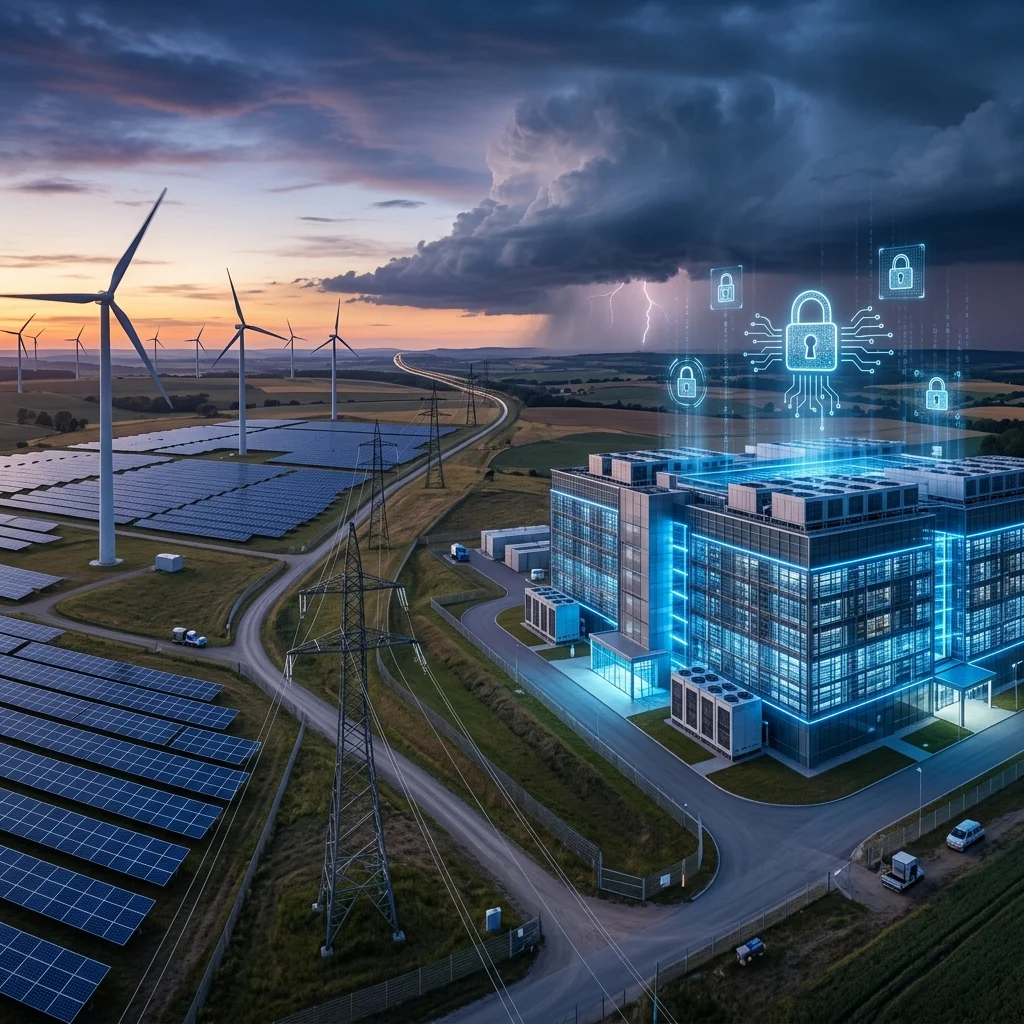
[IMAGE: A panoramic photorealistic scene of a modern energy grid at dusk. Left side: solar panels and wind turbines with a power line curving toward the horizon. Right side: a massive, glowing data center complex with cool blue light, digital security lock icons floating above. A storm cloud with faint lightning approaches from the background, symbolizing grid instability and cyber threats. High contrast, clean lines, no text or watermark, cinematic quality.]
Keywords

Omar Hassan
Energy Correspondent tracking OPEC+ policies and renewable energy transitions.