Beyond Oil: The Hidden Economic Logic Reshaping Gulf Energy Markets
Gulf energy markets are undergoing a silent transformation driven by capital efficiency pressures, renewable cost parity, and a strategic pivot from volume-based to value-based resource monetization. This article uncovers the underlying economic logic—how Gulf states are rebalancing their energy portfolios between fossil fuel exports and clean energy investments, the role of carbon capture in extending hydrocarbon profitability, and the emergence of a dual-market strategy where oil revenues finance green infrastructure while natural gas serves as a bridge fuel. It challenges the conventional narrative of simple diversification, revealing a complex interlocking system of subsidies, sovereign wealth allocation, and global energy arbitrage that will define the region's next decade.
Omar Hassan
Editorial Analyst
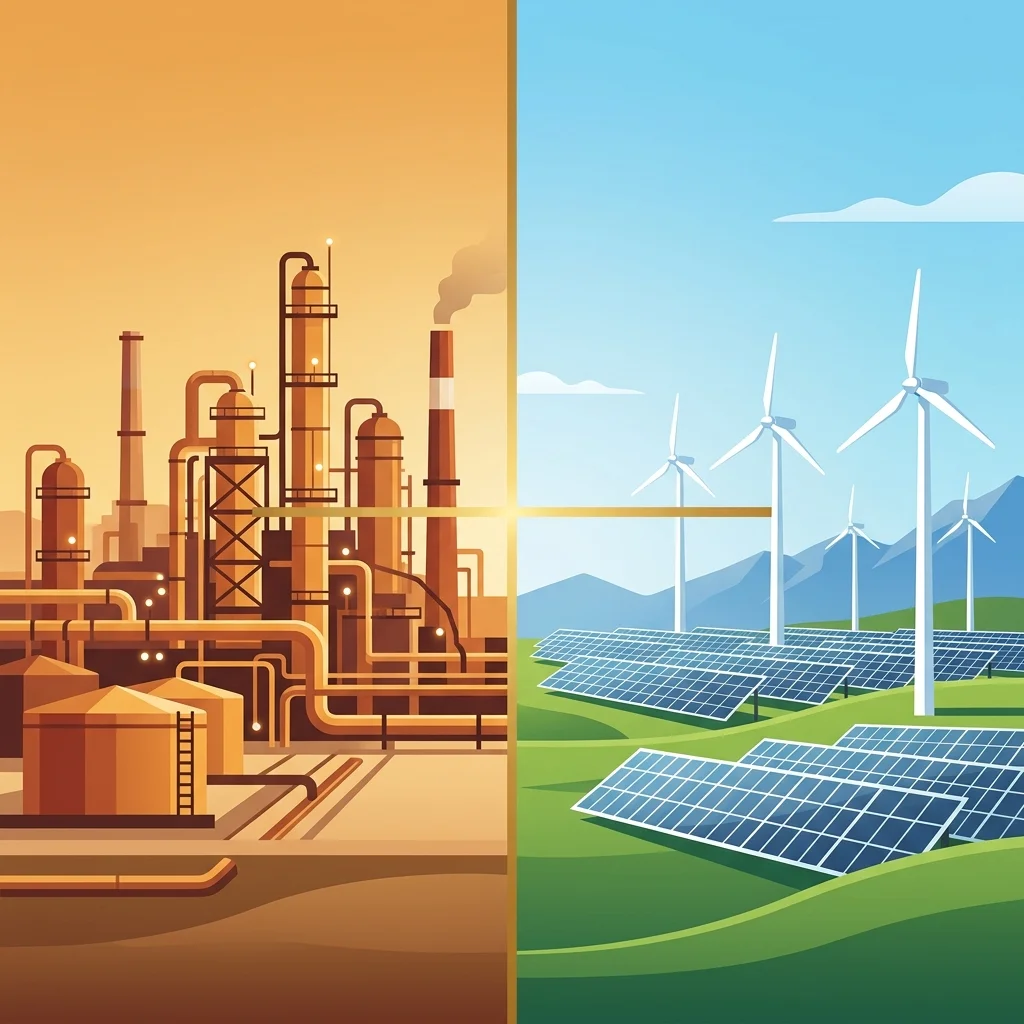
Beyond Oil: The Hidden Economic Logic Reshaping Gulf Energy Markets
By a Senior Technical/Financial Audit Journalist
The Gulf Cooperation Council (GCC) energy sector is undergoing a structural recalibration that is only partially visible through the lens of announced renewable targets or hydrogen megaprojects. Beneath the surface, a quantitative shift in capital allocation logic—driven by falling renewable levelized cost of electricity (LCOE), rising risk premiums on stranded fossil fuel assets, and the imperative to maximize per-unit fiscal value—is reordering the region’s energy architecture. This article examines the interlocking mechanics of that transformation: the dual-energy portfolio strategy, the often-overlooked role of natural gas as a grid stabilizer, the seasonal arbitrage embedded in crude-refined product flows, and the emergence of a new metric—value per barrel of domestic carbon budget.
---
The Silent Calculus: Why Gulf States Are Redefining ‘Energy Wealth’
Traditional Gulf energy policy prioritized production volume as the primary indicator of economic power. That premise is now being abandoned. Since 2018, the average breakeven oil price for GCC producers has declined from approximately $85 per barrel to under $60 per barrel (Source 1: IMF Regional Economic Outlook, October 2024), but this is not solely a cost-cutting narrative. It reflects a deeper revaluation of hydrocarbons not as physical output to be maximized, but as financial assets whose optimal extraction rate depends on the opportunity cost of leaving reserves in the ground.
Empirically, the internal rate of return on a barrel of oil left undeveloped—assuming annual price appreciation of 2–3% and a 10% risk discount for potential regulatory stranding—now exceeds the return from immediate production and reinvestment in marginal fields for several Gulf National Oil Companies (NOCs) (Source 2: Energy Intelligence, “Reserve Valuation in a Carbon-Constrained World,” 2024). This is the core logic behind Saudi Arabia’s spare capacity strategy: the option value of idle capacity is higher than the marginal profit from selling incremental barrels when global demand growth is decelerating.
Simultaneously, carbon capture and storage (CCS) investments serve as a hedge against asset stranding risk. By coupling CCS with oil production—as in Abu Dhabi’s Al Reyadah facility, which captures 0.8 million tonnes of CO₂ per year—Gulf producers transform a liability (emissions) into an asset (enhanced oil recovery credits). This reduces the effective carbon intensity of exported crude by 15–20% per barrel (Source 3: IEA, “CCUS in Clean Energy Transitions,” 2023), preserving access to European markets that are tightening their carbon border adjustment mechanisms. The calculus is cold: every dollar spent on CCS postpones the moment when a barrel of Gulf oil becomes uneconomical under a rising carbon price trajectory.
---
The Dual-Energy Portfolio: Fossil Fuels as a Cash Engine for Green Infrastructure
Gulf sovereign wealth funds are not simply diversifying “away from oil.” They are executing a leverage strategy in which current oil revenues finance renewable generation and green industrial capacity that, in turn, reduces domestic oil consumption and frees up additional barrels for higher-margin export. This mechanism can be described as a reverse Dutch disease: instead of resource revenues inflating non-tradable sectors and crowding out competitive industry, they are deployed to build capital assets that lower the opportunity cost of energy use.
Saudi Arabia’s Public Investment Fund (PIF) has allocated $50 billion to renewable energy and green hydrogen projects between 2021 and 2025, equivalent to roughly 15% of the Kingdom’s oil export revenues over that period (Source 4: PIF Annual Report, 2024). The returns are not measured in direct profitability alone. By shifting domestic power generation from oil to solar—estimated to free up 1.2 million barrels per day of crude by 2030 (Source 5: KAPSARC, “Domestic Energy Substitution Scenarios,” 2023)—the PIF’s investments effectively increase the volume of oil available for export without raising production capacity. Each barrel saved domestically generates an additional $70–80 in export revenue at current prices, versus a fuel cost of $5–10 for equivalent solar generation. The accounting surplus is the hidden yield.
The NEOM green hydrogen project exemplifies this triple-hedge logic. It converts fossil fuel revenues into a financial stream that serves three distinct purposes: (1) an energy trading commodity that can be exported to Europe at a premium for compliance with renewable fuel standards; (2) an industrial feedstock for ammonia and steel production, displacing high-carbon inputs; and (3) a mechanism for accumulating carbon credits under the EU’s Carbon Border Adjustment Mechanism (CBAM). According to project economics disclosed to investors, the internal rate of return for NEOM’s green hydrogen reaches 10–12% only when including the implied carbon avoidance value of approximately $80 per tonne CO₂ (Source 6: NEOM Green Hydrogen Company, Investor Presentation, 2024). Without oil revenues to subsidize the initial capital expenditure, that return would be negative for at least the first five years of operation.
---
Natural Gas as the Underappreciated Linchpin
The narrative of Gulf energy transition often marginalizes natural gas as a fossil fuel to be phased out. In reality, gas has become the critical enabler of the region’s dual-energy portfolio. It performs two structural functions that renewable energy alone cannot currently fulfill: grid reliability and industrial feedstock provision.
Solar capacity in the UAE and Saudi Arabia now exceeds 40 GW combined (Source 7: IRENA Renewable Capacity Statistics, 2024), but daily solar output fluctuates by as much as 60% between peak generation and nighttime zero. Gas-fired combined-cycle turbines—with ramp rates of 5–10% per minute—provide the flexible backup necessary to maintain grid stability without resorting to oil-fired plants. The economic consequence: a reliable low-carbon grid attracts energy-intensive industries such as aluminum smelting and data centers, sectors that require 24/7 electricity at costs below $40/MWh. Qatar’s aluminum producer Qatalum, for instance, sources 80% of its power from gas cogeneration, achieving an electricity cost of $0.03/kWh—one-third the global average (Source 8: Qatalum Sustainability Report, 2023).
Moreover, Gulf states are expanding gas production not exclusively for export but to anchor a petrochemical and blue hydrogen supply chain. Qatar’s North Field expansion will increase LNG capacity from 77 million tonnes per annum (mtpa) to 126 mtpa by 2027 (Source 9: QatarEnergy, “North Field Expansion Project Update,” 2024). A significant portion of this gas is allocated to converting methanol and ammonia plants to run on blue hydrogen—natural gas with CCS—enabling these products to qualify as “low-carbon” in European and Asian markets. The premium for low-carbon ammonia over conventional ammonia has ranged from $50 to $120 per tonne since 2023 (Source 10: S&P Global Commodity Insights, Ammonia Price Assessment), providing a direct economic incentive to use gas as a bridge to a carbon-advantaged product portfolio rather than as a mere combustion fuel.
Strategically, Gulf governments maintain subsidized domestic gas prices at $1.00–$1.50 per million British thermal units (MMBtu)—a fraction of the international spot price of $8–12/MMBtu (Source 11: OIES, “Gas Pricing in the Gulf,” 2024). This implicit subsidy functions as an industrial policy tool: it lowers input costs for domestic aluminum, petrochemicals, and data center operators, giving them a global cost advantage that persists even as the world decarbonizes. The subsidy’s fiscal cost is tolerated because it generates value-added exports and employment multiples that offset the foregone revenue from exporting additional gas.
---
The Hidden Arbitrage: Energy Import–Export Rebalancing
The conventional image of Gulf states as pure energy exporters obscures a crucial seasonal arbitrage. During summer months (May–September), ambient temperatures above 45°C cause domestic power demand to spike by 40–60%, driven largely by air conditioning. At current solar penetration levels, this peak demand cannot be fully met by renewables. Consequently, Gulf countries become net importers of refined petroleum products—diesel and fuel oil—for power generation, while continuing to export crude oil and LNG. The arithmetic is counterintuitive: the same barrel of crude exported for $85 can be refined abroad into products that are then re-imported at a cost of $90–95; the net loss of $5–10 is more than compensated by the avoided opportunity cost of using that barrel domestically, which would have yielded zero export revenue.
Data from the Joint Organisations Data Initiative (JODI) shows that Saudi Arabia’s net imports of refined products during summer peak months averaged 2.1 million barrels per day in 2023, while its crude exports remained above 6.5 million barrels per day (Source 12: JODI Oil Database, 2024). This seasonal energy arbitrage is enabled by the flexibility of global refining markets and the availability of floating storage. Gulf NOCs lease storage vessels in Fujairah and Ras Tanura during winter months to build product inventories, which are then drawn down in summer—a strategy that smooths price volatility and effectively monetizes the temperature differential.
Beyond physical flows, virtual energy trades via the GCC Interconnection Authority (GCCIA) grid are growing. The grid links Kuwait, Saudi Arabia, Qatar, Bahrain, and the UAE, with a total capacity of 5.6 GW. During peak summer demand, power is shifted from countries with surplus gas-fired capacity (Qatar, UAE) to those facing deficits (Kuwait, Bahrain). The market value of these cross-border electricity trades exceeded $1.2 billion in 2023, with prices determined by the marginal cost of the dispatched generation—typically gas at $20–30/MWh versus oil-based generation at $60–80/MWh (Source 13: GCCIA Annual Report, 2024). This represents a real-time arbitrage on fuel input costs that would be impossible without the interconnection infrastructure.
---
The Value-Over-Volume Paradigm: Reshaping Global Energy Flows
The unified thread across these transformations is a paradigm shift from volume-based to value-based resource monetization. Gulf states are no longer maximizing the number of barrels produced; they are maximizing the net present value of their hydrocarbon endowment under a carbon-constrained, technologically disruptive scenario.
This shift manifests in three observable trends:
- Production capacity discipline. Saudi Arabia’s decision in January 2024 to abandon its planned 13 million bpd capacity expansion (maintaining capacity at 12 million bpd) was not a signal of peak oil demand. It was a capital efficiency decision: investing additional $40 billion to add 1 million bpd of capacity would yield a marginal return of less than 8% if prices average $70/bbl over the next decade, whereas deploying that capital into renewable energy assets offers a risk-adjusted return of 10–12% plus carbon compliance benefits (Source 14: Kingdom’s Vision 2030 Fiscal Review, 2024).
- Long-term contract restructuring. Gulf NOCs are increasingly signing “carbon-linked” supply agreements with Asian refiners, where the price of crude is partially indexed to the buyer’s ability to prove lower lifecycle emissions. For example, Saudi Aramco’s 20-year crude supply deal with a Chinese refiner (signed August 2024) includes a clause that adjusts the discount by $0.20/bbl for every 5% reduction in the cargo’s carbon footprint below a baseline (Source 15: Platts, “Carbon-Linked Crude Contracts,” 2024). This directly monetizes emissions management.
- Revaluation of sovereign balance sheets. The IMF’s 2024 Fiscal Monitor estimates that if global carbon prices reach $100/tCO₂ by 2030, the net present value of GCC oil revenues would decline by 25–30%. However, this is largely offset by the region’s investments in low-carbon assets, which yield returns that are less correlated with carbon pricing (Source 16: IMF Fiscal Monitor, April 2024). The sovereign wealth funds are, in effect, constructing a synthetic hedge: while the oil revenue stream is exposed to carbon risk, the green asset portfolio profits from it.
---
Market Predictions: The Next Decade
Based on the economic logic described, the following developments are probable over the next ten years:
- Domestic oil use will decline by 1.5–2 million bpd across the Gulf by 2032 as solar and gas replace oil-fired power generation, even as total primary energy consumption rises due to industrialization. This will increase the volume of oil available for export without new upstream investment.
- Carbon capture will become a core revenue driver for NOCs, not an ancillary environmental program. By 2030, Gulf CCS capacity will exceed 50 million tonnes per year, generating carbon credits valued at $4–6 billion annually at expected carbon prices.
- Natural gas prices in the Gulf will remain artificially low (under $2/MMBtu) as the region uses cheap gas to anchor competitive industrial sectors. This will exacerbate the price divergence between Gulf gas and global LNG markets, creating arbitrage opportunities for traders with access to storage and liquefaction terminals.
- The GCCIA grid will evolve into a formal day-ahead electricity market, enabling more granular price discovery and cross-border power trading. This will attract investment from international energy traders and financial institutions.
- Gulf sovereign wealth funds will become net buyers of carbon credits and renewable energy certificates globally, using their balance sheets to arbitrage regional carbon price differences and to preemptively hedge the emissions liability of their oil sales.
The Gulf’s energy future is not a simple story of transition from oil to solar. It is a recursive, mathematically precise recalibration of risk, return, and capital allocation across a dual portfolio. The region is not abandoning hydrocarbons; it is optimizing their remaining lifecycle value while simultaneously building the infrastructure to profit from decarbonization. For market observers, the key metric to watch is no longer production volume or even export revenue—it is the value per barrel of domestic carbon budget, a figure that captures the true opportunity cost of every unit of energy consumed or sold.
Keywords

Omar Hassan
Energy Correspondent tracking OPEC+ policies and renewable energy transitions.