The Gulf’s Energy-Addition Strategy: Redefining Global Market Gravity Through Debt, LNG Ecosystems, and Industrialisation
The Gulf region is orchestrating a profound shift from a resource-export model to an integrated energy and industrial powerhouse. Rather than following the Western energy transition narrative, Gulf National Oil Companies (NOCs) are pursuing an 'energy-addition' strategy—expanding simultaneously in fossil fuels and renewables. This article uncovers the hidden economic logic behind the region’s preference for debt over equity, the evolution of LNG partnerships into multi-party ecosystems, and the long-term bet on industrialisation and digital infrastructure. Drawing on six weeks of on-the-ground insights from Charlie Abrines, it reveals why the Gulf is becoming the world’s energy centre of gravity and what that means for global supply chains, project finance, and market dynamics.
Omar Hassan
Editorial Analyst
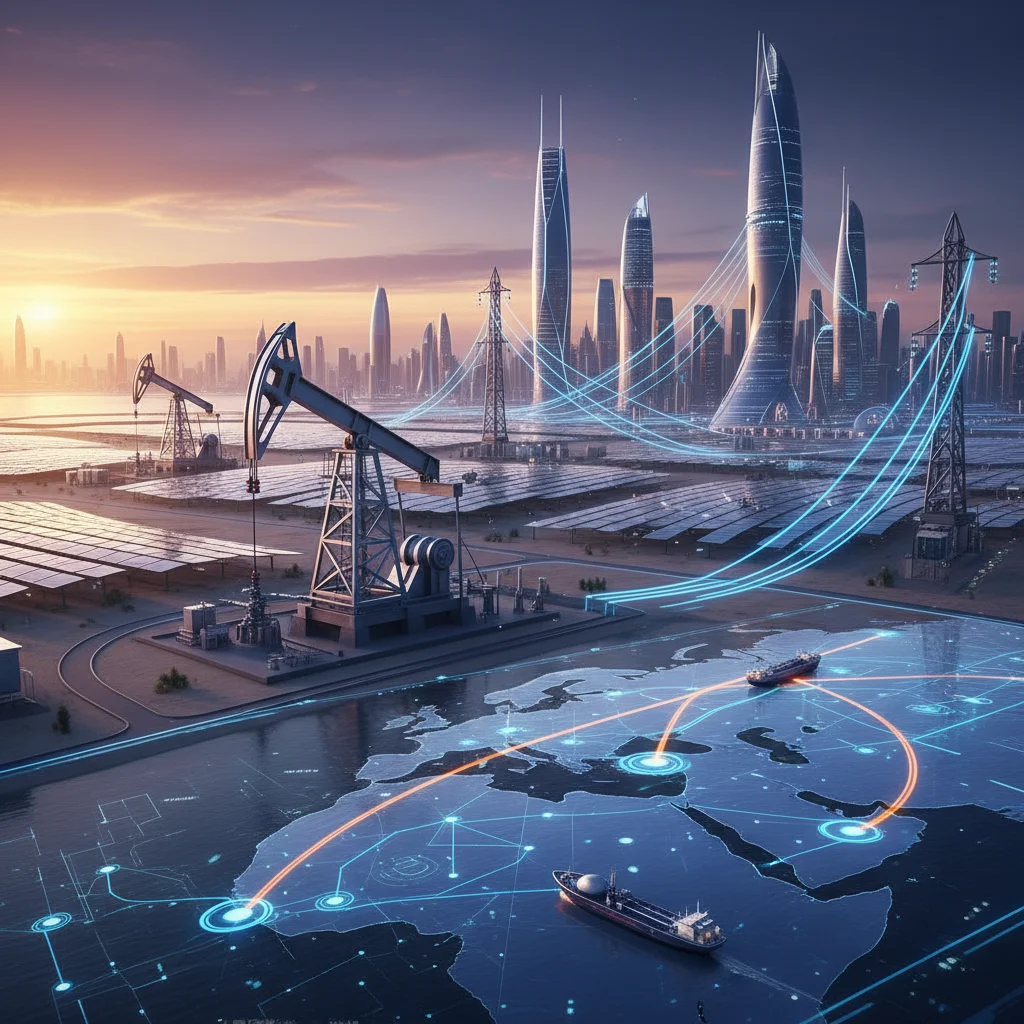
The Gulf’s Energy-Addition Strategy: Redefining Global Market Gravity Through Debt, LNG Ecosystems, and Industrialisation
Date: 26 February 2026
---
Introduction: The Gulf’s New Energy Narrative
Over six weeks traversing Saudi Arabia, Qatar, and the United Arab Emirates, Charlie Abrines, Group Managing Director at The Energy Council, observed a region undergoing a structural transformation that defies conventional Western energy transition frameworks (Source 1: On-the-ground observation, Q1 2026). The prevailing paradigm in Gulf capitals is not substitution but addition—a recognition that global energy demand trajectories, driven by population growth, industrialisation in the Global South, and digital infrastructure expansion, require concurrent investment across all energy categories.
"This is not an energy transition narrative as defined in Western markets. Instead, the Gulf’s framing is clear: the world will need more energy, not less, and the region intends to supply it across every category," Abrines stated, synthesising months of ministerial dialogues, project site visits, and capital market discussions.
The thesis emerging from these conversations is unambiguous: the Gulf is not merely maintaining relevance in global energy markets—it is actively constructing the gravitational centre around which those markets will orbit. This repositioning rests on three interlocked pillars: a deliberate capital strategy favouring debt over equity, the evolution of LNG partnerships into multi-party ecosystems, and a deepening commitment to industrialisation anchored in digital and energy-intensive infrastructure.
---
Debt Over Equity: The Unseen Capital Logic of Gulf NOCs
The capital allocation strategies of Gulf National Oil Companies (NOCs) reveal a structural preference that runs counter to the equity-financing models common among Western majors. Rather than diluting ownership through secondary offerings or strategic equity placements, entities such as Saudi Aramco and the Abu Dhabi National Oil Company (ADNOC) have systematically prioritised debt issuance to fund their dual-track expansion programmes (Source 2: Primary capital markets data, 2024-2026).
This preference for debt over equity serves multiple strategic objectives simultaneously. First, it preserves the sovereign control that Gulf states deem essential for long-term resource management. Second, in an environment where Gulf NOCs maintain some of the lowest cost of capital globally—a function of implicit sovereign backing and abundant domestic liquidity—debt financing reduces overall funding costs compared to equity, which would require offering a risk premium to external shareholders. Third, it aligns with sovereign wealth objectives: retained earnings and undiluted ownership maximise the flow of hydrocarbon revenues directly into state budgets and sovereign funds.
ADNOC’s utilisation of XRG and Masdar as diversification vehicles exemplifies this logic. Rather than selling equity in its core upstream and downstream assets to fund renewable and industrial expansion, ADNOC channels capital through wholly or majority-owned subsidiaries, maintaining operational and strategic control while accessing project finance and bond markets at subsidiary level (Source 3: Corporate structure filings, ADNOC Group, 2025-2026). This structure allows the NOC to expand simultaneously in fossil fuels and renewables—the core of the energy-addition strategy—without ceding decision-making authority to external shareholders who might demand accelerated divestment from hydrocarbon assets.
"This is an energy‑addition strategy, not an energy‑substitution one," Abrines noted, reflecting the consensus view among Gulf policymakers and NOC executives. The debt strategy is the financial infrastructure enabling this dual-track expansion: it provides the capital while ensuring that strategic direction remains in sovereign hands.
---
The LNG Puzzle: Pricing, Flexibility, and Multi-Party Ecosystems
Qatar’s ambitious LNG expansion programme, a central topic of discussion at the LNG26 conference and during Abrines’ Gulf tour, faces increasing scrutiny on three critical dimensions: pricing models, regulatory frameworks, and contract flexibility (Source 1: Conference proceedings and bilateral meetings, Q1 2026).
The traditional Gulf LNG model—long-term, fixed-quantity contracts with destination clauses and oil-linked pricing—is undergoing fundamental reassessment. Market participants interviewed during the six-week itinerary indicated growing pressure from buyers, particularly in Asian and European markets, for greater price indexation to gas hub benchmarks (Henry Hub, TTF, JKM) and reduced contract duration. Concurrently, regulatory frameworks in importing jurisdictions are demanding more transparent emissions reporting and supply chain carbon accounting.
The Gulf response has been to reconfigure LNG partnerships from bilateral producer-offtaker arrangements into multi-party ecosystems that include producers, commodity trading houses, infrastructure investors, end-users, and financial intermediaries. These ecosystems allocate risk across a broader base of participants, allowing each party to bear the risks most aligned with their comparative advantages—trading houses assume price and logistical risk; infrastructure investors manage operational and counterparty risk; financial intermediaries structure hedging and credit enhancement mechanisms.
"The future winners will be projects that can allocate risk transparently, integrate operations collaboratively and respond quickly to shifts in global demand," Abrines observed, summarising the consensus emerging from executive roundtables in Doha and Abu Dhabi.
This ecosystem approach transforms LNG from a commoditised fuel trade into a platform for industrial diplomacy and market influence. By embedding itself as the central node in these multi-party networks, Qatar—and by extension other Gulf LNG producers—creates dependencies that extend beyond simple supply contracts. Trading houses, infrastructure funds, and industrial off-takers become stakeholders in the stability and expansion of Gulf LNG capacity, creating a constituency that advocates for Gulf production interests in their home markets.
---
Industrialisation and Digital Infrastructure: The Long-Term Bet
The energy-addition strategy extends beyond hydrocarbons and renewables into a broader industrialisation programme that redefines the Gulf’s role in global value chains. Saudi Arabia’s industrial strategy—encompassing manufacturing, advanced materials, and knowledge-based industries—represents the most ambitious iteration, but Oman is pursuing a parallel trajectory, leveraging its geographic position and energy资源优势 to attract energy-intensive manufacturing (Source 2: National industrial strategies, Saudi Vision 2030 and Oman Vision 2040).
The Gulf’s positioning as a hub for hyperscale data centres illustrates the interconnected logic. Data centres require three inputs that the Gulf can provide at competitive scale: reliable baseload power from natural gas and, increasingly, civilian nuclear energy; land with favourable connectivity to submarine cable landing points; and capital for infrastructure investment. The region’s pursuit of civilian nuclear programmes—in the UAE (Barakah), Saudi Arabia (planned), and potentially other Gulf states—provides the carbon-free baseload power that hyperscale operators require to meet their own net-zero commitments (Source 3: International Atomic Energy Agency country profiles, 2025-2026).
This convergence of energy supply, industrial policy, and digital infrastructure creates a self-reinforcing cycle. Energy exports generate the capital for industrial investment; industrial development creates domestic demand for energy, justifying continued upstream investment; digital infrastructure attracts foreign technology investment and creates high-value employment, supporting the knowledge-economy transition.
The timeline for these structural shifts is measured in decades, not quarters. The 9-10 December 2026 Energy Council London conference will provide an opportunity to assess progress against the benchmarks established during Abrines’ Gulf tour, but the direction of travel is already clear (Source 1: Conference scheduling, Energy Council).
---
Conclusion: The New Centre of Gravity
The Gulf’s energy-addition strategy represents a coherent response to a structural reality that Western energy narratives have been slow to acknowledge: global energy demand is growing, not declining, and will continue to grow for at least two decades regardless of decarbonisation policies. By investing simultaneously across fossil fuels, renewables, nuclear, and digital infrastructure, Gulf states are positioning themselves to supply every category of energy demand, from baseload power to peaking capacity to industrial feedstock.
The debt preference, LNG ecosystem evolution, and industrialisation push are not separate initiatives but components of an integrated strategy. Debt preserves control and lowers capital costs; ecosystems create durable relationships that extend beyond commodity transactions; industrialisation builds domestic economic resilience and diversifies revenue sources without requiring the wholesale abandonment of hydrocarbon assets.
"For those trying to understand the future of global energy markets, the Gulf is no longer just a key player. It is the centre of gravity," Abrines concluded.
For international investors, project developers, and policy makers, the implications are measurable. Project finance structures must accommodate the Gulf’s preference for debt and retained control. LNG contracting models must evolve toward the multi-party ecosystem framework. Industrial development strategies must account for the Gulf’s growing capacity to host energy-intensive and digital infrastructure.
The market prediction: Gulf NOCs will continue to increase their share of global energy investment, both upstream and downstream, while maintaining the sovereign control that their debt-financing model enables. The LNG ecosystem model will be replicated across other energy vectors, including hydrogen and low-carbon fuels. Data centre investment in the Gulf will accelerate, driven by the unique combination of energy availability, nuclear baseload, and capital liquidity.
The world’s energy centre of gravity has shifted. Market participants who adjust their models accordingly will be positioned for the long-term structural trends; those who persist with frameworks designed for an energy-substitution world will face increasing misalignment with observable reality.
Keywords

Omar Hassan
Energy Correspondent tracking OPEC+ policies and renewable energy transitions.