The Fragility of Global Markets: How Gulf Energy Disruptions Reshape the Future of Supply Chains
This article offers a deep industry audit of the structural vulnerabilities in global energy markets exposed by Gulf disruptions. Moving beyond supply-shock narratives, it examines the hidden economic logic of spare capacity, the financialization of oil markets, and the long-term impact of Gulf sovereign wealth funds on global supply chains. Drawing on insights from the Center on Global Energy Policy at Columbia University, it proposes a new resilience framework for energy interdependence.
Omar Hassan
Editorial Analyst
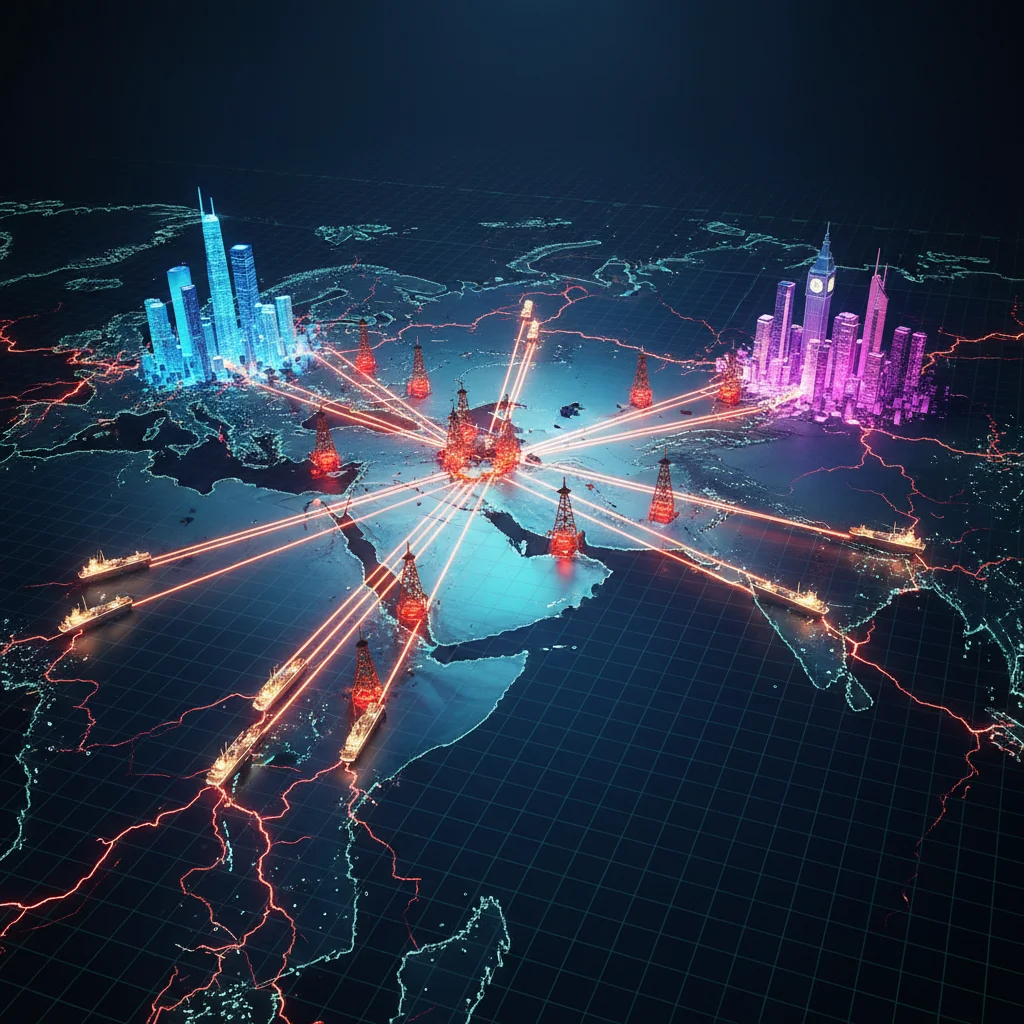
The Fragility of Global Markets: How Gulf Energy Disruptions Reshape the Future of Supply Chains
Introduction: The Fragility That Was Always There
On September 14, 2019, a swarm of drones and cruise missiles struck the Abqaiq oil processing facility and the Khurais field in eastern Saudi Arabia, temporarily knocking out 5.7 million barrels per day—more than 5% of global supply. In a single day, crude prices spiked by 15%, the largest single-day jump in decades. That shock, however, was not an anomaly. In 2023, OPEC+ announced a series of production cuts totaling 3.7 million barrels per day, sending Brent crude above $95 per barrel and reigniting inflation fears across developed economies. And in 2024, renewed tensions in the Strait of Hormuz—through which 20% of global oil passes—prompted insurance premiums for tankers to quadruple overnight.
These events are not isolated geopolitical dramas. They are recurring symptoms of a deeper, structural fragility embedded in the architecture of global energy markets—a fragility that has been masked by decades of assumed stability. The core thesis of this article is straightforward: the repeated disruptions in the Gulf reveal a systemic vulnerability that goes far beyond geopolitics. It is rooted in the hidden economic logic of spare capacity, the extreme concentration of supply in a handful of producers, the financialization of oil markets that amplifies every rumble of real-world disruption, and the long-term entanglement of Gulf sovereign wealth funds in the very infrastructure meant to provide energy independence.
To understand this new era of fragility, we draw on research from the Center on Global Energy Policy at Columbia University (CGEP), a leading think tank that has systematically analyzed the structural weaknesses in global energy security. Their work reveals that the shocks we see today are not temporary bumps—they are the new baseline.
[IMAGE: A timeline infographic of major Gulf energy disruptions from 1973 to the present, with price spikes annotated. Key events: 1973 Arab oil embargo, 1990 Gulf War, 2003 Iraq invasion, 2011 Arab Spring, 2019 Abqaiq-Khurais attack, 2023 OPEC+ cuts, 2024 Hormuz tensions.]
The Hidden Economic Logic: Spare Capacity as a Myth
For decades, the global oil market has relied on a single, implicit guarantee: Saudi Arabia’s spare capacity. The kingdom historically held between 1.5 million and 2.5 million barrels per day of production that could be brought online within weeks to calm markets. This buffer was the world’s insurance policy against supply shocks. But that policy is now severely underfunded.
According to data from the International Energy Agency and CGEP, OPEC’s effective spare capacity—the oil that can actually be produced within 30 days—has declined from over 4 million bpd in 2015 to an estimated 2.5 million bpd in 2025, with Saudi Arabia accounting for the vast majority. The reasons are structural: underinvestment in new fields during the 2015–2020 price crash, the natural decline of aging giant fields like Ghawar and Burgan, and rising domestic energy consumption in Gulf states that eats into exportable volumes. Saudi Arabia’s own consumption of crude for power generation and desalination has doubled in the past two decades.
But the real problem is not just the shrinking physical buffer. It is the moral hazard embedded in the very concept of spare capacity. CGEP researchers describe it as a “capacity put option”—an implicit guarantee that distorts long-term pricing signals and discourages diversification. When the market believes Saudi Arabia can always pump more, it underprices tail risks. Refiners, traders, and governments underinvest in storage, fuel switching, and alternative supply routes. They assume the buffer will always be there. But a buffer that everyone relies on, and that no one pays for, is no buffer at all.
This illusion is compounded by the financialization of oil markets. In 2020, less than 1% of oil futures contracts were settled by physical delivery. The rest—99%—were traded by hedge funds, algorithmic traders, and speculators. When a disruption occurs in the Gulf, these financial players magnify the panic. CGEP economists have shown that a 1% physical supply disruption can trigger a 10% price spike, purely because algorithm-driven trading systems react to headlines faster than physical supply chains can adjust. The result is an oil market that is both physically fragile and financially hyper-sensitive.
[IMAGE: A chart comparing OPEC spare capacity (1990–2025) with the oil price volatility index (OVX). The chart shows spare capacity declining from ~5 million bpd in 1990 to ~2.5 million bpd in 2025, while OVX spikes during disruption events (2008, 2011, 2019, 2022).]
Technology Trends: LNG and Renewables as Double-Edged Swords
If conventional oil markets are fragile, one might assume that diversification into liquefied natural gas (LNG) and renewables would reduce vulnerability. In theory, yes. In practice, these technologies create new forms of interdependence—and new single points of failure.
Take LNG. The Gulf, particularly Qatar, has become a dominant player in global LNG supply, with QatarEnergy aiming to increase production from 77 million tonnes per annum (mtpa) to 142 mtpa by 2030. At the same time, the United States has emerged as the world’s largest LNG exporter, with massive liquefaction capacity along the Gulf Coast. On the surface, this looks like diversification. But LNG is a deeply integrated global market: a cold snap in Northeast Asia can pull cargoes away from Europe, leaving countries like Germany or Italy scrambling. The 2021–2022 energy crisis demonstrated exactly this—Russian gas cuts were partially offset by increased US LNG, but only at the expense of Asian buyers who were outbid. The result was a global price shock that hit both continents.
More subtly, the LNG supply chain is concentrated in choke points. Roughly 40% of global LNG passes through the Strait of Hormuz, the same waterway that threatens oil tankers. A single disruption at a Qatari liquefaction terminal or a blockage in the Hormuz could remove 10% of global LNG supply overnight—even for countries that buy no oil from the Gulf.
Renewables, meanwhile, offer a different kind of fragility. The energy transition requires massive quantities of critical minerals such as lithium, cobalt, nickel, and rare earth elements. These minerals are not distributed democratically. The Democratic Republic of Congo supplies 70% of global cobalt; Chile and Australia dominate lithium; China processes 60% of rare earths. This is a new form of supply concentration that mirrors the old oil dependence. The CGEP has warned that a geopolitical crisis in the Congo or Chile could choke EV battery production just as effectively as a Gulf crisis chokes oil supply.
The real disruption, however, is not about peak oil demand. It is about the mismatch between investment cycles and policy timelines. Governments push aggressive decarbonization targets—Net Zero by 2050, carbon neutrality by 2035—but fossil fuel investment cycles run on 10- to 20-year horizons, and critical mining projects take 5–10 years to permit and build. This mismatch creates boom-bust cycles in both fossil and clean energy capacity. When oil demand doesn’t die as fast as expected (e.g., post-COVID demand rebound), spare capacity vanishes. When renewable deployment accelerates too quickly, mineral supply bottlenecks emerge. The result is a world where every energy transition pathway carries its own version of the Gulf fragility.
[IMAGE: Side-by-side maps: Left side shows traditional oil choke points (Strait of Hormuz, Bab el-Mandeb, Malacca Strait) and major oil production regions (Gulf, Russia, US). Right side shows new mineral supply routes (Congo, Chile, Indonesia) and major LNG shipping lanes (Qatar to Asia, US to Europe). Annotations highlight interdependencies.]
Long-Term Supply Chain Impact: The Gulf’s Sovereign Wealth Fund Leverage
Perhaps the most underappreciated dimension of Gulf energy disruption is the long-term transformation of global supply chains through sovereign wealth funds (SWFs). Gulf states are no longer content to simply sell oil. They are redeploying petrodollars to acquire strategic assets across the world’s infrastructure, creating what CGEP terms “backdoor control” over rival energy systems.
Consider the scale: The combined assets of the Abu Dhabi Investment Authority (ADIA), the Qatar Investment Authority (QIA), and Saudi Arabia’s Public Investment Fund (PIF) exceed $2.5 trillion. These funds are aggressively buying into everything from European power grids and Asian ports to lithium miners and data centers. ADQ, an Abu Dhabi-based holding company, has invested billions in European energy terminals, including LNG import facilities in the Netherlands and Italy. PIF has purchased stakes in major shipping lines and mining companies. The logic is strategic: by owning the infrastructure that transmits, stores, and transports energy globally, Gulf states ensure that their influence persists even as the world shifts away from crude oil.
But this creates a new kind of vulnerability for the rest of the world. A supply chain that depends on Gulf-funded assets—say, a European LNG terminal owned by ADQ—means that a political or economic disruption in the Gulf could cascade far beyond oil prices. A dispute over OPEC+ quotas, a regional conflict, or even a financial crisis in Abu Dhabi could disrupt the operation of that terminal, cutting gas supply to European homes and industries. Worse, the same Gulf SWFs are investing in critical mineral supply chains, buying lithium mines in Chile and cobalt processing in the Congo. The risk is that the world, in trying to decouple from Gulf oil, may inadvertently re-entangle itself with Gulf capital.
The broader implication is that energy security can no longer be defined solely in terms of crude supply. It must encompass the entire chain: oil, gas, minerals, infrastructure ownership, and financial flows. CGEP proposes a new resilience framework that moves beyond the traditional strategic petroleum reserve (SPR) model. Instead, nations need to build “strategic resilience reserves” that include flexible LNG contracts, diversified battery mineral supply agreements, and domestic production capacity for critical technologies. They also need to consider the financial exposure to Gulf funds and, where necessary, limit foreign ownership of critical energy infrastructure.
[IMAGE: A simplified flowchart showing “Gulf Sovereign Wealth Funds” at the center, with arrows radiating outward to: European LNG terminals (Netherlands, Italy), Asian ports (Singapore, Sri Lanka), lithium mines (Chile, Australia), cobalt processing (DRC, China), and data centers (EU, US). Below the flowchart: “Risk: A disruption in the Gulf could cascade through these assets, impacting energy, transport, and digital infrastructure globally.”]
Conclusion: Redefining Resilience in an Interdependent World
The fragility of global markets exposed by Gulf energy disruptions is not a temporary condition. It is the product of decades of market concentration, financial speculation, and an over-reliance on a shrinking spare capacity buffer. The energy transition, while promising, introduces new forms of concentration—in critical minerals, in LNG shipping routes, and in the financial power of Gulf sovereign wealth funds.
To navigate this new landscape, policymakers and business leaders must abandon the comfortable assumption that yesterday’s buffers will hold tomorrow. As CGEP’s research underscores, the solution is not to eliminate interdependence—that is impossible—but to make it more diversely resilient. That means investing in deep-cycle energy storage, building redundant supply chains for critical minerals, imposing stricter rules on foreign infrastructure ownership, and accepting that the financialization of commodity markets must be tempered with stronger circuit breakers.
The Gulf will remain a central player in global energy for decades. The question is whether the rest of the world will build a system that can absorb a Gulf shock without collapsing—or continue to rely on a myth that the spare capacity will always be there when it is needed most.
Keywords

Omar Hassan
Energy Correspondent tracking OPEC+ policies and renewable energy transitions.