Gulf Energy Information: A 160-Year Legacy of Energy Market Intelligence Across the Value Chain
Gulf Energy Information's brand portfolio spans more than 160 years of energy publishing, from the 1859 launch of Pipeline & Gas Journal to modern hydrogen and infrastructure titles. This article explores how the collection—covering upstream, midstream, downstream, and emerging sectors—reflects the economic and technological evolution of global energy markets. By examining founding dates, target audiences, and the integration of data tools like Global Energy Infrastructure, we uncover the hidden logic behind a media strategy that has anticipated industry shifts from fossil fuels to diversified energy systems. A must-read for investors, analysts, and operators seeking to understand the information backbone of energy decision-making.
Omar Hassan
Editorial Analyst
Gulf Energy Information: A 160-Year Legacy of Energy Market Intelligence Across the Value Chain
Introduction: The Information Architect of Energy
Gulf Energy Information’s brand portfolio is not merely a collection of trade magazines—it is a living, breathing historical archive of how the global energy industry has evolved over more than 160 years. From the first issue of Pipeline & Gas Journal in 1859 to the quarterly H2Tech journal today, each brand in the portfolio captures a specific technological era, a distinct market need, and a turning point in the energy value chain. This article examines the strategic logic behind that portfolio: how Gulf Energy Information has systematically built coverage across every link in the energy value chain—upstream, midstream, downstream, and emerging sectors—while simultaneously tracking the industry’s long-term shift toward decarbonized energy systems.
[IMAGE: Montage of old and new magazine covers arranged chronologically, starting with a sepia-toned issue from 1859 and ending with a sleek digital cover of H2Tech]
Historical Foundations: From Pipeline to Petrochemicals (1859–1934)
The origin story of Gulf Energy Information is inseparable from the birth of modern oil and gas infrastructure. Pipeline & Gas Journal, the oldest brand in the portfolio, launched in 1859—the same year Edwin Drake drilled the first commercial oil well in Titusville, Pennsylvania. This was no coincidence: the need to transport crude oil from wells to refineries created an immediate demand for pipeline engineering knowledge. For more than 165 years, Pipeline & Gas Journal has chronicled the design, construction, operation, and maintenance of midstream infrastructure, making it the longest continuously published energy trade journal in the world.
World Oil followed in 1916, originally titled The Oil Weekly. Its launch came during a period of rapid field discoveries in the American Southwest, Mexico, and the Middle East. The publication targeted upstream professionals—exploration geologists, drilling engineers, and production managers—providing technical articles, field reports, and market analysis that helped operators optimize extraction. The brand’s longevity reflects the upstream sector’s enduring need for reliable technical intelligence.
[IMAGE: A vintage black-and-white photo of early oil pipelines from the 1850s, with a subtle overlay of the Pipeline & Gas Journal logo]
In 1922, Hydrocarbon Processing entered the scene, covering the downstream sector of refining, petrochemicals, and gas processing. The Roaring Twenties saw a boom in automobile ownership and aviation fuel demand, which drove rapid advances in cracking, distillation, and chemical conversion technologies. Hydrocarbon Processing served as the primary platform for sharing process engineering innovations across the global refining community.
Petroleum Economist, launched in 1934, addressed a different need: financial and geopolitical analysis. As the oil industry matured into a global, capital-intensive business, executives required macroeconomic context—supply-demand balances, OPEC dynamics, fiscal regimes, and investment risk assessments. Petroleum Economist became the go-to source for energy finance professionals, bridging the gap between technical operations and business strategy.
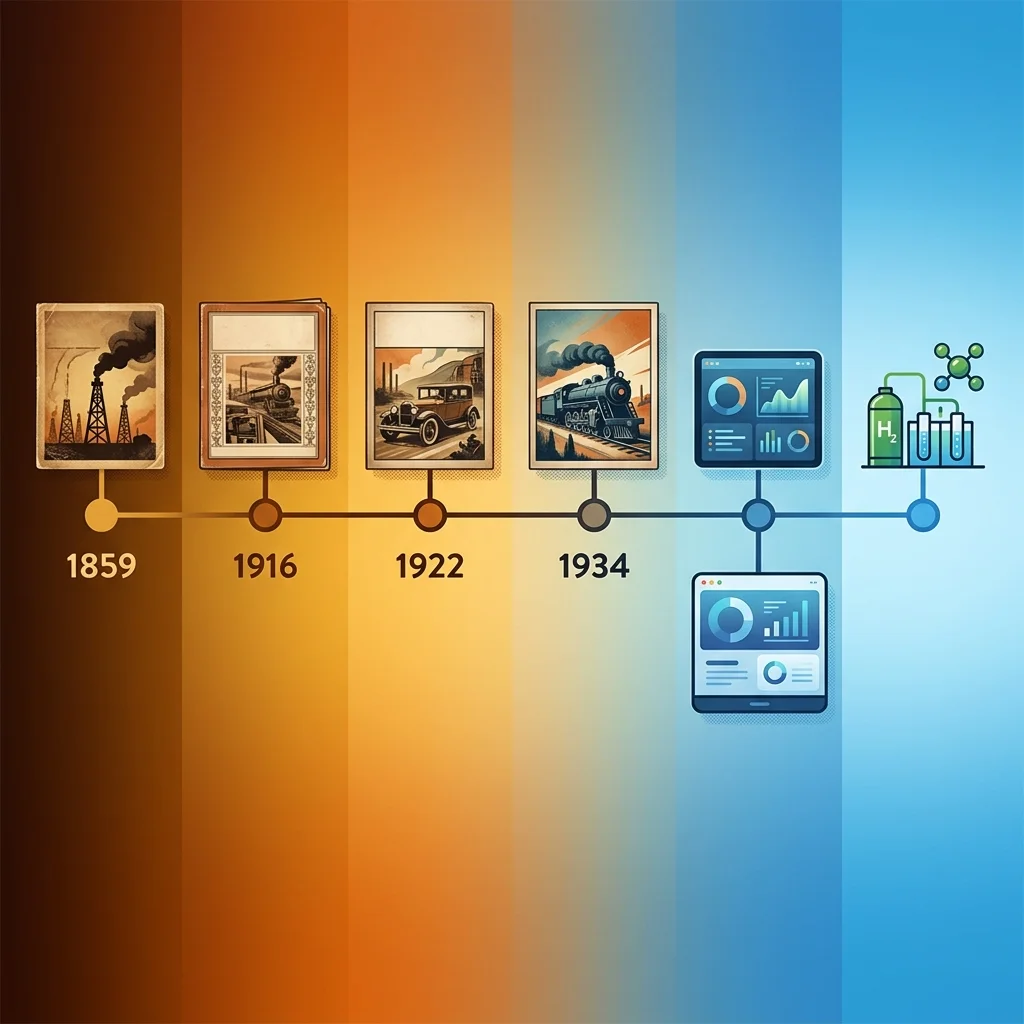
These four foundational brands—Pipeline & Gas Journal (1859), World Oil (1916), Hydrocarbon Processing (1922), and Petroleum Economist (1934)—mirror the chronological maturation of the oil and gas sector: first infrastructure, then exploration and production, then processing, and finally global financial analysis.
Covering the Full Energy Value Chain: Upstream, Midstream, Downstream, and Beyond
Today, Gulf Energy Information’s portfolio explicitly segments coverage by value chain stage, allowing each brand to serve a distinct professional community while enabling cross-selling of integrated intelligence. The structure is clear:
- Upstream: World Oil covers exploration, drilling, completions, production, and reservoir management. Its audience includes operators, service companies, and geoscience professionals.
- Midstream: Pipeline & Gas Journal and Gas Processing & LNG (a bimonthly launched in 2016) focus on pipeline transportation, natural gas liquids (NGL) handling, LNG liquefaction and shipping, and gas-to-liquids (GTL) technologies. This segment has grown rapidly as natural gas positions itself as a bridge fuel in the energy transition.
- Downstream: Hydrocarbon Processing serves refiners, petrochemical producers, and gas processors, with in-depth coverage of process optimization, catalyst technology, and regulatory compliance.
[IMAGE: Infographic showing a pipeline from wellhead to refinery to distribution, with each brand name placed at its respective stage—World Oil at the well, Pipeline & Gas Journal and Gas Processing & LNG along the pipeline, Hydrocarbon Processing at the refinery]
Notably, the portfolio also includes Underground Infrastructure, which covers water, sewer, natural gas, and telecom trenchless technology. While not strictly an energy title, this brand recognizes that energy infrastructure often shares underground space with broader utility networks. The overlap reflects a fundamental reality: the energy transition will require massive upgrades to both energy and non-energy underground systems.
This comprehensive coverage creates a powerful network effect. A subscriber reading World Oil may also need midstream logistics insights from Pipeline & Gas Journal and downstream market analysis from Hydrocarbon Processing. By offering cross-brand bundles and integrated data tools, Gulf Energy Information positions itself as a one-stop intelligence provider for the entire energy value chain.
The Hydrogenic Shift: New Frontiers in Energy Publishing
The most telling indicator of Gulf Energy Information’s strategic foresight is its recent addition: H2Tech, a quarterly journal dedicated entirely to hydrogen production, storage, transport, and utilization. Launched as the energy industry accelerates toward net-zero targets, H2Tech covers everything from green electrolysis and blue hydrogen with carbon capture to hydrogen fuel cells and ammonia as a hydrogen carrier.
[IMAGE: A modern hydrogen storage tank and wind turbine silhouette, with the H2Tech logo superimposed]
The creation of H2Tech is not an isolated bet—it is part of a broader portfolio expansion that anticipates the diversification of energy systems. Other newer titles include Gas Processing & LNG (2016), which filled a gap in midstream gas coverage as LNG trade expanded globally, and various digital products that aggregate news, data, and analysis across multiple sectors.
The hydrogen shift represents the most radical transformation in energy since the transition from coal to oil. Gulf Energy Information’s willingness to launch a dedicated hydrogen title before the market is mature demonstrates a media strategy that aims to shape—not just reflect—the industry conversation. By providing technical depth and investment-grade analysis early, H2Tech builds credibility that will pay dividends as hydrogen scales from niche to mainstream.
Data Integration: The Invisible Backbone of Energy Decision-Making
Beyond its print and digital publications, Gulf Energy Information has invested heavily in data tools that transform raw information into actionable intelligence. The flagship data product is Global Energy Infrastructure, a comprehensive database covering pipelines, LNG terminals, storage facilities, refineries, and processing plants worldwide.
[IMAGE: Screenshot mockup of an interactive GIS map showing pipeline routes, LNG terminals, and refining capacity overlays]
This tool integrates with the editorial portfolio in two key ways. First, editorial content drives traffic to the data platform—readers of a Pipeline & Gas Journal article about a new pipeline project can click through to view the exact route, capacity, and ownership data in the GIS interface. Second, the data tool itself becomes a content generation engine: analysts at Gulf Energy use the database to produce proprietary reports, market forecasts, and benchmarking studies that are distributed across all brands.
The combination of editorial coverage and structured data creates a competitive moat. A company trying to assess the feasibility of a blue hydrogen project may read H2Tech for technology trends, consult Global Energy Infrastructure for existing hydrogen pipeline networks and CO2 storage sites, and rely on Petroleum Economist for regulatory and fiscal risk analysis. No other media company offers this depth of integration across the full energy value chain.
Conclusion: The Next 160 Years
Gulf Energy Information’s 160-year trajectory is a microcosm of the energy industry itself: born in the age of oil, grown through the century of hydrocarbons, and now evolving into a diversified energy information platform. The portfolio’s hidden logic is that each brand corresponds to a specific economic or technological inflection point—midstream pipelines, upstream exploration, downstream processing, financial analysis, and now clean hydrogen.
[IMAGE: A stylized horizontal timeline graphic showing vintage magazine covers from 1859, 1916, 1922, 1934 evolving into modern digital interfaces and a hydrogen plant icon, with a gradient from warm orange to cool blue]
For investors, analysts, and operators, understanding this architecture is essential. The energy transition is not a single event but a series of overlapping shifts—from oil to gas, from centralized to distributed generation, from fossil to renewable feedstocks. Gulf Energy Information’s brand portfolio, with its layered coverage of legacy and emerging sectors, provides the informational backbone that enables informed decision-making across every stage of that transition. As the industry writes its next chapter, one thing is certain: the information architect will continue building the tools needed to navigate it.
Keywords

Omar Hassan
Energy Correspondent tracking OPEC+ policies and renewable energy transitions.