Gulf Energy Transition: How Renewable Development Reshapes Regional Markets and Global Supply Chains
The Gulf states are accelerating renewable energy deployment to diversify beyond oil and gas, driven by economic necessity, technological cost declines, and global decarbonization pressures. This article delves into the hidden economic logic behind the region''s solar, wind, and green hydrogen investments, examines their impact on energy markets and petrochemical supply chains, and identifies emerging opportunities and risks for investors and policymakers. Drawing on national strategies and industry data, we analyze how the Gulf''s energy transition is reshaping its role in global energy markets.
Omar Hassan
Editorial Analyst
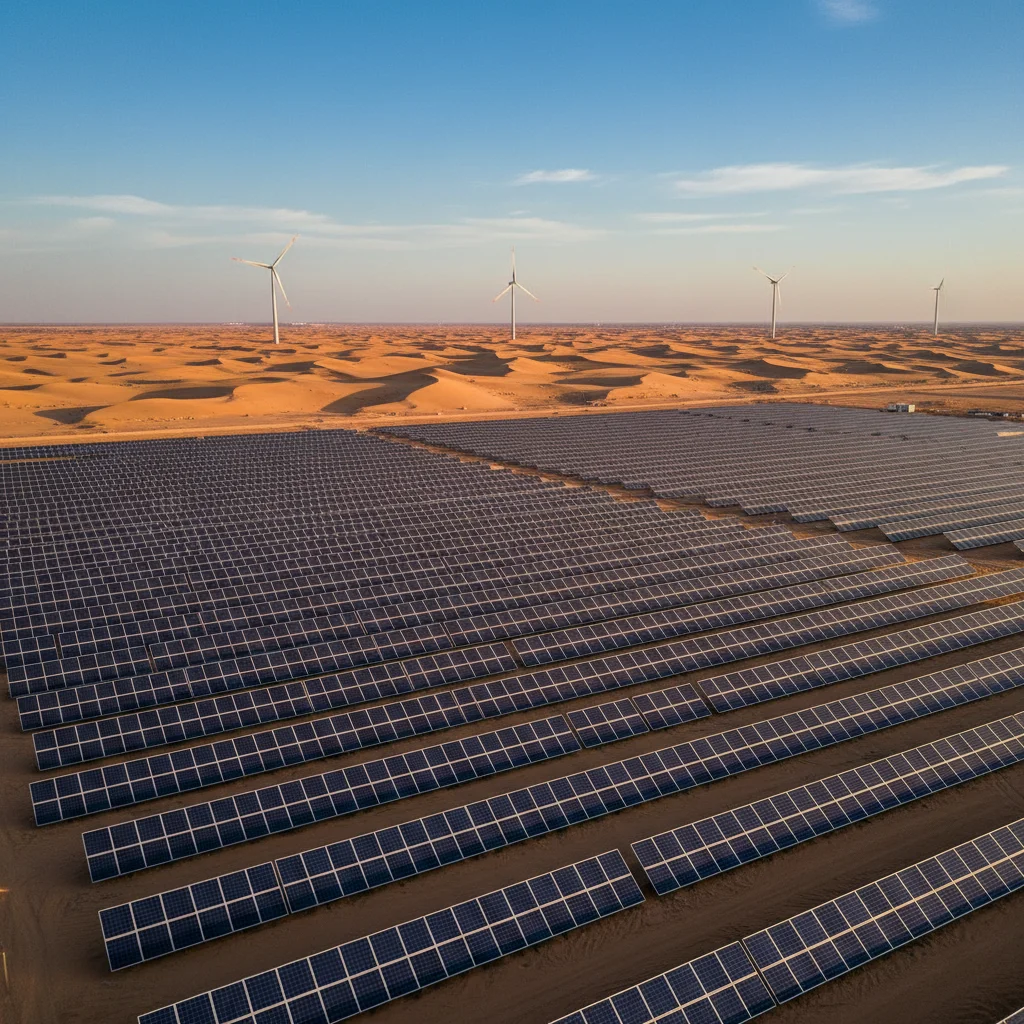
Gulf Energy Transition: How Renewable Development Reshapes Regional Markets and Global Supply Chains
Introduction: The Gulf's Energy Paradox — From Hydrocarbon Dominance to Renewable Ambition
For decades, the economic development of the Gulf Cooperation Council (GCC) states — Saudi Arabia, the UAE, Qatar, Kuwait, Oman, and Bahrain — has been deeply intertwined with global oil and gas markets. Oil revenues account for 60% to 90% of these countries' fiscal income, and the risk of economic volatility from the "oil curse" has remained unresolved. Yet over the past five years, a quiet but profound transformation has been unfolding across the Arabian Peninsula.
Saudi Arabia's "Vision 2030" explicitly targets renewable energy comprising 50% of installed power generation capacity by 2030. The UAE's "Energy Strategy 2050" plans to invest 600 billion dirhams to increase clean energy's share of its energy mix to 50%. These strategic blueprints are not merely environmental posturing but are grounded in a clear-eyed assessment of real economic pressures: intensifying global carbon reduction pressures, rapidly growing domestic energy demand, volatility in fossil fuel export revenues — and a critical number: the levelized cost of electricity (LCOE) for solar power in the Gulf has fallen to $0.02-0.03 per kilowatt-hour, making it one of the most cost-competitive power generation methods globally.
[IMAGE: Infographic showing trends in Gulf oil revenue changes versus renewable energy investment from 2010-2025, with oil revenue showing volatile decline and renewable investment showing steady increase.]
This article's core argument is that the accelerated deployment of renewable energy in the Gulf states is essentially a carefully calculated strategic economic restructuring. This is not a simple energy substitution but a necessary choice to redefine national competitiveness in the post-oil era.
Economic Logic: Why Renewables Are Critical for Oil-Dependent Economies
Understanding the key to Gulf renewable energy investment lies in an often-overlooked economic fact: these countries still use large amounts of crude oil and natural gas for domestic electricity generation. In Saudi Arabia, peak summer electricity demand during air conditioning season can reach 60 gigawatts, much of it from thermal power plants burning crude oil directly. This means that every barrel of oil used for power generation cannot be exported at international market prices — it is estimated that Saudi Arabia consumes approximately 500,000 barrels per day of crude oil for domestic power generation during summer, equivalent to an estimated $40 million per day in lost export revenue.
Value arbitrage is the fundamental logic of this transition: replace oil and gas used in domestic power consumption with cheaper, zero-cost solar energy, then push the saved oil and gas to export markets or downstream petrochemical chains. Large-scale photovoltaic projects like Saudi Arabia's Sudair Solar Park (1.5 GW) and the UAE's Noor Abu Dhabi (1.2 GW) have near-zero operating costs, far below the fuel costs of natural gas power generation. According to IRENA data, the LCOE for large-scale solar projects in the Gulf has fallen to the lowest levels globally, with one UAE project in 2023 bidding as low as $0.0135 per kWh.
[IMAGE: Line chart comparing the levelized cost of electricity (LCOE) for solar and natural gas power generation in Gulf states over the past decade, clearly showing solar costs declining and consistently remaining below natural gas.]
Moreover, the new jobs and economic diversification value created by renewable energy investment should not be overlooked. Saudi Aramco's supply chain localization program anticipates that the construction, operation, and maintenance of solar and wind farms alone could create over 100,000 direct jobs by 2030, spanning manufacturing, engineering, finance, and services. For a region where the young population exceeds 60%, this is not just economic restructuring but an investment in social stability.
Technology and Infrastructure: Scaling Solar, Wind, and Green Hydrogen
Renewable energy deployment in the Gulf is currently moving from pilot project phases into large-scale commercialization. In solar energy, Saudi Arabia is constructing the 2.6 GW Al Shuaibah Solar Park, and the UAE's Mohammed bin Rashid Al Maktoum Solar Park aims to reach 5 GW by 2030. Notably, the technology mix is evolving from pure photovoltaics (PV) to hybrid PV-concentrated solar power (CSP) systems to address solar intermittency. The UAE's Noor Energy 1 project is a typical CSP+PV hybrid, using molten salt storage to provide nighttime power.
In wind power, while average annual wind speeds in the Gulf (approximately 5-6 m/s) are lower than prime sites in Northern Europe, locations in Oman's Duqm and Dhofar regions and Saudi Arabia's northwestern Tabuk province have development potential. Oman has launched a 500 MW wind power tender expected to connect to the grid in 2026, which would become the first large-scale onshore wind farm in the Gulf. Even more promising is offshore wind, particularly in the shallow waters of the Persian Gulf and Arabian Sea — successful experience from Egypt's Gulf of Suez has demonstrated technical feasibility in the region.
However, what may truly change the global energy trade landscape is green hydrogen. The Gulf states' competitive advantages are extremely clear: the world's lowest-cost solar electricity (a core cost component of green hydrogen electrolysis), strategic locations close to European and Asian markets, and existing LNG export infrastructure that can be partially converted for hydrogen transport.
[IMAGE: Map of major renewable energy and green hydrogen projects in the Gulf region, marking locations and capacities of key projects like NEOM, Helios, and UAE blue hydrogen.]
Flagship projects include:
- NEOM Green Hydrogen Complex: Developed by ACWA Power, Air Products, and NEOM with $8.4 billion investment, integrating 4 GW of solar and wind generation capacity to produce 600 tons per day of green hydrogen, with byproduct nitrogen-based green ammonia for export.
- Saudi Helios Project: Plans to use Red Sea coastal solar PV resources to reach hundreds of thousands of tons of green ammonia annually in phases.
- UAE ADNOC: Pursuing a pragmatic "blue + green" dual-track strategy, investing in carbon capture facilities to reduce the carbon footprint of hydrogen from natural gas while advancing commercial testing of water electrolysis hydrogen.
Grid integration is another key challenge. Gulf states are enhancing cross-border power dispatch capabilities through the GCC Interconnection Authority (GCCIA) to share temporal complementarity of solar and wind resources across countries. High-voltage transmission line capacity upgrades between Dubai and Abu Dhabi, as well as the Saudi-Egypt power interconnection project, are paving the way for larger-scale renewable energy grid integration.
Market and Geopolitical Implications: Disrupting Traditional Energy Trade Patterns
The impact of the Gulf states' energy transition extends far beyond regional borders, redefining global energy trade routes and rules.
For global oil markets, the most direct impact comes from "freeing up export capacity." If Gulf states replace domestic oil consumption with solar energy, and demand does not fall sharply, the freed crude oil will increase OPEC+ spare capacity or expand export volumes. According to IEA estimates, renewable substitution in Saudi Arabia and the UAE alone could save about 1 million barrels per day of oil equivalent annually by 2030, generating approximately $30 billion in new annual export revenue (at current prices). This will put downward pressure on oil prices in the short to medium term while enhancing OPEC's ability to stabilize markets.
Green hydrogen trade could fundamentally reshape global energy supply chains. Gulf states are building "green ammonia corridors": Saudi Arabia, Australia, Chile, North Africa, and others are competing for the strategic window to export low-carbon fuels to Europe. The EU's Carbon Border Adjustment Mechanism (CBAM) is scheduled to impose carbon tariffs on imported goods beginning in 2026, forcing EU companies to seek low-carbon alternatives. Gulf green hydrogen, with production costs targeted below $2/kg entering European markets, could compete with LNG and even replace some marine fuels (such as methanol and ammonia). Forecasts suggest Gulf states could capture over 25% of the global green hydrogen trade share by 2030.
[IMAGE: Schematic diagram of expected global green hydrogen trade flows, showing main routes from Gulf to Europe and Asia, and competing sources (Australia, Chile).]
Geopolitical competition is also intensifying. Competition in renewable energy between the UAE and Saudi Arabia is particularly fierce: the former, through Masdar, invests in renewable energy projects in over 40 countries, building a global footprint; the latter, leveraging sovereign power and resource scale far beyond its neighbors, dominates large-scale domestic projects and competes for regional green finance hub status. Qatar continues to focus on natural gas, planning to expand LNG production capacity to 126 million tons per year by 2030 while investing in blue hydrogen projects. Oman has positioned itself as a "green energy hub," using its coastal industrial zones to develop green steel and green fertilizers, attracting low-carbon investment from China, Europe, and elsewhere.
The impact on petrochemical supply chains is equally profound. Gulf states are shifting from exporting crude oil to exporting petrochemical products and green fuels. Saudi Aramco and SABIC are jointly researching an integrated PV-hydrogen-synthetic fuel (e-fuels) value chain, aiming to replace fossil fuels in traditional refining processes with green hydrogen, thereby reducing the carbon footprint of petrochemical products. This strategy addresses CBAM challenges while aiming to convert a "low-carbon" label into a premium in high-end markets.
Conclusion: From Oil Monarchies to Green Superpowers — Not a Choice but an Imperative
The Gulf states' energy transition is neither an environmentalist moral performance nor a short-term economic experiment. At a deeper level, it is a targeted response to three core challenges: resource depletion anxiety (OECD forecasts suggest major Gulf oil fields will peak in the 2030s), climate political pressure (COP28 being hosted in the UAE is itself a test by the international community), and economic diversification urgency (youth employment and fiscal sustainability).
Looking ahead five to ten years, the Gulf region will experience a gradual unraveling of the "impossible trinity" — seeking dynamic balance among fossil fuel exports, renewable energy investment, and green finance hub status. Those countries that choose "selectively embrace" renewables (such as the UAE and Saudi Arabia) will gain first-mover advantages: better export commodity premiums, stronger geopolitical leverage (e.g., as part of a green hydrogen exporting alliance), and lower domestic carbon abatement costs.
But risks are also real. Technological pathways carry uncertainty (the pace of electrolyzer cost reduction, carbon capture efficiency, potential for nuclear integration). Geopolitical competition could translate into trade friction (green hydrogen subsidy races). And continued volatility in fossil fuel revenues will affect the pace of energy transition investment.
Ultimately, the Gulf's green transition is answering a fundamental question: when the world no longer needs as much oil, how can a region built on oil maintain its global influence? The answer is now clear — not by betting on the price volatility of a single commodity, but by becoming the world's lowest-cost producer of renewable energy, an exporter of low-carbon fuels, and a builder of green industrial technology. In the long-term reshaping of global energy trade patterns, this is the shrewdest survival strategy and the most necessary strategic investment.
Keywords

Omar Hassan
Energy Correspondent tracking OPEC+ policies and renewable energy transitions.