Beyond Cost Parity: How Governance, Integration, and Innovation Shape the Renewable Energy Future
As solar photovoltaic and onshore wind power approach cost-competitiveness in European markets by 2030, a deeper transformation is underway. Technological breakthroughs in battery storage, smart grids, and IoT enable 100% renewable systems for remote locations, while emerging economies face a critical bottleneck: effective governance. This article explores the hidden economic logic behind these trends, arguing that the real challenge is not technology alone but the institutional capacity to integrate and scale it. Drawing on the latest research and McKinsey insights, we examine how the interplay of innovation, policy, and market dynamics will determine the speed and equity of the global energy transition.
Omar Hassan
Editorial Analyst
How Governance, Integration, and Innovation Shape the Renewable Energy Future Beyond Cost Parity
As solar photovoltaic (PV) and onshore wind power approach cost-competitiveness in European markets by 2030, a deeper transformation is unfolding beneath the surface. Technological breakthroughs in battery storage, smart grids, and the Internet of Things (IoT) now make 100% renewable systems technically viable for remote locations. Yet emerging economies face a critical bottleneck that has little to do with hardware: effective governance. This article explores the hidden economic logic behind these trends, arguing that the real challenge is not technology alone but the institutional capacity to integrate and scale it. Drawing on the latest research and McKinsey insights, we examine how the interplay of innovation, policy, and market dynamics will determine the speed and equity of the global energy transition.
---
The 2030 Cost Milestone: A Reality Check
Solar photovoltaic and onshore wind are projected to reach grid parity across multiple European markets by 2030, driven by manufacturing scale and efficiency gains. According to the latest levelized cost of electricity (LCOE) projections from BloombergNEF and the International Renewable Energy Agency (IRENA), solar PV costs in Germany, Spain, and France could fall below €30 per megawatt-hour by the end of the decade, undercutting new coal and combined-cycle gas plants even without carbon pricing. Onshore wind, already competitive in parts of Northern Europe, will see further reductions as turbine sizes increase and supply chains mature.
[IMAGE: Bar chart showing levelized cost of electricity (LCOE) projections for solar and wind vs. fossil fuels in selected European countries, 2020–2035.]
Yet this cost-competitiveness is not uniform. Regional differences in policy stability, grid infrastructure, and resource quality will create winners and laggards. Countries with strong permitting frameworks, modern transmission networks, and high solar irradiance—such as Spain and Portugal—will attract renewable investment faster than those with fragmented regulations or ageing grids. As McKinsey notes in its recent analysis of the energy transition, “Identifying and responding to technology trends is critical for companies to remain competitive and drive growth.” The same logic applies to nations: those that fail to align their institutional frameworks with falling renewable costs risk falling behind.
---
Technological Engine: Solar, Wind, and the Storage Revolution
Behind the cost milestone lies a rapid technological evolution. Advances in photovoltaic efficiency—now exceeding 24% for commercial modules—combined with larger turbine designs (onshore turbines reaching 6–7 MW and offshore prototypes hitting 15 MW) are lowering system-level costs faster than anticipated. But the real game-changer is battery storage. Lithium-ion battery pack prices have fallen by nearly 80% since 2015, and by 2030, the cost of four-hour duration storage is expected to drop to around $50–60 per kWh, making solar-plus-storage a genuine alternative to baseload fossil generation.
[IMAGE: Infographic showing the key technology layers: solar panels, wind turbines, battery storage, smart grid control center, and IoT sensors connected via cloud.]
Beyond hardware, digital technologies are enabling real-time balancing of variable renewable output. Smart grids equipped with AI-driven forecasting, IoT sensors, and cloud computing facilitate distributed energy management. For example, a solar farm in Denmark can now automatically reduce output when cloud cover is predicted, while a wind farm in Scotland adjusts its pitch to match grid demand minute by minute. These integrations make 100% renewable systems technically feasible for remote and island communities—a development that serves as a laboratory for the wider energy system.
---
Remote Off-Grid Systems: The Laboratory for Full Renewables
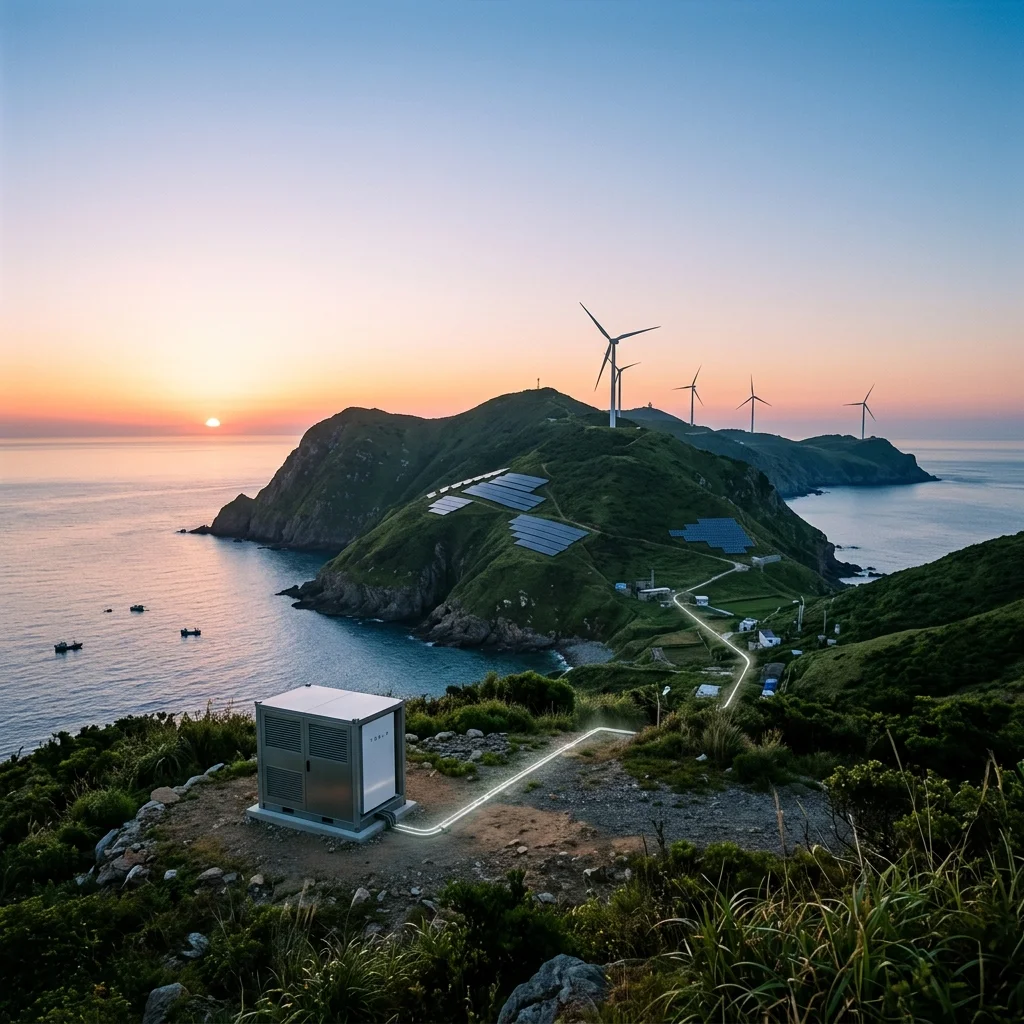
Current research and development efforts are increasingly focused on creating self-sufficient 100% renewable energy systems for non-electrified islands and remote mainland areas. Projects such as the Smart Islands Initiative in Greece, the Tokelau Renewable Energy Project in the Pacific, and Hawaii’s commitment to 100% clean electricity by 2045 demonstrate that a mix of solar, wind, and battery storage can replace diesel generators entirely. These microgrids operate as real-world testbeds for integration, storage optimization, and grid resilience.
[IMAGE: Photo of a small island community with a solar-wind-battery microgrid installation, surrounded by turquoise water and lush greenery.]
The lessons learned from these off-grid systems are directly applicable to larger mainland grids. For instance, managing the variability of solar and wind across a small island requires accurate day-ahead forecasting, rapid battery dispatch, and demand-response mechanisms—all capabilities that become critical as renewable penetration increases on national grids. However, the success of such projects depends on more than hardware. Local context, community engagement, and technical support are equally important. Without trained operators, maintenance supply chains, and institutional backing, even the best-designed microgrid can fail within months.
---
The Governance Imperative: Why Emerging Economies Need More Than Tech
While technology costs are falling, a different challenge looms for emerging economies. Studies consistently emphasize that renewable energy consumption, technological innovation, and effective governance are interdependent drivers of sustainable growth. In a 2023 meta-analysis published in Renewable and Sustainable Energy Reviews, researchers found that the impact of renewable energy deployment on economic development in low-income countries is mediated by institutional quality: rule of law, regulatory efficiency, and corruption control.
[IMAGE: World map highlighting countries with high renewable potential but weak governance scores, overlaid with color-coded risk indicators.]
Without strong institutions, transparent policies, and anti-corruption measures, even the cheapest renewables may fail to attract investment or deliver reliable power. Consider the case of India: while solar PV tariffs have dropped below ₹2.50 per kWh (about $0.03), actual project completion rates are hampered by land acquisition delays, grid connection bottlenecks, and payment defaults from state-owned distribution companies. Similarly, in sub-Saharan Africa, countries with high solar irradiance like Chad and Niger have attracted minimal utility-scale investment due to political instability and weak contract enforcement.
The governance bottleneck extends beyond installation. Scaling 100% renewable systems requires integrated planning across ministries, utility reforms, and regulatory frameworks that support smart grid integration and battery storage deployment. Emerging economies that prioritize governance reforms—such as independent energy regulators, transparent auction processes, and regional power pooling—will unlock renewable deployment far faster than those that rely solely on falling hardware costs.
---
Beyond Technology: The Integration Challenge
The global energy transition is not a linear story of solar panels getting cheaper. As the McKinsey quote reminds us, responding to technology trends requires strategic foresight. For developed economies, the challenge is integration: upgrading transmission infrastructure, reforming electricity markets to value flexibility, and investing in digital grid management. For emerging economies, the challenge is twofold: adopting the best available technology while simultaneously building the institutional capacity to operate and scale it.
The renewable energy trends of the next decade will be shaped as much by governance reforms, tariff structures, and public acceptance as by breakthroughs in perovskite solar cells or solid-state batteries. The countries that succeed will be those that combine cost-competitiveness with smart policy design, creating a virtuous cycle of investment, innovation, and institutional learning. The energy transition policy of the 2030s must therefore move beyond the simplistic narrative of "cheap renewables will fix everything" and embrace a more nuanced understanding of how governance, integration, and innovation interact.
---
Conclusion: The Race for Institutional Readiness
The milestone of cost parity in 2030 represents a historic opportunity. Solar PV and onshore wind are now cheaper than fossil fuels in many regions, and battery storage innovation is closing the gap on dispatchability. Smart grid integration and 100% renewable energy systems for remote locations are no longer science fiction. Yet the true test lies in whether the global community can match technological maturity with institutional readiness.
For emerging economies, the race is not merely about deploying the cheapest kilowatt-hour. It is about building the governance structures—transparent regulation, anti-corruption mechanisms, robust grid codes—that will allow renewables to deliver sustained economic benefits. For developed nations, it is about integration and system-level thinking. The next decade will determine not just whether renewables become dominant, but whether the transition is equitable, resilient, and rapid enough to meet climate targets.
As the sun rises over a remote island where solar panels, wind turbines, and battery storage power a community for the first time, the question is no longer "Can we?" but "Will we govern wisely enough to do it at scale?"
Keywords

Omar Hassan
Energy Correspondent tracking OPEC+ policies and renewable energy transitions.