Top 6 Energy Sector Trends Shaping 2026: Demand Growth, Policy Shifts, and the New Resilience Imperative
This article examines six forces reshaping the energy sector in 2026 across oil and gas, power and utilities, and clean energy. The central theme is not just rising demand, but a structural rebalancing of the energy system driven by data centers, reshoring, electrification, and EV adoption. It also explores how an all-of-the-above mix, grid modernization, LNG, and policy changes such as the One Big Beautiful Bill Act are altering investment priorities. The article will emphasize why resiliency has become a core business strategy and why natural gas remains a backbone fuel even as clean energy continues to expand at a slower pace.
Omar Hassan
Editorial Analyst
Top 6 Energy Sector Trends Shaping 2026: Demand Growth, Policy Shifts, and the New Resilience Imperative
The energy sector enters 2026 with a familiar tension: demand is rising, but the system is not being asked to grow in a straight line. It is being asked to absorb faster load growth, support electrification, maintain affordability, and remain reliable under tighter operating conditions. In practice, that means capital is flowing across oil and gas, power and utilities, and clean energy at the same time, but not evenly. The result is a structural rebalancing of the energy system rather than a single-direction transition.
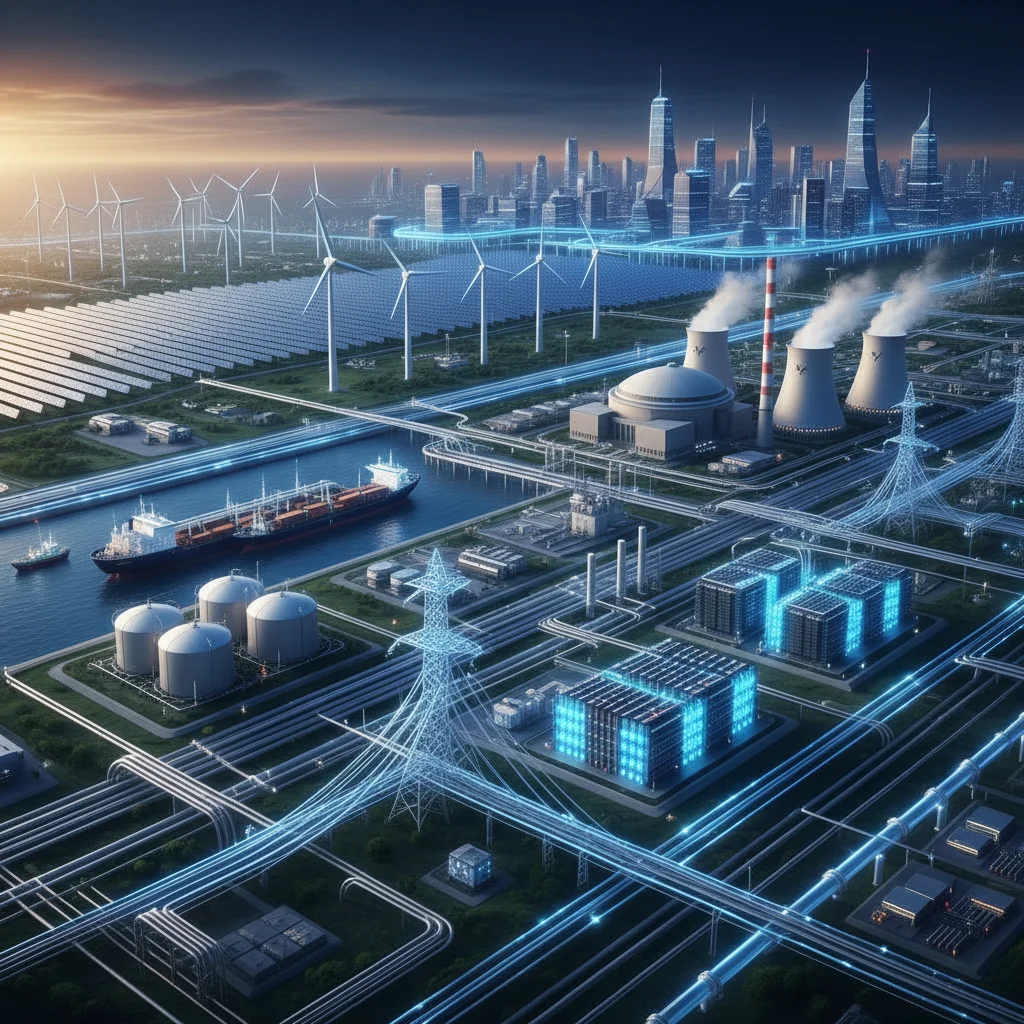
[IMAGE: A broad cinematic view of interconnected energy infrastructure in 2026, including transmission lines, gas pipelines, LNG facilities, wind turbines, solar farms, battery storage, and a data center skyline.]
1. 2026 Is About Rebalancing the Energy System, Not Just Growing It
The central theme for energy sector 2026 is not simply higher consumption. It is the reallocation of investment toward the parts of the system that can deliver dependable power, flexible fuel supply, and faster interconnection. Utilities, independent power producers, midstream operators, and grid equipment suppliers are all responding to the same underlying question: where does new demand actually land, and what infrastructure is needed to serve it?
The answer is increasingly shaped by resilience. In earlier cycles, growth could often be met by adding generation capacity alone. In 2026, that is not enough. New demand is concentrated in places where transmission is constrained, permitting is slow, and load profiles are more volatile than in the past. That means the system needs more than megawatts. It needs dispatchable power, storage, upgraded substations, distribution automation, and fuel logistics that can hold up under stress.
This is why the “all-of-the-above” energy mix is best understood as a practical response to volatility. It is not a slogan so much as a hedge against mismatch: mismatch between load growth and grid buildout, mismatch between intermittent generation and demand timing, and mismatch between policy goals and infrastructure timelines. For investors, the implication is clear. The most attractive assets are increasingly those that improve system reliability, not just those that add nameplate capacity.
2. Demand Growth Is Being Driven by the Real Economy
A major misconception is that current power demand growth is only a rebound from a weak period. In reality, the new load cycle is being driven by structural changes in the economy.
Three sources matter most:
- Data centers
- Reshoring and industrial expansion
- Electrification and EV adoption
The data center buildout is especially important. AI training, cloud services, and digital infrastructure are all increasing electricity consumption, often in concentrated geographic clusters. In many markets, this creates a planning problem before it becomes a generation problem. The bottleneck is not only power supply; it is the ability to connect large loads on time.
Manufacturing reshoring adds a second layer. New fabs, industrial parks, battery plants, and domestic supply-chain facilities require steady power, often at high reliability standards. These facilities also tend to be located in areas where transmission was not originally designed for such large incremental load.
Electrification and EV adoption add a third layer. Even if EV growth is uneven by region, transportation electrification still changes the shape of demand. It shifts load toward evenings, depots, highways, and urban distribution networks. Heat pumps and industrial electrification do the same in different forms.
The key point is that these drivers affect the whole stack at once. Natural gas demand can rise because gas-fired generation remains needed for balancing. Electricity prices can move higher because supply and delivery are tighter. Clean energy can continue to expand, but the buildout pace may still lag the pace of demand. The system is under pressure not because demand is collapsing or recovering, but because it is changing in composition.
[IMAGE: A data center, advanced manufacturing facility, EV charging corridor, and utility substation linked by visual energy flows.]
What matters most for planning
For utilities and regulators, the main issue is not average annual demand. It is peak demand, local congestion, and interconnection timing. A region can have adequate total generation on paper and still face shortages if transmission is constrained or if new loads arrive faster than infrastructure can be approved and built.
That is why deep analysis in 2026 needs to focus on:
- load growth by region,
- queue backlogs for interconnection,
- transformer and substation availability,
- gas deliverability during peak events,
- and the timing mismatch between demand and capital expenditure.
3. Electricity Prices and Grid Modernization Are Resetting Utility Economics
Rising electricity prices are becoming a central issue in power and utilities. In some markets, the pressure comes from fuel costs. In others, it comes from transmission investment, storm hardening, distribution upgrades, and the need to serve new load. In many cases, all of these forces are present together.
This is changing the economics of the utility sector. Historically, utilities could rely on relatively stable demand growth and long planning cycles. That model is under strain. Now they need to balance affordability, reliability, and decarbonization goals at the same time. If they underspend on the grid, they face outages, queue delays, and regulatory scrutiny. If they overspend, they risk rate shock and political resistance.
Grid modernization is no longer optional in this environment. It is central to reliability and to the ability to absorb new demand. That includes advanced distribution management systems, digital monitoring, capacitor and substation upgrades, dynamic line rating, wildfire mitigation in exposed regions, and better forecasting for distributed resources. It also includes a stronger push to expand transmission, which remains one of the slowest parts of the system to deliver.
[IMAGE: A modern transmission network with digital overlays, smart meters, and urban electricity demand in the background.]
Supporting data to verify here
This is the right place to insert market-specific evidence from:
- utility rate cases,
- ISO/RTO planning studies,
- and recent filings from grid operators on congestion and interconnection delays.
For example, analysts should compare:
- capex plans by major utilities,
- allowed returns versus current financing costs,
- and recent retail rate changes by region.
The most important question is not whether prices are higher in absolute terms. It is whether the increase is being driven by a temporary fuel cycle or by a longer-run infrastructure reset. If it is the latter, then grid modernization becomes a multi-year investment theme rather than a short-term response.
4. Natural Gas and LNG Remain the Balancing Backbone
Natural gas remains one of the most important balancing fuels in the system. That is true in electricity markets, industrial supply, and seasonal reliability planning. Gas-fired generation is still one of the few large-scale resources that can respond relatively quickly to demand spikes, renewable variability, and weather-driven stress.
The role of natural gas in 2026 should be viewed in two ways.
First, it remains a domestic reliability asset. Gas plants help support peak power demand, provide firm capacity, and backstop grids with high levels of intermittent generation. In regions with constrained transmission, the value of dispatchable gas can rise even if total annual generation from gas does not increase proportionally.
Second, LNG continues to matter as both a domestic and global market mechanism. On the domestic side, LNG-linked infrastructure can support supply flexibility and basin connectivity. On the global side, export capacity ties U.S. gas to broader trade flows and price signals. That makes LNG not only a commodity story, but also a logistics and strategic infrastructure story.
[IMAGE: An LNG export terminal with pipelines, storage tanks, and cargo ships, alongside gas-fired generation infrastructure.]
This matters because the market is not just asking whether gas is “clean enough” or whether renewables will eventually replace it. It is asking whether the system has enough firm, flexible capacity to keep electricity reliable while demand grows faster than permitting and transmission upgrades can deliver. In that sense, gas is often less a growth engine than a bridge and a buffer.
A necessary counterargument
There are, however, important counterarguments to this narrative. Some analysts argue that leaning too heavily on gas and LNG could lock in emissions, expose buyers to fuel-price volatility, and delay investment in non-fossil flexibility options such as batteries, demand response, transmission expansion, and long-duration storage. Others note that grid planning should prioritize efficiency and electrification management before approving more gas infrastructure.
These concerns are material. In some markets, batteries paired with solar, demand response, and upgraded transmission may reduce the need for new gas capacity. In others, policy and financing constraints may favor lower-emission flexibility over new long-lived fossil assets. The correct answer is likely regional, not universal.
5. Policy Is Shifting from Broad Goals to Implementation Constraints
The policy debate in 2026 is less about whether the energy transition continues and more about how it is implemented under budget, reliability, and permitting constraints. Federal and state policymakers are increasingly focused on interconnection reform, transmission siting, tax treatment, domestic manufacturing requirements, and the practical limits of subsidy-driven deployment.
That shift matters because policy can accelerate some parts of the system while slowing others. For example, clean energy deployment can continue to expand, but transmission delays, local opposition, and supply-chain bottlenecks may keep growth below what long-term scenarios assume. At the same time, policies supporting domestic energy security, industrial development, and reliability can strengthen the business case for gas, grid equipment, storage, and generation with firm capacity.
Rather than focusing on one legislative label or one political frame, the more useful approach is to look at what policy is doing to project economics. Is it improving the return on grid upgrades? Is it shortening interconnection queues? Is it changing the relative attractiveness of dispatchable versus intermittent resources? Those are the questions that matter for capital allocation.
For investors, this means the most important policy risk is not only subsidy direction. It is timing. A project can be economical in theory and still fail if permitting, procurement, or interconnection takes too long. The same is true for transmission and substation investments: the revenue need may be clear, but delivery remains slow.
6. Clean Energy Is Still Expanding, but at a More Uneven Pace
Clean energy remains central to the long-term system, but 2026 is likely to be defined by uneven execution rather than linear expansion. Solar, wind, storage, and nuclear all have roles to play, yet each faces constraints that differ by region.
Solar and battery storage continue to benefit from modular deployment and lower build times, but they still depend on land, interconnection, and transmission. Wind projects face siting and permitting issues in many markets. Nuclear retains strategic interest for firm, low-carbon power, but timelines and financing remain challenging. Distributed energy resources can improve resilience, but they do not yet replace the need for large-scale backbone infrastructure.
[IMAGE: A balanced clean energy landscape with solar arrays, wind turbines, battery storage, and a nuclear facility connected to the grid.]
The most realistic 2026 view is that clean energy will expand, but not fast enough to eliminate the importance of firm fuels and grid upgrades. That does not mean the transition is failing. It means the system is constrained by construction speed, capital cost, and permitting complexity. In that environment, the technologies that improve flexibility and resilience are likely to capture more attention than those that simply add capacity.
Conclusion: Resilience Is Now a Core Energy Strategy
The biggest shift in energy sector 2026 is that resilience has moved from a secondary objective to a core business requirement. Utilities need it to keep service reliable under load growth. Producers need it to secure throughput and reduce operational risk. Infrastructure investors need it to identify assets that can perform across different demand and policy scenarios.
The sector is still being shaped by the same familiar forces: demand growth, policy change, decarbonization, and capital discipline. But the order of priority has changed. The market is now rewarding infrastructure that can deliver power, manage volatility, and scale under constraint.
That is why natural gas and LNG remain important, why grid modernization has become urgent, and why clean energy growth increasingly depends on the quality of the grid around it. The next phase is not about one fuel replacing another on a clean timetable. It is about building a system that can absorb growth without sacrificing reliability, affordability, or flexibility.
Keywords

Omar Hassan
Energy Correspondent tracking OPEC+ policies and renewable energy transitions.