The Gulf''s Strategic Pivot to Asia: How Sovereign Wealth Funds and Trade Are Reshaping Global Power Dynamics
The Gulf states are executing a historic economic reorientation toward Asia, with trade reaching $516 billion in 2024 and Sovereign Wealth Funds directing 40% of global deployments to Asia. China has overtaken the West as the Gulf's largest trading partner, and projections indicate Asian dominance will deepen by 2028. This article examines the underlying economic logic—hydrocarbon dependency, SWF-driven diversification, and geopolitical hedging—while uncovering how Gulf capital is reshaping Asian innovation ecosystems and supply chains. It also explores the implications of Trump's 2025 Gulf visit as a Western countermove against Chinese influence, and what the $802 billion trade target by 2030 means for global middle power dynamics.
Khalid Al-Mansouri
Editorial Analyst
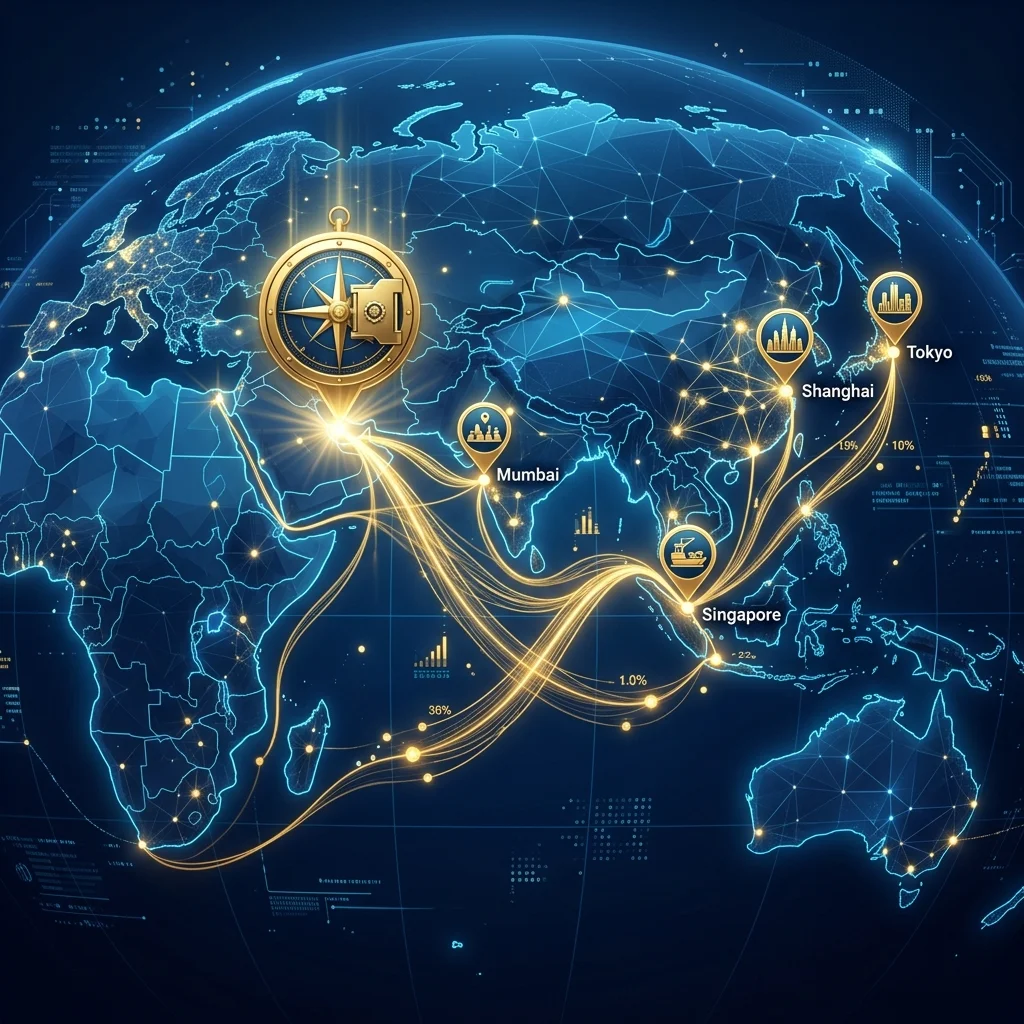
The Gulf's Quiet Shift: $516 Billion Trade With Asia Reshapes Global Power
How sovereign wealth funds, hydrocarbon dependencies, and strategic hedging are pulling the Middle East eastward — and what it means for the West
Introduction: The Gulf’s Quiet Shift from West to East
In 2024, a historic economic reorientation reached a tipping point. Trade between the Gulf Cooperation Council (GCC) states and Asia hit $516 billion — a 14.4% surge from the previous year — while Gulf-West trade contracted by 4%. The numbers, compiled by the Asia House trade monitor and corroborated by IMF directional trade data, signal something far deeper than a cyclical fluctuation: a structural pivot that is redefining global middle power dynamics.
For decades, the Gulf’s economic center of gravity lay in the Atlantic. Oil dollars flowed to London, New York, and Paris; military alliances anchored the region to the U.S. security umbrella; and sovereign wealth funds built trophy portfolios in Western real estate, equities, and infrastructure. That pattern is now being turned inside out.
Today, the Gulf states are emerging as classic global middle powers — states with enough economic weight and diplomatic agency to balance between the U.S. and China, rather than being subsumed by either. The pivot to Asia is not an abandonment of the West, but a deliberate hedge. By deepening trade ties with Beijing, investing in Asian innovation ecosystems, and diversifying hydrocarbon revenue through sovereign wealth fund (SWF) deployments, the Gulf is positioning itself as a linchpin in the world’s most dynamic economic corridor.
The underlying logic is twofold. First, hydrocarbon exports remain foundational: 85% of Middle East crude and LNG shipments now go to Asia, driven by China, India, Japan, and South Korea’s insatiable energy demand. Second, SWF capital is increasingly the strategic lever for acquiring future tech, securing supply chain influence, and locking in long-term demand for the energy transition era. The pivot is quiet, but the data is loud.
[IMAGE: Infographic showing trade flow arrows from Gulf to Asia vs. West, with percentage changes and 2024 totals. Blue arrows for Asia (up 14.4%), gray arrows for West (down 4%). Trade volume numbers $516 billion and corresponding Gulf-West figure.]
Trade Data Deep Dive: China Leads, ASEAN Surges
To understand the scale of the shift, unpack the $516 billion headline. The lion’s share belongs to Gulf-China trade, which hit $257 billion in 2024 — overtaking the combined Gulf-West total of $256 billion for the first time. China is now the Gulf’s largest trading partner, a position it has consolidated rapidly since the Belt and Road Initiative accelerated infrastructure linkages in the early 2010s.
The United Arab Emirates, the region’s most diversified economy and trade hub, drove 27% growth in its trade with emerging Asia, reaching $268 billion. Much of that growth came from re-exports, logistics services, and financial intermediation — the UAE acting as a gateway for Asian goods into Africa, the Levant, and Europe. Meanwhile, Gulf-ASEAN trade rose 14.8% to $128 billion, led by Malaysia, Vietnam, and Indonesia, which are absorbing Gulf petrochemicals, aluminum, and increasingly, investment into downstream processing.
Projections from the Asia House report, cross-referenced with World Bank trade data trends, indicate this momentum will accelerate. By 2028, Asia is expected to surpass advanced economies as the Gulf’s top trading bloc — a milestone that seemed improbable a decade ago. The longer-range target is even more ambitious: Gulf-Asia trade is forecast to reach $802 billion by 2030, fueled by rising energy imports, infrastructure financing, and digital services.
A cautionary note: hydrocarbons still account for roughly 85% of Middle East exports to Asia. This structural dependency means the pivot is asymmetrical — the Gulf needs Asia more than Asia needs the Gulf, at least for now. But that is precisely why the SWF strategy is so critical. By deploying capital into Asian tech, renewables, and manufacturing, the Gulf is trying to convert a commodity relationship into a strategic partnership that survives the energy transition.
[IMAGE: Bar chart comparing Gulf trade with China, West, and ASEAN over 2023-2024, with projected 2028 lines. Three groups: China (light blue), West (gray), ASEAN (green). Bars for 2023, 2024, and a dotted projection line for 2028 showing Asia surpassing West.]
Sovereign Wealth Funds: The Hidden Engine of Economic Diplomacy
If trade is the headline, sovereign wealth funds are the hidden gears. In the first nine months of 2025 alone, Gulf SWFs deployed $56 billion globally, with 40% — over $22 billion — directed to Asia. To put that in context, Gulf funds now account for more than a third of all cross-border SWF investments into Asian assets, a share that has doubled since 2020.
This is not the passive, diversified portfolio allocation of the past. The strategic shift is unmistakable: from buying London office towers and U.S. Treasuries to acquiring stakes in Asian electric vehicle (EV) battery supply chains, artificial intelligence startups, semiconductor fabrication, and green hydrogen projects. The goal is not merely financial return — it is building influence in the supply chains of the future while securing long-term demand for the Gulf’s own hydrocarbon output.
Take a few concrete examples. Mubadala Investment Company (Abu Dhabi) has co-invested in India’s renewable energy platform ReNew Power and in Chinese AI chip startups. The Public Investment Fund (PIF) of Saudi Arabia has poured billions into Japan’s SoftBank Vision Fund, which in turn backs Asian tech giants, and has established a dedicated Asia investment office in Hong Kong. ADQ, Abu Dhabi’s holding company, has struck partnerships in Southeast Asian agritech and logistics. These are not isolated deals; they represent a coordinated push to embed Gulf capital into the innovation ecosystems of the Indo-Pacific.
The economic diplomacy dimension is equally important. Gulf SWF investments often come bundled with state-to-state agreements on energy supply, trade facilitation, and infrastructure. When Saudi Arabia’s PIF invests in a Chinese EV battery manufacturer, the deal typically includes a memorandum of understanding for Saudi crude supply, a licensing agreement for technology transfer to Saudi factories, and a commitment to use Saudi ports as a re-export hub. This is the new model of resource-backed industrial diplomacy.
But the West is not standing idle. In May 2025, former President Donald Trump made a high-profile visit to the Gulf — his first overseas trip after returning to office — signing a series of technology and defense agreements with the UAE and Saudi Arabia. The visit yielded several deals: a $15 billion AI joint venture with U.S. firms, expanded semiconductor co-investment, and a commitment from Gulf SWFs to increase their allocation to U.S. infrastructure. The message was clear: Washington is trying to counter Beijing’s influence by offering the Gulf a seat at the table of Western tech.
Yet the data suggests the West is playing catch-up. While U.S.-Gulf trade has remained relatively flat, and U.S. SWF investment from the Gulf has actually declined as a share of total deployments, the Trump visit did secure near-term commitments. The question is whether these reactive deals can reverse the structural gravity pulling the Gulf eastward.
[IMAGE: World map with bubble sizes indicating Gulf SWF deployment by region in 2025 (first 9 months). Asia bubble (40%) largest, followed by North America (30%), Europe (20%), other (10%). Callouts: "Mubadala – India renewables", "PIF – Japan SoftBank", "ADQ – SE Asia agritech".]
Geopolitical Hedging: The Middle Power Playbook
The Gulf’s pivot to Asia is not an ideological break with the West. It is a carefully calibrated hedge by middle powers that have learned from the Cold War and the more recent U.S.-China rivalry: never put all your eggs in one superpower’s basket. The UAE, Saudi Arabia, and Qatar are all members both of the U.S.-led coalition against the Houthis and of China’s Belt and Road Forum. They host U.S. military bases and Chinese-built ports. They sell oil to both Washington and Beijing, and they invest their surpluses in both directions.
This dual alignment has practical benefits. It gives the Gulf leverage in negotiations with Western powers — for instance, on arms sales, technology transfer, and visa regimes — because their Asian alternatives are credible. It also insulates them from the risk of secondary sanctions, as seen during the Russia-Ukraine conflict when Gulf states maintained energy ties with Moscow while still cooperating with the U.S. on oil price caps.
For Asian nations, the pivot is equally valuable. China gains a reliable energy supplier that is not subject to the maritime chokepoints of the South China Sea, while also securing a market for its surplus industrial capacity and infrastructure services. India, Japan, and South Korea see the Gulf as a diversification away from over-reliance on any single energy source. And for emerging Asian economies like Vietnam and Indonesia, Gulf investment brings capital for green transition projects that Western funds have been slow to back.
Implications for Global Supply Chains and the Energy Transition
The volume of Gulf capital flowing into Asian tech has direct implications for global supply chains. Consider EVs: the Gulf is investing in every link of the battery value chain, from lithium mining in Australia and Chile (often through Gulf-backed consortiums) to refining in China and battery manufacturing in Indonesia. Saudi Arabia’s PIF has taken a stake in Lucid Motors and is building an EV factory in Saudi Arabia, but the real strategic play is in controlling the inputs — critical minerals, processing technology, and logistics hubs in Southeast Asia.
Similarly, in AI and semiconductors, Gulf funds are backing Asian startups that are developing alternatives to Western-dominated supply chains. The $22 billion deployed to Asian tech in 2025 includes investments in chip design firms in Taiwan, data center operators in Malaysia, and AI model trainers in India. These investments may not be large enough to challenge U.S. or Chinese dominance, but they give the Gulf a foothold in a sector that will define the next economic cycle.
The energy transition presents a more complex picture. Gulf hydrocarbons remain essential to Asian growth, but both sides are racing to develop alternatives. The Gulf is investing heavily in blue hydrogen and carbon capture, betting that its natural gas reserves will serve as a transition fuel for decades to come. Asia, meanwhile, is building solar and wind capacity at breakneck speed. The $802 billion trade target for 2030 suggests both sides expect the energy relationship to remain central, even as its composition changes — more green tech, less crude.
Conclusion: A New Axis of Economic Gravity
The Gulf’s strategic pivot to Asia is not a temporary trend; it is a structural realignment that will deepen through the end of this decade and beyond. The numbers speak for themselves: $516 billion in trade, 40% of SWF deployments, China overtaking the West, and an $802 billion target by 2030. Behind these statistics lies a deliberate strategy by Gulf states to transform themselves from commodity exporters into integrated partners in Asian growth stories.
For the West, the challenge is not to reverse the pivot — that is no longer possible — but to compete for influence within it. The Trump 2025 visit was a recognition that Gulf capital and trade are no longer default Western assets. They must be earned through technology access, security guarantees, and economic ties that match what Asia offers.
For Asia, the opportunity is to lock in a long-term partnership with a region that controls a significant share of the world’s energy, capital, and logistics. The Gulf is not a passive supplier; it is an active investor, a diplomatic broker, and an emerging middle power in its own right.
In the end, the quiet shift from West to East is not about choosing sides. It is about the Gulf finally using its trillions of dollars in sovereign wealth to buy a seat at every table — and Asia is the table where the future is being built.
---
Data sources: Asia House Trade Monitor 2025; IMF Direction of Trade Statistics; Global SWF 2025 Annual Report; World Bank trade projections.
Keywords

Khalid Al-Mansouri
Senior Financial Analyst covering GCC capital markets with 15 years of experience.