Gulf Capital Market Revolution: From Oil Wealth to Global Investment Hub
The Gulf region is undergoing a profound capital market transformation, with investable assets surging from $677 billion in 2019 to $2.2 trillion by early 2025. Yet the investable ratio remains low at 24%, compared to 34% for emerging markets and 83% for developed markets, largely due to state-owned giants like Aramco. This article unpacks the hidden logic behind the region's push to deepen liquidity, diversify asset classes, and attract global capital. We analyze the rapid growth of IPOs, sukuk, bonds, and private equity, and explore how closing the 'investable gap' could reshape global portfolio allocations and spur a new era of non-oil economic development.
Khalid Al-Mansouri
Editorial Analyst
Gulf Capital Markets: The $3.3 Trillion Puzzle—and Why Only 24% Is Accessible to Investors
The Gulf Cooperation Council (GCC) has quietly built one of the world’s fastest-growing capital markets. Total market capitalization across the six member states now stands at $3.3 trillion, a figure that places the region ahead of many established financial hubs. But a closer look reveals a striking anomaly: only 24% of that value is truly investable—meaning shares available for trading, bonds accessible to foreign buyers, and private market stakes open to outside capital. That ratio sits far below the emerging-market average of 34% and the developed-market benchmark of 83%.
The single biggest reason sits in Saudi Arabia. Saudi Aramco, the state-controlled oil giant, accounts for roughly two-thirds of the Saudi stock market’s total capitalization, and the vast majority of its shares remain tightly held by the government. This structural bottleneck has long frustrated global portfolio managers who see the Gulf’s wealth but cannot access it at scale.
Yet what appears as a limitation is, in fact, the central axis of a deliberate transformation. Policy makers across the region are pushing to loosen state grip on assets, increase free float, and deepen liquidity—all while expanding the menu of asset classes available to international investors. The outcome is a capital market revolution that is still in its early chapters, but whose logic is reshaping everything from IPO pipelines to sovereign wealth fund strategies.
[IMAGE: Infographic comparing investable ratios: Middle East vs. EM vs. DM with Aramco highlighted as a block]
---
From $677 Billion to $2.2 Trillion: The Multi-Asset Explosion
To understand the scale of change, look at the total investable market—equities, bonds, sukuk, private equity, and private debt combined. That figure has surged from $677 billion in the fourth quarter of 2019 to $2.2 trillion by early 2025, a 227% increase in just over five years. The growth has been propelled by three forces: a flood of post-pandemic liquidity from oil revenue windfalls, the accelerating pace of Saudi Vision 2030 reforms, and a global search for yield that has drawn attention to a region historically overlooked by diversified portfolios.
Despite this explosive growth, the Gulf’s share of the Global Market Portfolio remains tiny—just 1.2%. For context, that is roughly the same weight as Switzerland, a country with a fraction of the Gulf’s combined GDP. The implication is clear: as the region’s market depth improves and barriers fall, the potential for capital inflows is enormous.
Bonds currently dominate the investable landscape, with $1.2 trillion outstanding. Within that, sukuk—Islamic bonds—account for 19.2% of the total, offering a unique sharia-compliant asset class that has attracted interest from both Muslim-majority and conventional investors seeking diversification. The sukuk market alone has grown more than 150% since 2019, driven by regular issuances from sovereigns, quasi-sovereign entities, and increasingly from corporates.
[IMAGE: Bar chart showing growth of each asset class from 2019 to 2025]
---
Saudi Arabia: The Dominant Engine, But Not the Only Game
Saudi Arabia is the undisputed heavyweight of Gulf capital markets. It controls 66.5% of the region’s sukuk issuance and 35.6% of total bond volumes. The Saudi stock exchange (Tadawul) is the largest in the Middle East, and its inclusion in major emerging-market indices such as MSCI and FTSE has already drawn billions in passive inflows. But the kingdom is also the most constrained by state ownership. The low free-float problem is most acute here, and the government’s privatization pipeline—which includes further sales of Aramco shares, stakes in petrochemical companies, and minority listings of state-owned enterprises—is the primary mechanism for closing the investable gap.
The United Arab Emirates, while smaller in absolute terms, is growing faster in certain niches. Dubai and Abu Dhabi have positioned themselves as fintech and innovation hubs, attracting a wave of tech listings and special-purpose acquisition companies (SPACs). The UAE accounts for 23.3% of the region’s bonds and 18.6% of sukuk. The two emirates also host the region’s most active venture capital ecosystem, with more than 40% of all Middle East private equity deals by value originating from UAE-based funds in 2024.
Smaller GCC states are also stepping up. Oman’s $2 billion OQ IPO—the largest ever in the sultanate—and Asyad Shipping’s $330 million listing in 2024 signal that privatization momentum is spreading beyond the big two. Regional IPOs rose 15% in 2024 to $13 billion, with a healthy pipeline of planned listings from logistics, healthcare, and energy companies across Kuwait, Qatar, and Bahrain.
[IMAGE: Map of GCC countries with proportional circles showing market size and key recent IPOs]
---
Private Equity: The Quiet Revolution in Alternative Assets
While public markets grab headlines, the quiet revolution is happening in private equity. Assets under management (AUM) in Gulf-based PE funds have more than doubled from $36 billion in 2019 to $80.1 billion in early 2025. The growth is fueled by sovereign wealth funds (SWFs) such as Saudi Arabia’s Public Investment Fund (PIF), Abu Dhabi’s Mubadala and ADQ, and Qatar Investment Authority, alongside a rapidly maturing family office ecosystem that now manages an estimated $500 billion across the region.
These SWFs are shifting from passive global allocations to direct investments in Gulf-based companies, particularly in non-oil sectors. The PIF alone has committed over $50 billion in domestic private equity since 2020, targeting industries from electric vehicles (Lucid, Ceer) to logistics (Maersk partnership) and healthcare (G42). This creates a virtuous cycle: SWF capital provides anchor funding for private companies, which later mature into IPO candidates, further deepening the public market.
The growth of private equity also broadens the region’s capital ecosystem beyond traditional equity and bonds. For international investors, gaining exposure to Gulf private markets—whether through co-investments with SWFs or via dedicated funds—offers a way to participate in the region’s non-oil growth story without the free-float constraints of public markets.
[IMAGE: Line chart of private equity AUM growth over time, with annotations of key SWF investments]
---
Investable Gap as Opportunity: What the World Gets Wrong About Gulf Markets
The conventional narrative frames the Gulf’s low investable ratio as a weakness—a sign that markets are still state-dominated and opaque. But that view misses a critical strategic choice. The region’s policy makers have deliberately structured their capital markets to retain control over key strategic assets while gradually opening the floodgates to foreign capital. This is not inertia; it is a sequenced liberalization designed to maximize value extraction.
Saudi Aramco’s secondary share offering in 2024—which raised $12 billion and attracted strong demand from international institutional investors—demonstrates the appetite that exists when assets are priced attractively and regulatory barriers are lowered. Each additional percentage point of free float in major state-owned enterprises unlocks billions in potential portfolio inflows. If the Gulf were to raise its investable ratio to even the emerging-market average of 34%, the region would add roughly $330 billion in accessible market capitalization overnight.
The implications for global portfolio allocation are profound. Investors constrained by low free float and limited asset diversity have historically underweighted the Gulf relative to its economic size and growth potential. As the investable gap narrows—driven by IPO pipelines, sukuk issuance growth, and private market expansion—portfolio managers will have fewer excuses to ignore the region.
Beyond headline numbers, the structural reforms underway address the deeper question of diversification. Gulf countries are no longer content to be single-commodity economies. The push to deepen capital markets is a direct lever for non-oil economic development: deeper markets lower the cost of capital for private enterprises, enable SMEs to access funding, and create a virtuous cycle where local savings are channeled into productive domestic investments. The numbers tell the story: non-oil GDP across the GCC grew at an average of 4.5% annually between 2021 and 2024, outperforming many developed economies.
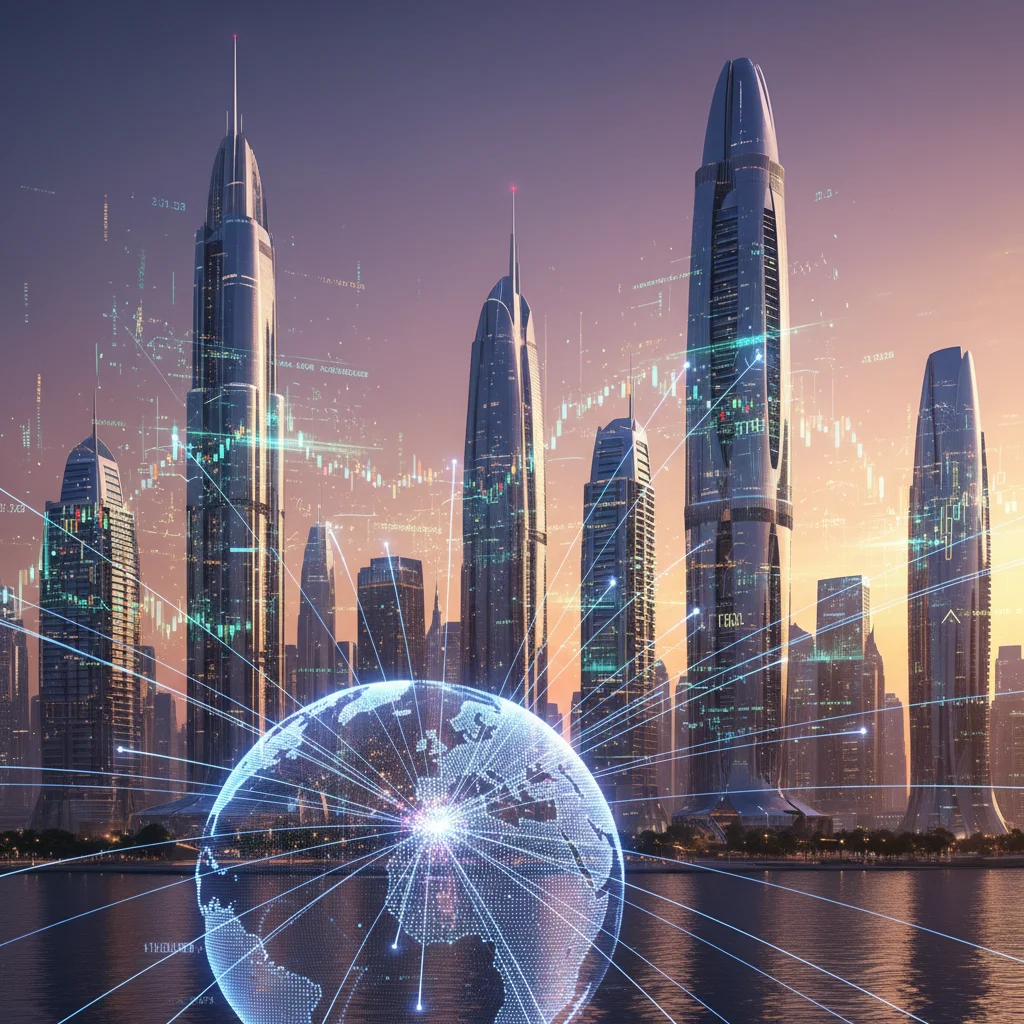
[IMAGE: Composite visual showing a globe with fiber-optic light trails connecting Gulf financial centers to New York, London, and Singapore, overlaid on stock market tickers]
---
What Lies Ahead: A New Normal in Global Capital Flows
The Gulf capital market transformation is not a speculative trend—it is a structural shift backed by government policy, sovereign wealth firepower, and growing investor appetite. The $2.2 trillion investable base is projected to reach $4–5 trillion by 2030, assuming continued privatization, increased sukuk and bond issuance, and the maturation of private equity and venture capital ecosystems.
For global investors, the message is clear: the Gulf is moving from an oil-dependent outlier to a mainstream component of the Global Market Portfolio. The investable gap, far from being a barrier, represents the largest pent-up opportunity in emerging market finance today. The question is no longer whether to allocate to the region, but how to do so efficiently as the barriers fall one by one.
The revolution is real. It is deliberate. And it is only just beginning.
Keywords

Khalid Al-Mansouri
Senior Financial Analyst covering GCC capital markets with 15 years of experience.