The Gulf''s Capital Paradox: Record Outflows and Inflows Redefine Global Finance
The Gulf Cooperation Council (GCC) is experiencing a transformative shift in its financial architecture. Despite a steep decline in current account surpluses—from 15.7% of GDP in 2022 to just 3.8% in 2025—the region has become both a top source and destination of global capital. Net resident outflows hit $271 billion in 2025, while non-resident inflows reached $228 billion, driven by sovereign wealth fund spending (43% of global total) and record inward investment (9.6% of GDP). Saudi Arabia and the UAE account for 85% of these flows, but with starkly different compositions: UAE relies on FDI, Saudi on portfolio investments. Saudi Arabia’s current account deficit and $90 billion bond issuance signal a deliberate strategy to sustain domestic transformation without liquidating external assets. This article uncovers the hidden logic behind the ‘capital duality’—how the Gulf is recycling petrodollars into global markets while simultaneously attracting foreign capital to finance its own economic overhaul, and what this means for global supply chains and investment patterns.
Khalid Al-Mansouri
Editorial Analyst
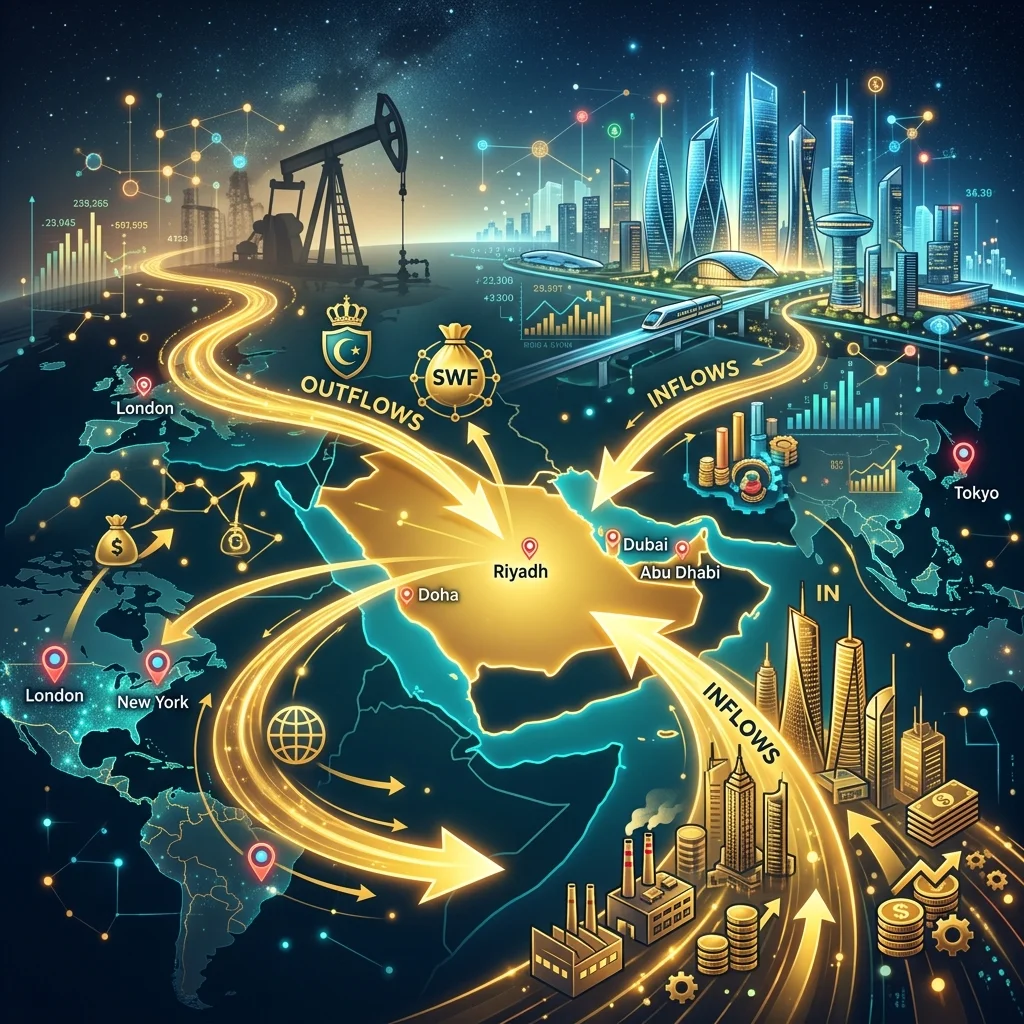
The Gulf’s Capital Paradox: Record Outflows and Inflows Redefine Global Finance
Introduction: The Surplus That Vanished—and the Capital That Doubled
In 2022, the Gulf Cooperation Council (GCC) enjoyed a current account surplus of 15.7% of GDP—a towering cushion built on soaring oil prices. By 2025, that surplus had collapsed to just 3.8% of GDP, the lowest since the pandemic-era lows. Yet in the same period, the region has emerged as an unprecedented two-way conduit for global capital. Net resident outflows—money leaving the GCC via sovereign wealth funds, private investors, and corporates—surged to $271 billion in 2025, while non-resident inflows—foreign investment into the region—reached $228 billion. The Gulf is simultaneously exporting and importing capital at record levels.
This duality defies conventional economic logic. How can a region that is running out of oil-driven surpluses still be the world’s largest net exporter of capital? And why are foreigners pouring tens of billions into a region whose own savings are declining? The answer lies in a deliberate strategy of transformation, where the Gulf states—led by Saudi Arabia and the UAE—are using their remaining petrodollar firepower to finance domestic overhauls while simultaneously courting global capital to sustain those same projects. According to data from the Institute for International Finance (IIF) and analysis by BNP Paribas, this “capital duality” is reshaping global finance in ways that go far beyond the region.
[IMAGE: A dual-axis line chart showing the decline of current account surplus (as % of GDP) alongside the rise of net capital flows (both resident and non-resident) from 2022 to 2025. X-axis: years 2022–2025; left Y-axis: current account surplus % (descending from 15.7% to 3.8%); right Y-axis: net capital flows in billions USD (ascending from ~$200B to $271B outflows and $228B inflows). Clear labeling of two lines and bars.]
The Erosion of Oil-Led Surpluses: Structural or Cyclical?
The trajectory of the GCC current account surplus tells a stark story: 15.7% of GDP in 2022, 8.0% in 2023, 5.9% in 2024, and just 3.8% in 2025. The decline is sharp, but its causes are a mix of cyclical headwinds and structural shifts.
On the cyclical side, oil prices have retreated from their 2022 peaks, averaging around $75–80 per barrel in 2025 compared to $100+ in 2022. But the more profound factor is structural: GCC governments are spending aggressively on economic diversification. Saudi Arabia’s Vision 2030 mega-projects—NEOM, Red Sea resorts, industrial cities—require massive imports of construction materials, machinery, and technology services. The UAE is similarly pouring capital into advanced manufacturing, logistics, and renewable energy. These imports, combined with rising domestic consumption and government salaries, have eroded the trade surplus.
Saudi Arabia’s role is central. The Kingdom recorded a current account deficit of approximately 3% of GDP in 2024—its first in over two decades. To finance this deficit and maintain its spending momentum, Saudi Arabia issued $90 billion in bonds in 2025, a record for any emerging market. This is a deliberate trade-off: instead of liquidating overseas assets (held by its sovereign wealth fund PIF), Riyadh is borrowing on international markets to keep its domestic transformation on track while allowing its foreign investment portfolio to grow. The message is clear: the Gulf is no longer content to simply save oil revenues abroad; it is now using its balance sheet to simultaneously build at home and invest globally.
[IMAGE: A stacked bar chart comparing oil revenue vs. non-oil GDP contribution over the same period for key GCC countries (Saudi Arabia, UAE, Qatar, Kuwait). Each bar for 2022, 2023, 2024, 2025 shows the share of oil revenue (e.g., 50%→30%) and non-oil GDP (rising). Highlight Saudi Arabia’s non-oil GDP surpassing oil GDP in 2025.]
Outward Flows: The Sovereign Wealth Fund Revolution
Even as the current account shrinks, Gulf-based sovereign wealth funds have never been more active. Net resident capital outflows rose 10% over 2023–2025, reaching $271 billion in 2025. The driving force is the region’s sovereign funds, which accounted for 43% of all global sovereign wealth fund spending in 2025—a historic share. Saudi Arabia’s Public Investment Fund (PIF), the UAE’s ADIA and Mubadala, and Qatar’s QIA are deploying capital at an accelerated pace, focusing on technology (artificial intelligence, renewable energy, semiconductors), infrastructure, private equity, and strategic assets across Asia, Europe, and the United States.
The logic is straightforward: Gulf states are using their accumulated wealth to secure future revenue streams outside oil. They are buying stakes in global tech giants, funding green energy transitions, and acquiring critical infrastructure like ports and data centers. This “petrodollar recycling” is no longer just buying sovereign bonds—it is actively reshaping global supply chains. For example, the GCC’s push into AI and data centers has seen funds invest billions in U.S. and Chinese tech firms, while also building domestic capacity to attract foreign tech companies to set up regional hubs.
[IMAGE: A world map with arrows originating from the Arabian Peninsula to major destinations: North America (Silicon Valley, New York), Europe (London, Paris), Asia (Beijing, Singapore, Mumbai). Arrow thickness proportional to investment volume. Icons: microchip for tech, wind turbine for renewables, building crane for infrastructure. No text, minimal design.]
Inward Flows: Foreign Capital Rushes In
The other side of the paradox is equally striking. Non-resident inflows into the GCC hit $228 billion in 2025, equivalent to 9.6% of the region’s GDP—a level rarely seen in emerging markets. Foreign direct investment (FDI) and portfolio investment are both surging, but their composition varies dramatically between the two largest economies.
The UAE has become the Gulf’s FDI magnet. Thanks to its open economy, stable regulatory environment, and status as a global hub for trade and finance, the country attracts the bulk of inbound capital in the form of greenfield investments, real estate purchases, and private equity. In 2025, UAE’s FDI inflows reached an estimated $40 billion, driven by expansions in renewable energy, logistics, and fintech. The government’s proactive policies—including 100% foreign ownership in many sectors and long-term visas—have created a virtuous cycle where foreign capital funds further diversification.
Saudi Arabia, by contrast, relies much more heavily on portfolio inflows—bonds and equities—rather than FDI. The $90 billion bond issuance alone accounted for a significant share of total non-resident inflows into the Kingdom. Foreign investors have been eager buyers of Saudi sovereign debt, attracted by relatively high yields and improving credit ratings. However, despite Vision 2030’s ambitious FDI targets, actual foreign direct investment into Saudi Arabia remains modest compared to the UAE, partly due to bureaucratic hurdles and the still-dominant role of the state in the economy.
Together, Saudi Arabia and the UAE account for 85% of all GCC capital flows—both outward and inward—but with sharply different compositions: the UAE is an FDI-driven economy; Saudi Arabia is a portfolio-driven one. This divergence reflects their distinct development models and will shape how each country navigates the coming decade.
[IMAGE: A side-by-side comparison chart: left bar for Saudi Arabia, right bar for UAE. Each bar broken into two colors: FDI (green) and portfolio (blue). Saudi shows a large blue segment (portfolio) and small green; UAE shows large green and small blue. Below: labels with exact numbers: Saudi FDI $X B, portfolio $Y B; UAE FDI $Z B, portfolio $W B. Source: IIF.]
The Duality in Action: Why Borrow While Investing Abroad?
The central paradox—running a current account deficit while simultaneously being the world’s largest outward investor—raises the obvious question: why doesn’t Saudi Arabia simply use its overseas assets to finance its domestic spending instead of borrowing $90 billion? The answer reveals a sophisticated financial strategy.
First, the cost of borrowing is low relative to the returns the PIF expects from its global investments. By issuing bonds at around 4–5% yield, Saudi Arabia can keep its sovereign wealth fund fully deployed in higher-return asset classes like technology and infrastructure, where annualized returns often exceed 10–15%. Second, maintaining a large external portfolio provides a buffer against oil price volatility and ensures the Kingdom retains strategic influence in global markets. Third, the borrowing itself deepens Saudi Arabia’s domestic bond market, attracting foreign investors and building a local capital market that can finance future private-sector growth.
This “capital duality” is thus not a contradiction but a deliberate balancing act. The Gulf is using its oil legacy to borrow cheaply from global markets while investing aggressively abroad, effectively leveraging its sovereign balance sheet to accelerate two transformations at once: the domestic economic overhaul and the globalization of its capital.
What This Means for Global Supply Chains and Investment Patterns
The implications extend far beyond the Gulf. As GCC sovereign wealth funds become the dominant force in global capital deployment—43% of all SWF spending—they are reshaping investment flows into sectors that align with their long-term strategic goals. Technology, particularly AI and renewable energy, is the top priority. In 2025, Gulf funds accounted for more than half of all global sovereign investment in climate-tech startups. Their growing appetite for infrastructure assets—ports, airports, logistics hubs—is also influencing global trade routes, as the region positions itself as a transshipment hub between Asia, Europe, and Africa.
On the inflow side, the Gulf’s ability to attract foreign capital—especially FDI into the UAE and portfolio investment into Saudi Arabia—is creating new nodes in global supply chains. International companies are setting up regional headquarters in Dubai or Riyadh, using them as launchpads for expansion into the Middle East, Africa, and South Asia. This trend is accelerating as geopolitical tensions in other regions push investors to seek stable, neutral ground.
However, risks remain. The GCC’s heavy reliance on oil prices means that a prolonged downturn could curtail both outward investment and the ability to service foreign debt. Saudi Arabia’s current account deficit, if sustained, could erode its foreign exchange reserves and increase vulnerability to capital flow reversals. Moreover, the region’s success in attracting FDI depends on continued regulatory reform and the rule of law—areas that remain works in progress.
[IMAGE: A conceptual diagram showing the Gulf as a central node with arrows coming in (foreign capital: FDI, bonds) and going out (SWF investments: tech, infrastructure). Around the central node: icons for AI, renewables, logistics, finance. At the edges: global regions (Asia, Europe, Africa, Americas) with small icons representing supply chain links. No text except minimal labels.]
Conclusion: The New Logic of Gulf Finance
The Gulf’s capital paradox is not a temporary anomaly but the emergence of a new financial architecture. Gone are the days when the region simply exported oil and imported capital. Today, the GCC is a two-way street for global money, channeling its own wealth into the world while simultaneously borrowing from global markets to fund its own transformation. This duality is driven by sovereign wealth funds that are both the world’s largest investors and the engines of domestic growth.
For investors, the message is clear: the Gulf is no longer a passive recipient of capital but an active participant in global finance. Understanding the dynamics of Saudi Arabia’s bond issuance, the UAE’s FDI story, and the shifting composition of capital flows is essential for anyone tracking petrodollar recycling, emerging market trends, or the restructuring of global supply chains. The paradox is here to stay—and it is redefining the rules of the game for decades to come.
Keywords

Khalid Al-Mansouri
Senior Financial Analyst covering GCC capital markets with 15 years of experience.