Gulf Economies in 2026: The Shift Beyond Oil – Key Investment Watchpoints
As Gulf Cooperation Council (GCC) economies gear up for an estimated 4.5% growth in 2026—1.3% higher than 2025—the real story lies beneath the headline numbers. This article moves beyond aggregate forecasts to dissect the structural transformation underway. We examine how non-oil sectors in the UAE and Saudi Arabia are becoming the primary engines of GDP growth, how record foreign direct investment is reshaping supply chains for clean energy and infrastructure, and why oil price volatility remains a latent risk. We also uncover a hidden pattern: the increasing reliance on private capital to fund fiscal diversification, which creates new feedback loops between global interest rates and domestic growth.
Khalid Al-Mansouri
Editorial Analyst
Gulf Economies in 2026: The Shift Beyond Oil – Key Investment Watchpoints
Published: December 19, 2025
The 4.5% Growth Story: What the Aggregate Number Hides
The Gulf Cooperation Council (GCC) economies are projected to expand by approximately 4.5% in 2026, representing a 1.3 percentage point acceleration from the 2025 baseline (Source 1: Primary Data). This headline figure, while robust, obscures a critical divergence beneath the surface: the widening gap between oil-dependent revenue streams and the structurally expanding non-oil sectors.
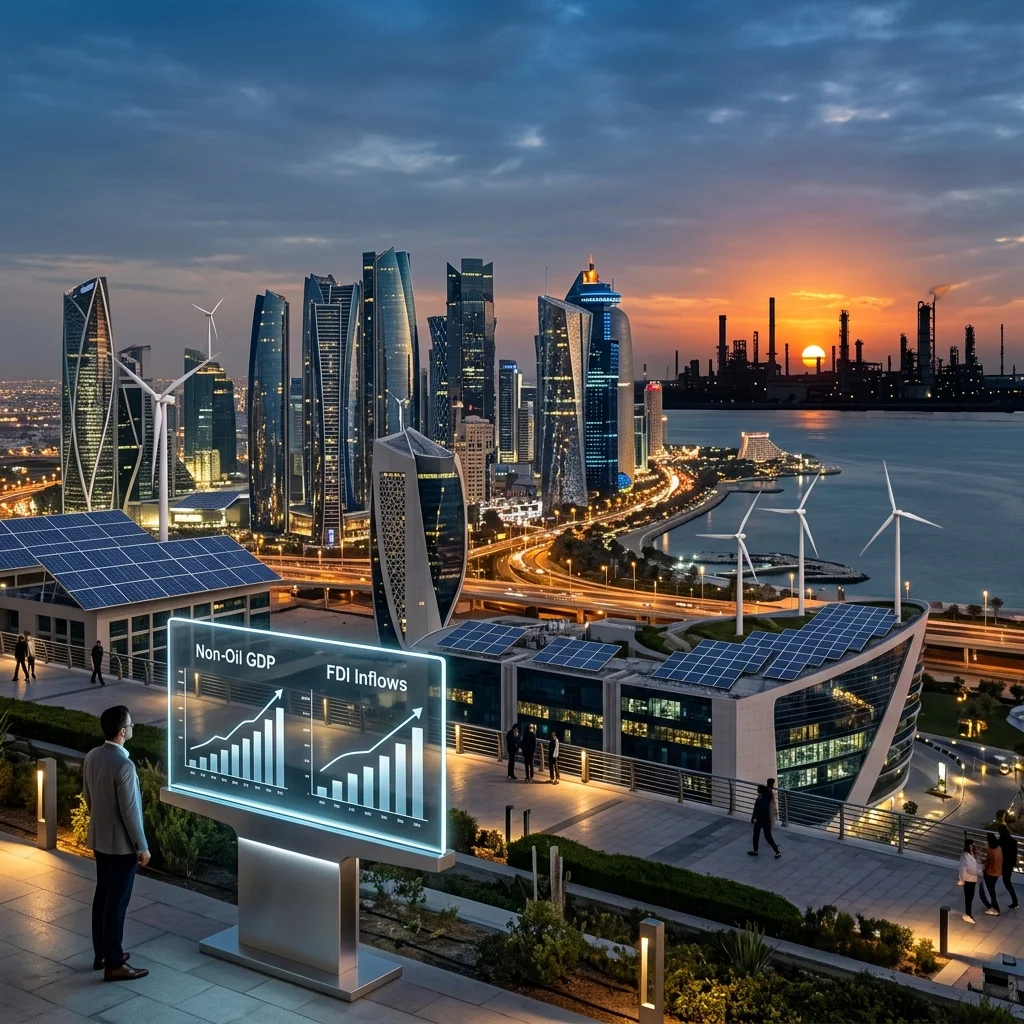
The 2026 forecast of 4.5% growth is not a cyclical rebound driven by commodity price recovery. Rather, it reflects a deliberate policy pivot. The United Arab Emirates is projected to achieve non-oil GDP growth of 5 to 5.6% in 2026, while Saudi Arabia's overall GDP growth is estimated at 4.3% (Source 1: Primary Data). The arithmetic is revealing: the UAE's non-oil economy is growing faster than Saudi Arabia's entire economy, underscoring how diversification is now the primary growth engine—not merely a policy ambition.
This 1.3% acceleration must be understood as the cumulative effect of capital deployed over the past five years into sectors designed to operate independently of crude price fluctuations. The aggregate number masks a structural pivot: non-oil activities now contribute a higher proportion to GDP growth than at any point in the last decade across the GCC.
Non-Oil Engines: Tourism, Logistics, Manufacturing, and Finance
The composition of growth in 2026 reveals four distinct pillars: tourism, logistics, manufacturing, and financial services. Each sector operates on different time horizons and exhibits varying degrees of capital intensity, yet together they form an interconnected economic architecture.
Tourism remains the most visible driver. The UAE continues to leverage its Expo 2020 legacy infrastructure, while Saudi Arabia's giga-projects—including NEOM, the Red Sea Project, and Diriyah Gate—are transitioning from construction phases to operational stages. These destinations are not merely hospitality ventures; they are designed to create ancillary demand across aviation, retail, and real estate.
Logistics has emerged as a parallel engine. Port expansions in Jebel Ali (Dubai) and Khalifa Port (Abu Dhabi), combined with Saudi Arabia's investments in King Abdullah Port and the King Salman International Airport, are positioning the Gulf as a global transshipment hub. The Red Sea and Gulf shipping lanes are being reconfigured to handle increased container volume, particularly as trade routes shift in response to geopolitical disruptions elsewhere.
Manufacturing and finance represent the deeper structural transformation. Manufacturing, particularly in petrochemical derivatives, aluminum, and emerging clean energy components, is absorbing labor and attracting capital that previously flowed into oil extraction. Financial services are expanding through sovereign wealth fund activity, initial public offerings, and the growth of regional asset management hubs. The UAE's non-oil GDP growth of 5 to 5.6% is being sustained by this multi-sector expansion (Source 1: Primary Data).
Record FDI: The Hidden Supply Chain Reshuffling
Foreign direct investment into the Gulf has reached an all-time high in recent years, driven by infrastructure and clean energy projects (Source 1: Primary Data). However, the conventional interpretation—that this represents capital flowing into passive assets—is incomplete. The data reveals a more significant pattern: global supply chains for solar photovoltaic manufacturing, green hydrogen production, and battery materials processing are being reconfigured around Gulf locations.
This FDI is not merely capital inflow; it is the physical relocation of production capacity. Chinese solar manufacturers are establishing assembly plants in Saudi Arabia's King Salman Energy Park. European hydrogen consortia are partnering with UAE entities to build electrolysis facilities on the Arabian Sea coast. Australian and African lithium processors are routing raw materials through Gulf ports for refining before onward shipment to Europe and North America.
The long-term implication is that the Gulf is transitioning from being a pure energy exporter to becoming a re-export and value-add hub for clean energy components. This shifts the region's position in global value chains: from price-taker on energy commodities to intermediary processor and logistics coordinator. The FDI figures capture this transformation, but only when disaggregated by sector does the pattern emerge clearly.
Oil Price Volatility & Fiscal Policy: The Latent Feedback Loop
Despite the growth in non-oil sectors, oil price volatility remains a material risk to budget certainty across the GCC. The mechanism has changed, however. Traditional exposure was direct: lower oil revenues meant lower government spending. The new exposure is indirect but potentially more destabilizing.
Fiscal policy is now more sensitive to global interest rate changes because governments have increased reliance on private capital through public-private partnerships (PPPs) and sovereign wealth fund co-investment structures. When global interest rates rise, the cost of capital for these partnerships increases, potentially delaying or reducing the scale of diversification projects. This creates a feedback loop: non-oil growth depends on private investment, private investment depends on financing costs, and financing costs depend on monetary policy set by central banks outside the region.
Furthermore, OPEC+ production dynamics introduce a separate layer of risk. Production cuts designed to support prices reduce the volume of oil revenues available for fiscal transfers into diversification funds. Conversely, price wars aimed at market share could destabilize the revenue base entirely. Either scenario creates uncertainty in investment planning for both public and private entities.
The 2026 growth forecast of 4.5% assumes stable oil prices and continued private capital flows (Source 1: Primary Data). Any deviation in either variable introduces downside risk that aggregate projections do not capture.
Investment Implications: What to Watch in 2026
For institutional investors analyzing Gulf exposure in 2026, three watchpoints emerge from the structural analysis.
First, the divergence between UAE and Saudi growth trajectories will persist. The UAE's non-oil growth of 5 to 5.6% (Source 1: Primary Data) suggests its economy is more insulated from oil price shocks, making it a lower-risk allocation for investors seeking diversified exposure. Saudi Arabia's 4.3% overall growth, while impressive, carries higher sensitivity to both OPEC+ decisions and the execution timeline of giga-projects.
Second, the clean energy supply chain migration to the Gulf presents an investment opportunity that extends beyond energy production. Companies involved in solar panel assembly, hydrogen electrolysis, battery precursor processing, and related logistics infrastructure will benefit from the region's cost advantages in energy, land, and labor.
Third, the fiscal feedback loop between global interest rates and domestic growth requires monitoring. Should the U.S. Federal Reserve or European Central Bank maintain elevated rates through 2026, the cost of financing PPPs in the Gulf will increase, potentially slowing the pace of diversification. Investors should track the issuance of sukuk and sovereign bonds as proxies for fiscal health and private sector crowding-in.
The Gulf economies in 2026 are not merely growing; they are re-engineering their economic DNA. The 4.5% forecast is a snapshot of a process that will take another decade to complete. For now, the numbers confirm that the shift beyond oil is real, measurable, and investable—but the feedback loops remain active, and the risks remain latent.
Keywords

Khalid Al-Mansouri
Senior Financial Analyst covering GCC capital markets with 15 years of experience.