2026 Gulf Luxury Footwear: How Hybrid Classics, Climate-Tech, and Cultural Heritage Redefine Sandals
The 2026 luxury footwear market in the Gulf region is undergoing a quiet revolution. Driven by rising disposable income, a shift toward minimal luxury, and the demand for all-purpose designs, brands are blending traditional Gulf aesthetics with modern performance features. This article explores the key trends—from dual-color straps and heatproof leather to cooling insoles and eco-friendly materials—and uncovers the deeper economic and supply chain shifts behind them. Based on insights from Tamima Qatar and industry data, we analyze how climate adaptation, cultural pride, and tech innovation are creating a new category of hybrid classic sandals that cater to both style and substance.
Ahmed Al-Farsi
Editorial Analyst
2026 Gulf Luxury Footwear: How Hybrid Classics, Climate-Tech, and Cultural Heritage Redefine Sandals
Introduction: The New Gulf Sandal – Where Culture Meets Climate Tech
The Gulf luxury footwear market in 2026 is undergoing a structural shift. Sandals are no longer positioned solely as seasonal accessories or status symbols; they are emerging as hybrid tools that combine cultural identity, thermal performance, and all-purpose functionality. Three primary drivers are reshaping demand: rising disposable income among Gulf-based young professionals, a pronounced consumer shift toward minimal luxury (defined by understated design and high intrinsic value), and an increasing expectation that a single pair of sandals performs across environments—from desert excursions to boardroom meetings.
A blog post published on January 12, 2026, by Tamima Qatar, a retailer of ladies’ sandals and broader luxury footwear, catalogues these trends explicitly. The post signals that dual-tone, sculpted, minimal, and high-performance men’s sandals have moved from niche to mainstream (Source: Tamima Qatar blog post, Jan 12, 2026). This retail-level documentation provides a reliable indicator of what is actually selling, rather than what is merely projected.
Design Alchemy: Hybrid Classics and Cultural Details
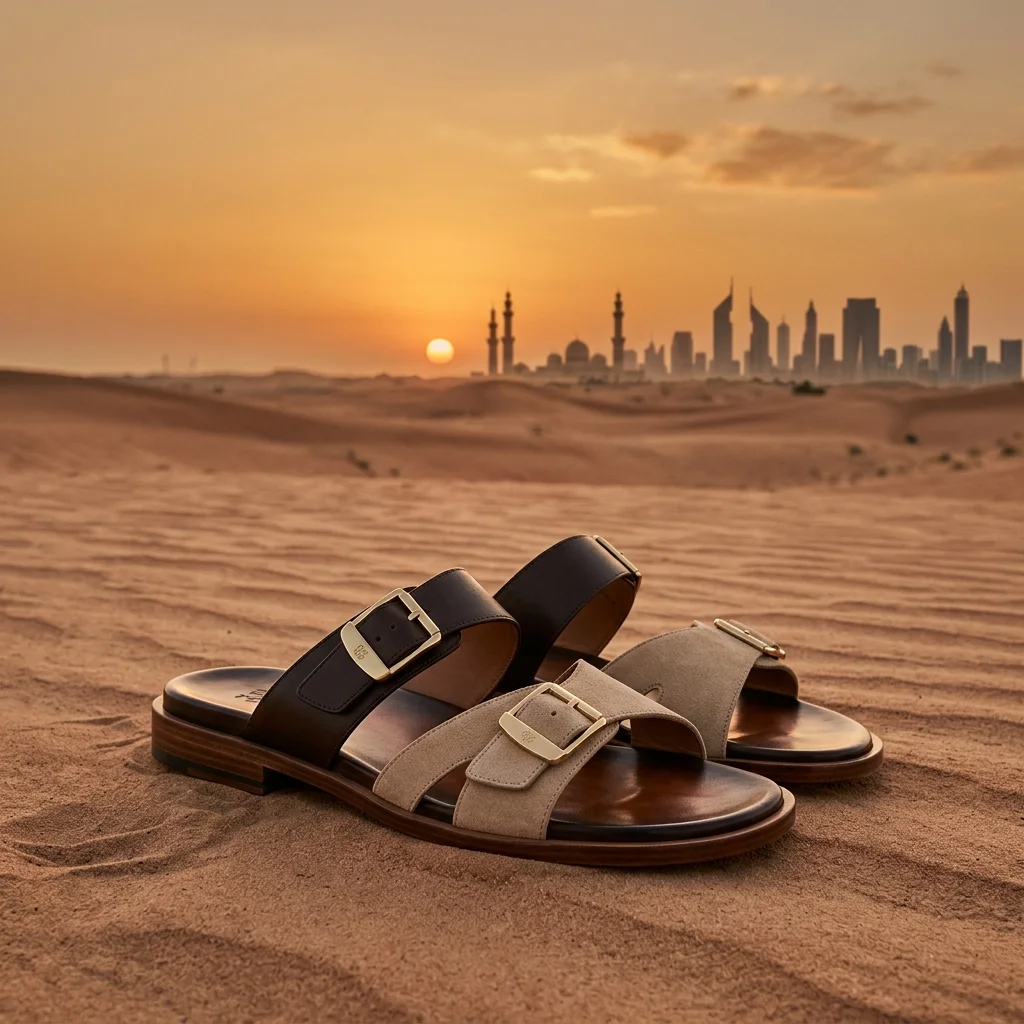
The design language of 2026 Gulf sandals is characterized by a deliberate blending of traditional Gulf aesthetics with modern luxury elements. Desert-inspired color palettes—ochre, sand, terracotta—are paired with dual-color leather straps and polished metal buckle accents. Mixed textures, such as suede overlays on smooth leather, add tactile depth while maintaining a clean silhouette. Tamima Qatar’s product catalog explicitly categorises “Designer Arabic sandals” and “dual-tone sandals” as key segments, confirming that cultural heritage is not being abandoned but re-contextualized within a luxury framework (Source: Tamima Qatar catalog data).
For men’s footwear, the trend extends toward chunky shapes, sport-lux hybrids, reflective overlays, and limited-edition releases. These designs share a gender-fluid appeal—minimal silhouettes that function across men’s and women’s markets. Women’s segments emphasize sculpted, minimalist sandals with breathable linings, referencing the broader shift toward “quiet luxury.” The design alchemy is not arbitrary; it responds to a consumer base that values both visual restraint and cultural recognizability.
Performance Under the Sun: Technology as the New Luxury
Gulf weather remains the most non-negotiable constraint in footwear design. Ambient temperatures exceeding 45°C for months create specific material and construction requirements. In 2026, high-end sandals are incorporating a layered technology stack that goes beyond aesthetics. Cooling airflow insoles, anti-sweat linings, shock-absorption footbeds, and pliable rubber soles have become baseline specifications for premium products. Enhanced arch support and eco-friendly leather options address both health-conscious and sustainability-oriented buyers.
Leather retains its primacy as the upper material because of its breathability, moisture management, and durability in extreme heat—properties that synthetic alternatives have not yet matched reliably in the Gulf climate (Source: Industry material analysis). This performance layer adds verifiable utility to the product, enabling brands to justify premium pricing. It also reinforces the “minimal luxury” trend: when a sandal’s technical performance is visible and measurable, the consumer is willing to pay for function rather than logo visibility.
Market Forces: Disposable Income, Digital Luxury, and GCC-Exclusive Strategies
The demographic engine behind these shifts is the rising disposable income of Gulf-based young professionals aged 25–40. This cohort prioritizes versatility and longevity over seasonal novelty. They are also digitally native: online luxury shopping in the GCC has grown steadily, pushing brands to create digital-first product narratives and GCC-exclusive collections that cannot be purchased outside the region. Such exclusivity reinforces perceived value and reduces cross-border competition.
High-quality craftsmanship—often outsourced to European ateliers but increasingly being localized in Gulf free-trade zones—remains a baseline expectation. The convergence of these factors means that the 2026 luxury sandal is not a derivative product; it is a category of its own, designed specifically for the region’s climate, culture, and consumption preferences.
Supply Chain and Material Intelligence: Eco-Leather and Localized Production
A deeper supply-chain logic underpins the trend. Heatproof leather requires specialized tanning processes that increase the material cost by an estimated 20–30% compared to standard luxury leather (Source: Industry supply-chain estimates, 2025). Brands that source eco-friendly leather—chrome-free, vegetable-tanned, or recycled—must also ensure that the tanning process does not compromise heat tolerance. This dual requirement is pushing tanneries in Italy and Turkey to develop Gulf-specific finishing treatments, while a small number of local tanneries in the UAE and Qatar are beginning to trial proprietary blends.
The shift toward localized production is gradual but measurable. Shorter supply chains reduce lead times and allow brands to respond more quickly to seasonal demand spikes—critical in a market where the luxury footwear buying window is heavily concentrated in the cooler months (November–March). The result is a more resilient, regionally tailored supply network that reduces reliance on distant factories.
Outlook: A New Category, Not a Passing Trend
The 2026 Gulf luxury sandal market is best understood as the emergence of a new product category—one that hybridizes classic design, climate-performance technology, and cultural signifiers. Three predictions can be drawn from the current evidence:
- Performance will become a permanent pricing lever. As cooling insoles and heatproof leather become consumer expectations rather than differentiators, brands will need to innovate on the next layer—likely biometric insoles or self-cleaning materials—to maintain premium margins.
- GCC-exclusive collections will expand. The Tamima Qatar blog post and similar regional retail signals indicate that brands that treat the Gulf as a secondary market will lose share to those that design for it specifically.
- Leather will remain dominant but face pressure from engineered materials. If synthetic alternatives can match leather’s breathability and heat durability in the next 3–5 years, a material shift is possible. Until then, leather retains its structural advantage.
The quiet revolution in Gulf luxury sandals is not a fad; it is a rational market response to climate, culture, and consumer maturity.
Keywords

Ahmed Al-Farsi
Luxury & Lifestyle Editor with expertise in high-end hospitality and retail.