GCC Personal Luxury Market Defies Global Gloom: A $12.8 Billion Strategy in Resilience and E-Commerce Pivot
While the global personal luxury market stumbled by -2% in 2024, the GCC surged by +6% to reach USD 12.8 billion, proving itself a resilient and structurally different luxury ecosystem. This article analyzes the hidden economic logic behind this divergence, focusing on the region's unique consumer mix—where Russian tourists drive 16% of spending—and a strategic pivot to e-commerce, which despite a low 13% share, is growing at +13% versus a global decline. We dissect the micro-trends in beauty (fragrance dominance, skincare surge) and the watch market's stagnation as leading indicators. Finally, we forecast the pathway to USD 15 billion by 2027, arguing that the GCC is not merely a market but a global stress-test for physical retail innovation and brand resilience.
Ahmed Al-Farsi
Editorial Analyst
GCC Personal Luxury Market Defies Global Gloom: A $12.8 Billion Strategy in Resilience and E-Commerce Pivot
Dubai, UAE – June 11, 2025 — While the global personal luxury goods market contracted by an estimated -2% in 2024, the Gulf Cooperation Council (GCC) region expanded by +6% year-on-year, reaching USD 12.8 billion in retail sales. This divergence, documented in the Chalhoub Group's latest GCC Personal Luxury report, positions the six-nation bloc—comprising the UAE, Saudi Arabia, Kuwait, Qatar, Bahrain, and Oman—as a structurally distinct luxury ecosystem operating on different economic and consumer dynamics than mature Western markets.
The report, analyzing 77 high-end fashion brands, over 1,000 prestige beauty brands, 30 luxury watch brands, and 16 fine jewellery brands, indicates that the GCC is not merely riding a temporary wave of petrodollar liquidity. Rather, a confluence of tourism inflows, strategic retail infrastructure investment, and shifting consumer preferences has created a resilient market projected to reach USD 15 billion by 2027.
---
The Divergence: GCC +6% vs. Global -2% – A Structural Anomaly
The global personal luxury market's contraction in 2024—estimated between -1% and -2% across major consultancy reports—was attributed to post-pandemic normalization, inflation-weary consumers in Europe and North America, and a pronounced slowdown in China. Against this backdrop, the GCC's +6% growth represents more than simple regional outperformance; it signals a fundamental structural insulation from global headwinds.
The economic logic is twofold. First, GCC economies have aggressively diversified away from hydrocarbon dependency. Non-oil GDP—driven by tourism, real estate, financial services, and logistics—has sustained high levels of domestic consumption and employment. Second, the region has become a net beneficiary of geopolitical displacement. High-net-worth individuals (HNWIs) from Russia, Asia, and parts of Europe have relocated assets and residency to the Gulf, particularly Dubai and Abu Dhabi, creating a permanent base of luxury consumers who might otherwise have shopped in London, Paris, or Singapore.
Jasmina Banda, Chief Strategy Officer and President of Joint Ventures at Chalhoub Group, contextualized the performance: "As we analyse the findings of our latest GCC Personal Luxury report, it is evident that the luxury sector in our region continues to demonstrate resilience and adaptability despite global economic challenges." (Source: Chalhoub Group, May 2025)
This "resilience and adaptability" is not passive. It reflects deliberate strategic positioning: GCC retailers and mall operators have continued to invest in physical infrastructure and brand experiences while global peers tightened capital expenditure. The region's luxury retail square footage has expanded in 2024, even as Paris and Milan saw flat or declining foot traffic.
---
Consumer Micro-Segments: The Russian Tourist Effect and the Hidden Beauty Boom
Beneath the aggregate +6% growth lies a granular consumer landscape that challenges conventional luxury market assumptions.
The Russian Tourist Factor
Russian nationals accounted for the highest share of total luxury spending in the GCC at 16% (Source: Chalhoub Group, May 2025). This concentration, unprecedented in pre-2022 data, reflects both sanctions-driven capital flight and the direct aviation and banking connectivity between Moscow and Gulf hubs. The Russian consumer in the GCC exhibits distinct spending patterns: high average transaction values, preference for watches and jewellery, and loyalty to heritage European maisons.
For brands, this creates a strategic imperative. GCC stores are no longer merely serving a local expatriate and Emirati base; they are effectively functioning as proxy European boutiques for a displaced Russian clientele. Inventory allocation, merchandising, and even staffing decisions must account for this demographic. Brands that fail to tailor their GCC operations to Russian preferences—from language support to VAT-free shopping logistics—risk ceding market share to competitors who do.
The Beauty Vertical: Fragrance Dominance, Skincare Surge
Beauty emerged as the fastest-growing luxury category in the GCC, expanding +12% in 2024. Within this segment, two micro-trends reveal cultural specificity and convergence simultaneously.
Fragrance commanded a 49% weight within total beauty spending (Source: Chalhoub Group, May 2025). This is not accidental. The GCC has a centuries-old tradition of perfumery—oud, amber, and rose-based attars are deeply embedded in regional culture. International luxury fragrance houses have responded by developing Gulf-exclusive blends and limited editions, often launching new scents in Dubai or Riyadh months before global rollouts. The high fragrance penetration is a structural feature, not a temporary fad.
Simultaneously, skincare recorded the highest growth rate at +17% year-on-year, nearly double the overall beauty category growth (Source: Chalhoub Group, May 2025). This convergence with global luxury beauty trends—where skincare has long been the fastest-growing segment in Asia and North America—indicates that GCC consumers are adopting multi-step, ingredient-conscious regimens alongside their traditional fragrance preferences. Brands that succeed in the GCC must master both: the heritage-driven fragrance play and the science-forward skincare narrative.
Watch Market: Stagnation as Victory
Watches remained flat at 0% growth in the GCC during 2024 (Source: Chalhoub Group, May 2025). At first glance, this appears lackluster. However, the global context transforms this stagnation into a relative triumph. Global luxury watch sales declined by -5% to -7% in the same period, as secondary market prices corrected sharply from pandemic-era peaks and consumer demand shifted from investment pieces to experiential luxury.
The GCC watch market's stability underscores its function as a safe haven for a troubled category. The region's high concentration of HNWIs, combined with zero personal income tax and a culture of visible status signalling, creates a floor for watch demand that does not exist in price-sensitive Western markets. Jewellery, which grew +7% in the GCC, further reinforces this thesis: hard luxury in the Gulf remains buoyed by cultural wedding traditions, gifting norms, and the perception of watches and jewellery as stores of value in a volatile global economy.
---
The E-Commerce Paradox: Low Penetration, High Growth, and a Global Lesson
The GCC's digital luxury channel presents a paradox that demands careful interpretation. Online sales captured only 13% of the market in 2024, significantly below the global average of 20% (Source: Chalhoub Group, May 2025). On the surface, this suggests a lagging digital adoption. Yet the e-commerce segment grew at +13% year-on-year, while global luxury e-commerce declined by -1% to -4% (Source: Chalhoub Group, May 2025).
The slow analysis—the conclusion that the GCC is simply "behind" and catching up—is insufficient and potentially misleading. A more rigorous reading suggests the region is building a high-quality, omnichannel model that avoids the structural pitfalls that have plagued global luxury e-commerce.
Globally, luxury e-commerce expanded rapidly during 2020-2022, driven by pandemic lockdowns and aggressive discounting by multi-brand platforms. This created a race to the bottom: heavy promotional cadences eroded brand equity, high return rates (often exceeding 40% in apparel) destroyed margin, and customer acquisition costs ballooned. Many luxury brands now view e-commerce as a necessary evil—a high-volume, low-margin channel that cannibalizes full-price physical retail.
The GCC, by contrast, has developed e-commerce differently. The low penetration rate means the physical store remains the primary profit center. Digital is deployed as a high-margin extension: click-and-collect, virtual appointments, personalized concierge services, and loyalty integration with in-store experiences. Without the pressure to achieve unrealistic online penetration targets, GCC retailers have avoided the discounting trap.
Banda explicitly noted this strategic direction: "New retail developments are also creating opportunities for brands to elevate the in-store experience and customer service, in order to meet the rising expectations of the GCC consumer." (Source: Chalhoub Group, May 2025)
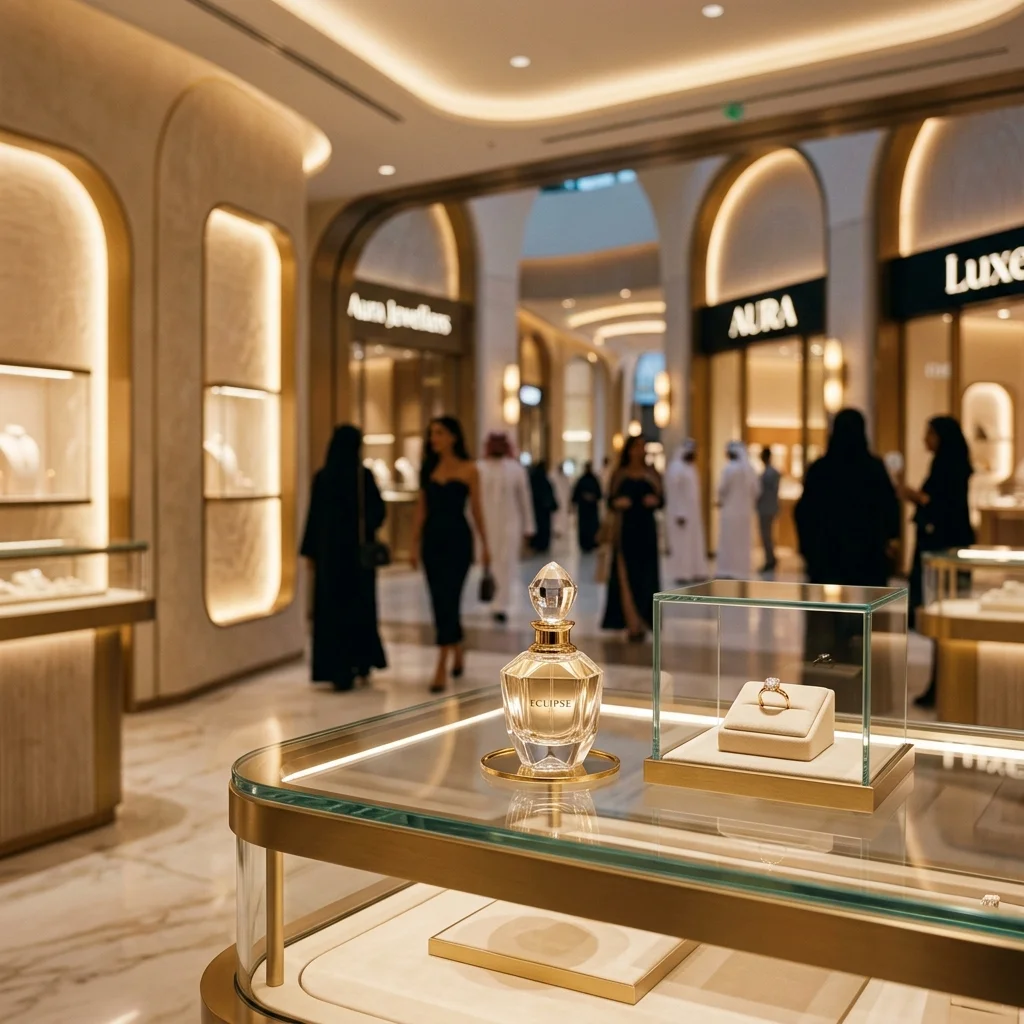
This is not a trivial observation. The GCC consumer, accustomed to valet parking, personal shoppers, champagne receptions, and same-day delivery from physical stores, has developed expectations that the global luxury industry must eventually reckon with. The region is effectively serving as a stress-test laboratory for physical retail innovation: if a brand can satisfy a GCC luxury consumer, it can likely satisfy the most demanding customers anywhere.
The +13% e-commerce growth, moreover, is accelerating. First-quarter 2025 data shows luxury fashion up +11% and prestige beauty up +23% versus the prior year (Source: Chalhoub Group, May 2025). This suggests the digital channel is gaining traction without cannibalizing physical retail—the optimal scenario for luxury brands.
---
Market Forecast: The Pathway to USD 15 Billion by 2027
The Chalhoub Group projects the GCC personal luxury market will expand to USD 15 billion by 2027, implying a compound annual growth rate of approximately 5.4% from the 2024 baseline (Source: Chalhoub Group, May 2025). Several structural factors support this trajectory:
Tourism inflows will intensify. Saudi Arabia's Vision 2030 tourism targets, Qatar's post-World Cup momentum, and Dubai's continued attraction as a safe-haven destination will sustain the visitor-driven luxury demand. The Russian segment, while potentially volatile depending on geopolitical developments, has established a permanent community in the UAE that will maintain spending regardless of travel restrictions.
Category diversification will broaden the consumer base. The beauty surge, particularly skincare, is bringing younger, female, and digitally-native consumers into the luxury ecosystem. These consumers, once acquired through prestige beauty, often trade up to fashion and accessories over time. The +23% Q1 2025 beauty growth suggests this pipeline is accelerating.
Physical retail investment remains unmatched. The GCC continues to develop world-class luxury retail destinations—from Dubai Mall's expansion to Riyadh's Diriyah Gate and Doha's Place Vendôme—while global peers face construction cost inflation and zoning restrictions. This infrastructure advantage compounds over time as brands allocate more flagship space to the region.
The e-commerce pivot provides incremental lift. As the digital channel matures without discounting pressure, it will add an estimated 2-3 percentage points to overall market growth annually. The key assumption is that GCC e-commerce penetration reaches 18-20% by 2027—still below the current global average, but achieved with superior unit economics.
---
Conclusion: The GCC as a Global Stress-Test
The GCC personal luxury market's 2024 performance—+6% growth to USD 12.8 billion against a global -2% contraction—is not a statistical anomaly or a temporary resource-curse dividend. It is the product of deliberate economic diversification, strategic retail investment, and a consumer base with structurally different preferences and spending power.
The region's e-commerce model, growing at +13% from a low 13% base, offers a global blueprint for how luxury brands can integrate digital channels without sacrificing margin or brand equity. The beauty vertical, with its fragrance-heavy weighting and skincare acceleration, provides a microcosm of how cultural specificity and global convergence can coexist profitably.
The watch market's flat performance, contextualized against a -7% global decline, demonstrates the GCC's function as a stabilizing force for categories under pressure elsewhere.
"The luxury sector in our region continues to demonstrate resilience and adaptability," Banda stated. (Source: Chalhoub Group, May 2025)
The data supports this assessment. The pathway to USD 15 billion by 2027 is credible. More significantly, the GCC is emerging not merely as a growth market, but as a global laboratory for the future of luxury retail—where physical experience, digital extension, and cultural precision must coexist in a single, high-performance ecosystem. Brands that master the GCC will be better equipped to navigate the challenges facing the global luxury industry at large.
Keywords

Ahmed Al-Farsi
Luxury & Lifestyle Editor with expertise in high-end hospitality and retail.