The Rise of the Curated Digital Sovereign: How Gulf Luxury Redefines Regional Fashion Media
Gulf Luxury is not a marketplace or a fast-fashion site; it is a purpose-built editorial platform for Gulf region fashion and lifestyle. This article explores the hidden logic behind such a non-commerce digital space—serving as a cultural gatekeeper, brand storyteller, and trend curator in a luxury market increasingly wary of algorithmic commodification. By focusing on editorial collaborations with brands, designers, and creatives, Gulf Luxury positions itself as an arbiter of taste in a region where authenticity and exclusivity are prized. We analyze how this model signals a broader shift from transactional to trust-based luxury engagement, and what it means for regional fashion supply chains and media ecosystems.
Ahmed Al-Farsi
Editorial Analyst
The Rise of the Curated Digital Sovereign: How Gulf Luxury Redefines Regional Fashion Media
Introduction: The Anti-Marketplace in a Region of Malls
The Gulf region houses some of the most concentrated retail luxury infrastructure on Earth. The Dubai Mall alone spans 5.9 million square feet of retail space, hosting over 1,200 stores, many representing the highest-grossing single locations for European luxury houses globally. The Mall of Qatar, the Avenues in Kuwait, and the Bahrain City Centre collectively represent a built environment predicated on transaction-driven consumption. Against this backdrop, the emergence of Gulf Luxury—a digital platform that explicitly defines itself as "not a marketplace" and "not a fast fashion platform"—presents an operational paradox.
Gulf Luxury is a curated digital platform focused on fashion and lifestyle content specific to the Gulf region. Its value proposition does not include a shopping cart, product listings, or transactional interfaces. Instead, the platform operates as a purely editorial entity: it generates, selects, and distributes content that interprets and represents Gulf-region fashion narratives. This separation from commerce in a region defined by retail dominance signals a strategic recalibration. The thesis is straightforward: in a luxury market saturated with distribution channels, the currency of influence has shifted from access to products toward control over narratives.
The Hidden Logic: Gatekeeping as a Business Model
The economic logic underpinning an editorial-only luxury platform in the Gulf derives from a structural tension between abundance and value. The Gulf Cooperation Council (GCC) countries exhibit one of the highest per capita luxury spending rates globally, with a significant proportion allocated to fashion. However, the same markets are also among the most exposed to global fast fashion penetration, counterfeiting networks, and algorithmic discounting via social commerce. In such an environment, brand dilution is a measurable commercial risk.
Editorial platforms that deliberately restrict commerce serve as prestige filters. By declining to display price tags or enable direct purchase, Gulf Luxury eliminates the downward pricing pressure inherent in e-commerce comparison engines. There is no "add to cart" button to devalue the cultural weight of a featured garment. Instead, the platform broadcasts signals of scarcity and exclusivity through controlled editorial access—a digital approximation of the velvet rope.
Gulf Luxury "collaborates with brands, designers, media, and creatives" (Source: platform description). This partner ecosystem functions as the platform's operative currency. The act of collaboration—not transaction—determines inclusion. A designer featured on the platform receives editorial validation that cannot be purchased through advertising spend alone. This positions Gulf Luxury as a taste-making intermediary, not a content aggregator. Aggregation implies algorithmic passivity; curation implies deliberate exclusion. In a luxury economy, exclusion is a value-creating mechanism.
Slow Analysis: The Long-Term Impact on Supply Chains and Local Design Networks
The shift from fast analysis—covering trends as they surface—to slow analysis—examining structural consequences—reveals how an editorial-first model reshapes the regional fashion supply chain. Platforms like Gulf Luxury, by focusing exclusively on "Gulf region fashion and lifestyle content," create demand signals that are geographically specific. These signals do not merely influence consumer preference; they shape production incentives.
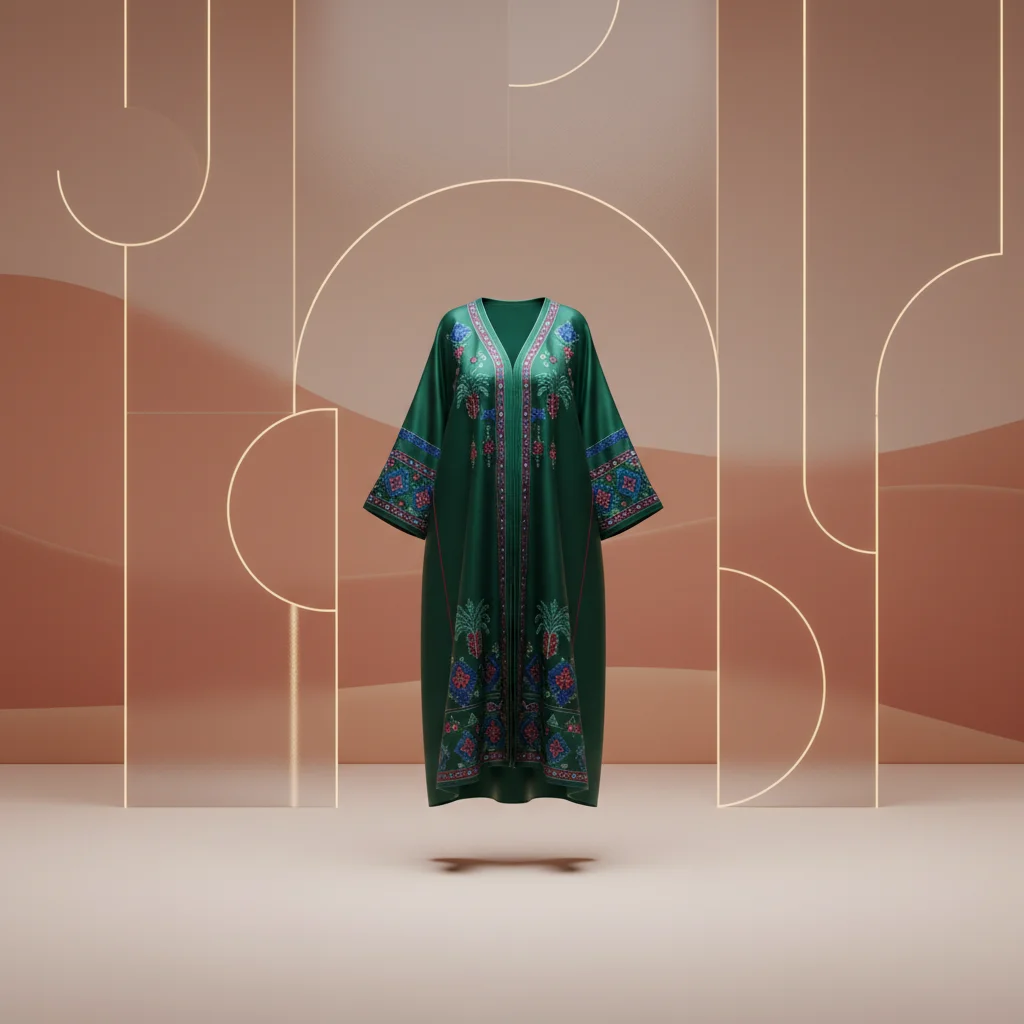
Local ateliers and artisans derive a measurable benefit from editorial validation. When an embroidered abaya from a Doha-based workshop appears in an editorial feature, the demand signal travels backward through the supply chain: raw material suppliers, embroiderers, pattern makers, and finishing specialists all receive indirect confirmation that their output aligns with curatorially validated luxury standards. Over time, this feedback loop incentivizes production toward craft intensity, material quality, and slow manufacturing cycles.
Conversely, the absence of algorithmic discounting and flash-sale mechanics removes the pressure for local producers to race toward cost-minimization. The editorial model supports a structural decoupling from mass-market import dependency. Currently, a significant portion of Gulf luxury consumption imports finished goods from European and Asian manufacturing hubs. An editorial ecosystem that consistently elevates regionally produced garments gradually reorients both consumer expectation and producer capability. The long-term consequence is a self-sustaining ecosystem of designers, photographers, stylists, editors, and media professionals whose commercial viability depends on regional specificity rather than global emulation.
A New Archetype: The Curatorial Middleman
The digital luxury landscape has produced two dominant archetypes: the aggregator (platforms that maximize SKU count and volume) and the marketplace (platforms that facilitate direct buyer-seller transactions). Gulf Luxury represents a third archetype: the curatorial middleman.
Unlike aggregators, the curatorial middleman deliberately constrains its inventory of content. Unlike marketplaces, it explicitly refuses to broker commercial exchange. Instead, the platform monetizes its editorial authority through indirect channels: brand partnerships, sponsored editorial series, creative direction credits, and media syndication rights. The curatorial middleman does not sell clothes; it sells proximity to taste.
This model is structurally more defensible than either aggregation or marketplace models in the Gulf luxury context. Aggregators face margin compression and brand resistance as luxury labels increasingly enforce selective distribution. Marketplaces face authenticity liabilities and logistical complexity in a region with fragmented customs regimes. The curatorial middleman faces neither: it holds no inventory, processes no payments, and bears no counterfeit risk. Its asset is exclusively reputational—a stock of trust built through consistent editorial judgment.
Supply vs. Demand: The Dual Market Correction
To understand the strategic position of Gulf Luxury, one must disaggregate the fashion market into its supply-side and demand-side dynamics. On the demand side, Gulf consumers exhibit high disposable income, high digital engagement, and high brand awareness—but also high vulnerability to status-signaling fatigue. The algorithmic flood of sponsored content and influencer promotions has devalued the credibility of organic recommendations. Editorial curation counters this devaluation by reintroducing a scarcity of attention. A feature on Gulf Luxury signals to the consumer that a specific piece or designer has passed through an editorial gate—which in the region's luxury consumer psychology holds more weight than an influencer's sponsored post.
On the supply side, brands and designers face a saturated marketing landscape where paid reach is increasingly expensive and increasingly mistrusted. Editorial collaboration offers a higher-value signal precisely because it cannot be bought in the traditional media-buying sense. The platform's willingness to feature a designer signals external validation that the brand cannot manufacture internally.
This dual correction—reducing demand-side noise and increasing supply-side signal fidelity—is the core operational function. The platform is not competing with e-commerce sites. It is competing with perception management itself.
Conclusion: Predicting the Trajectory of Editorial Luxury Platforms
The editorial luxury platform model in the Gulf is unlikely to scale toward commerce. The structural incentives that make the pure-editorial approach viable—prestige filtering, supply chain signaling, trust monetization—would be compromised by the introduction of a transactional layer. Market logic suggests three probable outcomes.
First, Gulf Luxury and analogous platforms will deepen their editorial specialization, moving toward vertical niches such as bridal couture, artisanal footwear, or sustainable Gulf fashion. Specialization increases curatorial authority and decreases substitutability. Second, the platform will develop monetization models tied to brand consulting, creative direction, and talent development—functions that sit upstream of commerce rather than within it. Third, the success of this model in the Gulf may attract replicators in other high-luxury, high-identity markets such as Southeast Asia, the Indian subcontinent, and the Middle East's broader Levantine sphere.
The ultimate commercial test for Gulf Luxury is not whether it generates direct revenue from content placement; it is whether brands perceive inclusion on the platform as a measurable enhancement to their regional brand equity. If editorial curation can demonstrate a quantifiable impact on downstream retail performance—without ever facilitating the transaction itself—the curatorial middleman archetype will be validated as a permanent structural layer in the luxury fashion media ecosystem, not a temporary digital experiment.
Keywords

Ahmed Al-Farsi
Luxury & Lifestyle Editor with expertise in high-end hospitality and retail.