Beyond the Glitz: How Homegrown Brands Are Redefining Gulf Luxury from the Inside Out
A new Vogue Arabia report reveals a structural shift in Gulf luxury: homegrown brands are gaining ground over international houses, driven by cultural authenticity, geopolitical consciousness, and institutional retail support. This article goes beyond the surface trend to explore the hidden economic logic—how mall operators, pop-up platforms, and strategic partnerships are building an independent luxury ecosystem. Through exclusive quotes from designers Bazza Alzouman, Reema Al Banna, and influencer Karen Wazen, we uncover why global brands feel ‘superficial’ and how local designers are turning identity into competitive advantage. The trend mirrors earlier shifts in India and China, suggesting a long-term reconfiguration of Gulf retail and luxury supply chains.
Ahmed Al-Farsi
Editorial Analyst
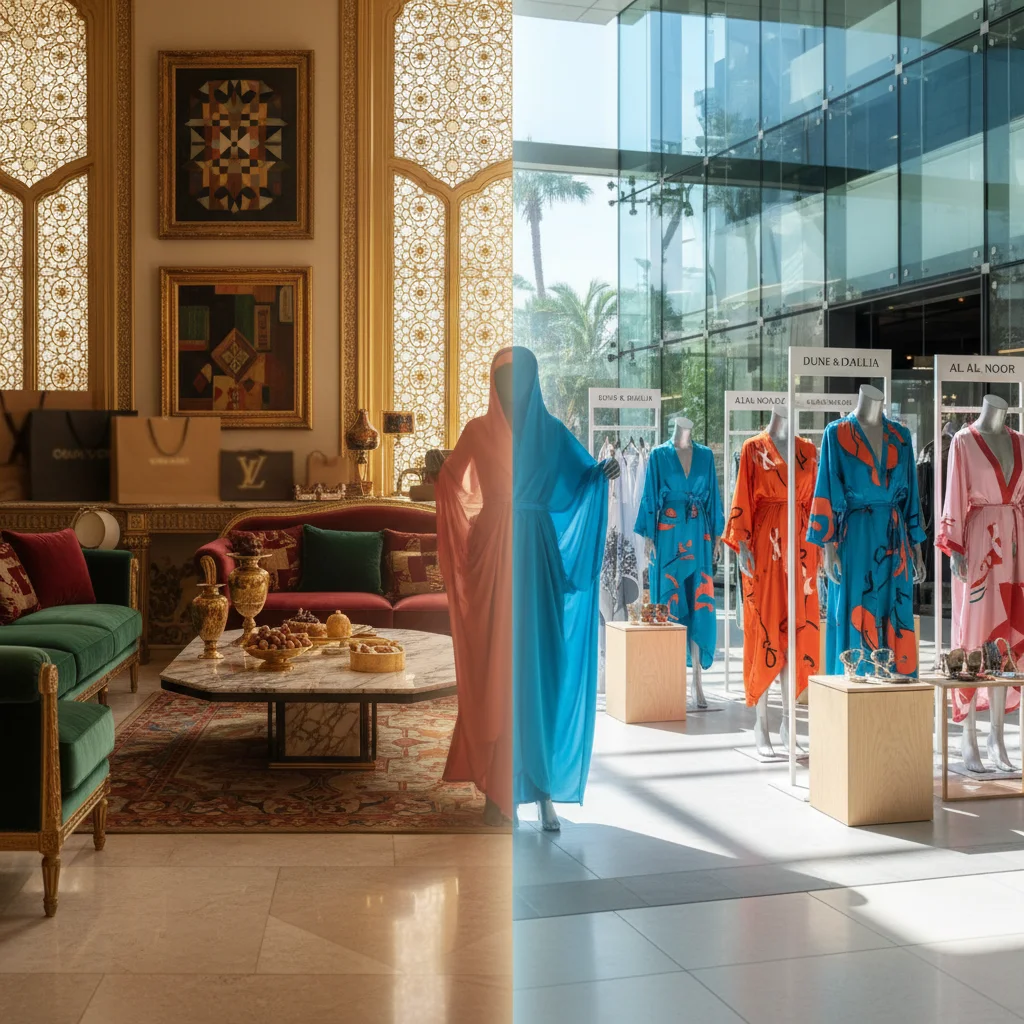
From Margin to Mainstream: How Homegrown Brands Are Redefining the Gulf Luxury Landscape
Introduction: The Quiet Revolution Beneath the Glitter
As the window displays of Gucci and Louis Vuitton in the Dubai Mall remain dazzling, a deeper transformation is quietly unfolding in the Gulf's luxury market. A recent in-depth report by Vogue Arabia (May 2026) reveals that homegrown designer brands are no longer mere点缀 in the retail landscape — they are becoming strategic pillars of the Gulf's luxury industry. This shift is not driven by fleeting consumer whims but by a structural transformation fueled by cultural identity, retail infrastructure upgrades, and evolving consumer consciousness.
[IMAGE: A panoramic photo: against a golden sunset backdrop of the Dubai city skyline, a designer adjusts a garment on a model wearing a gown that blends traditional embroidery with modern tailoring. In the background, the glass facades of a shopping mall reflect city lights. The overall atmosphere merges tradition with modernity, luxury with authenticity.]
The "Surface Feeling" of Global Brands: How Homegrown Brands Fill an Emotional Void
Luxury consumers in the Gulf are undergoing a subtle psychological shift. For many affluent consumers long accustomed to international luxury brands, the meticulously crafted advertising campaigns and seasonal collections are beginning to feel "superficial." Kuwaiti designer Bazza Alzouman stated bluntly that special collections launched by international brands for Ramadan or Eid al-Fitr "feel quite superficial" — they attempt to capture the festive atmosphere but struggle to reach deeper cultural and emotional cores.
This "surface feeling" does not stem from product quality. International luxury brands have generally increased their investment in the Gulf in the post-pandemic era, with significant growth in both boutique size and marketing budgets. Yet the problem lies in a lack of cultural resonance — when consumers seek not just a luxury label but a narrative that reflects their identity, traditions, and lifestyle, the standardized strategies of global brands begin to feel inadequate.
Homegrown brands are precisely filling this emotional vacuum. From Saudi Arabia to Kuwait to the UAE, a growing number of consumers are actively seeking brands that can tell their own stories. These brands' design languages are rooted in local culture — traditional embroidery patterns, Arabic calligraphy elements, desert tones combined with urban architectural silhouettes — yet presented through modern design techniques and international aesthetic standards, fulfilling identity needs without compromising luxury quality standards.
A key indicator of this shift is the awakening of consumer consciousness. The younger generation of Gulf consumers — who form the backbone of luxury spending in the region — are no longer satisfied with simple decisions about "what to wear," but are asking "why buy." They want to know who founded the brand, the story behind the design, and the values the product represents. This shift in consumption logic allows homegrown brands to build a competitive advantage over international brands on the dimension of "cultural authenticity."
Cultural Roots: Drawing Design Power from Heritage
For many Gulf-based homegrown designers, their work is not merely fashion expression but a practice of cultural preservation. UAE-based Palestinian designer Reema Al Banna's work exemplifies this. Her designs are deeply rooted in traditional Palestinian handicrafts and embroidery techniques, yet through modern tailoring and fabric choices, she creates visual effects that are both traditional and avant-garde.
"Every piece I design carries a story," Reema Al Banna said in an interview. "Traditional embroidery is not just decoration; it is a language that records identity and belonging. When I incorporate these elements into contemporary designs, I am finding new ways to express this language."
This ability to transform cultural elements into a design language is the core advantage that distinguishes homegrown brands from international competitors. International brands typically adopt two strategies for "localization": launching limited-edition collections featuring local cultural symbols, or collaborating with local KOLs on marketing campaigns. Yet these practices often remain superficial, lacking deep understanding and respect for the culture. In contrast, homegrown designers have a natural connection to their cultural heritage — culture is not an element they "adopt" but the backdrop of their lives.
Notably, this culture-driven design strategy does not排斥 the international market. On the contrary, some Gulf homegrown brands are attracting international buyers from London, Paris, and New York. International fashion buyers are increasingly interested in Middle Eastern design, seeing these brands as offering a unique aesthetic language — both familiar and foreign, both ancient and modern. This "cultural premium" is becoming a passport for homegrown brands to go global.
The Institutional Engine: Strategic Leap from Pop-Ups to Shopping Malls
The rise of homegrown brands is not driven solely by consumer preferences; institutional support is the key to sustaining this trend. Retail operators in the Gulf are building a complete homegrown brand ecosystem, encompassing everything from supply chain support to retail space and marketing promotion, creating a closed loop.
Majid Al Futtaim Group's "Ma'an" platform in collaboration with the Dubai SME development agency is a typical example. This platform does not merely offer pop-up opportunities to homegrown brands but deeply integrates them into core retail spaces like the Mall of the Emirates and VOX Cinemas. For emerging designers, this means access to a curated, high-end retail channel, not just temporary sales space. The "Ma'an" platform also provides training, logistics, and marketing support to help homegrown brands meet international operational standards.
Another notable case is The Edit Dubai, which curated original brand pop-ups at City Walk showcasing the work of six Emirati designers. This "curated retail" model differs from the traditional department store model — it is more like a carefully orchestrated brand narrative, allowing consumers to experience the diverse faces of Gulf design in a single space. The Giving Movement's "The Movement Edit" similarly embodies this concept, combining sustainable fashion with homegrown design to create a consumption space that embodies both social responsibility and cultural identity.
Influencer Karen Wazen's case illustrates another possibility. The Lebanese blogger, with millions of Instagram followers, is transitioning from content creator to physical retail participant. Her pop-up events at beach clubs sparked buying frenzies, and her planned first physical store at the Dubai Mall marks a leap for homegrown brands from digital-native to physical retail. For other homegrown designers, Karen Wazen's path offers an important insight: the combination of personal brand and product brand can create powerful market appeal.
Reshaping the Retail Landscape: A Long-Term Shift in the Gulf's Luxury Supply Chain
From a broader perspective, the rise of homegrown brands is reshaping the Gulf's luxury supply chain. Traditionally, the Gulf luxury market was heavily import-dependent — international brands dominated, supply chains extended from Europe to the Middle East, and local designers survived only in niche circles. But this landscape is changing.
Retail operators are actively seeking and cultivating homegrown designer resources. Mall brand mix strategies are shifting from "international-first" to "international and homegrown in balance." Some emerging mall projects are even setting aside dedicated areas for homegrown design brands, viewing them as core differentiators. This trend is particularly evident in Saudi Arabia, where the "Vision 2030" plan explicitly supports the development of the local fashion industry, providing policy tailwinds for homegrown brands.
The investment community is also paying attention to this sector. Several retail funds and incubator programs focused on Gulf homegrown brands have been launched, offering not only financial support but also business mentoring, supply chain connections, and international market expansion resources. The emergence of this institutional support means homegrown brands can now rely on systematic business backing rather than solely on founders' personal resources and creative inspiration.
The implications of this shift are profound. As homegrown brands secure more stable positions in retail spaces, they begin to create a "siphon effect" on the supply chain — more material suppliers, processing factories, and craft studios are focusing on serving homegrown design brands, forming a virtuous industrial ecosystem. The establishment of this ecosystem means homegrown brands no longer need to outsource production to Europe or Asia but can complete the entire design-to-production process locally.
The Commercialization of Cultural Identity: From Marketing Slogan to Competitive Moat
Beyond the commercial aspects, the rise of homegrown brands signals a deeper socio-cultural shift. Gulf consumers are redefining the meaning of "luxury" — from "what is the most expensive?" to "what is the most meaningful?"
This shift is especially evident among younger consumers. Gen Z and Millennial Gulf consumers grew up in the era of globalization, are intimately familiar with international brands, yet are also rediscovering the value of their own culture. For them, buying a homegrown design brand is not merely a consumption act but a statement of identity. This psychological need allows homegrown brands to build competitive moats that transcend price and brand recognition — cultural identity.
For international luxury brands, this trend presents both challenges and opportunities. The challenge lies in needing to understand and respond to local consumers' cultural needs more deeply, rather than relying solely on globally uniform marketing strategies. The opportunity lies in the Gulf luxury market still growing rapidly, and the relationship between homegrown and international brands is not zero-sum — they can create richer choices for consumers through collaboration.
Looking Ahead: From Trend to Norm
Looking back at the development trajectories of India and China, a similar path emerges: when local consumer brands reach a certain scale and quality, consumers shift from "admiring foreign brands" to "confident in local brands," and local brands gradually move from margin to mainstream. The Gulf's luxury market is undergoing the same turning point.
In the next five years, more Gulf homegrown brands are expected to move from regional markets to the global stage. Their development models will become more diverse — some may choose to collaborate with international brands on co-branded collections, while others may insist on independent development, expanding global customer bases through pop-ups and e-commerce. Meanwhile, Gulf retail infrastructure will continue to upgrade, providing more robust support systems for homegrown brands.
For consumers, this means they will have a more diverse range of luxury choices. It is no longer a simple "buy or not buy" decision, but "which one to buy" — international or homegrown, traditional luxury or cultural luxury. This increase in choice itself is a marker of the Gulf luxury market's maturation.
As the Vogue Arabia report reveals, "support local" is no longer just a marketing slogan — it is becoming the core logic by which Gulf consumers redefine luxury. The convergence of cultural authenticity, emotional resonance, and institutional support is transforming the region from a mere luxury consumption market into a vibrant creative ecosystem. In this ecosystem, homegrown brands are no longer supporting actors to international giants but are writing their own stories.
[IMAGE: A full landscape photo: against a golden sunset backdrop of the Dubai city skyline, a designer adjusts a garment on a model wearing a gown that blends traditional embroidery with modern tailoring. In the background, the glass facades of a shopping mall reflect city lights. The overall atmosphere merges tradition with modernity, luxury with authenticity.]
Keywords

Ahmed Al-Farsi
Luxury & Lifestyle Editor with expertise in high-end hospitality and retail.