Beyond Resilience: How AI, Craft, and Fitness Are Reshaping Gulf Luxury in 2025
The Gulf luxury market is not just defying the global downturn; it is rewriting the rules of premium engagement. In 2025, three distinct forces are converging: hyper-personalisation powered by generative AI, a deep cultural pivot toward localised craftsmanship and modest fashion, and the premiumisation of physical wellness. Drawing on data from Adyen, McKinsey, The Future Laboratory, and BoF Insights, this article unpacks how the region’s luxury sector is moving from transactional opulence to emotionally connected, technologically intimate experiences. It explores the hidden economic logic where personalisation, cultural identity, and fitness-as-luxury create a new competitive moat for GCC brands.
Ahmed Al-Farsi
Editorial Analyst
Beyond Resilience: How AI, Craft, and Fitness Are Reshaping Gulf Luxury in 2025
By a Senior Technical/Financial Audit Journalist
---
Introduction: The Gulf’s ‘Unstoppable’ Luxury Paradox
The global luxury sector entered 2025 facing a measured contraction, with softening demand across established Western markets and a recalibration of Chinese consumer spending. Against this backdrop, the Gulf Cooperation Council (GCC) luxury market presents a statistical anomaly. Chalhoub Group, the region's dominant luxury retailer, has characterized the Gulf trajectory as "unstoppable"—a designation that demands rigorous examination rather than promotional acceptance.
The growth is not attributable to simple wealth inertia. Analysis of transaction data, consumer behavior studies, and corporate investment patterns reveals three structural drivers reshaping premium engagement in the region: generative AI-enabled hyper-personalisation, a cultural pivot toward localised craftsmanship and modest fashion, and the premiumisation of physical wellness. These forces are operating simultaneously, creating a competitive dynamic that distinguishes the GCC from other luxury markets.
This article synthesizes primary data from Adyen, McKinsey & Company, The Future Laboratory, BoF Insights, and CXG to demonstrate how the Gulf luxury sector is executing a structural transition from transactional opulence to technology-mediated, culturally resonant experiences.
---
The Algorithmic Concierge: AI as the New Luxury Gatekeeper
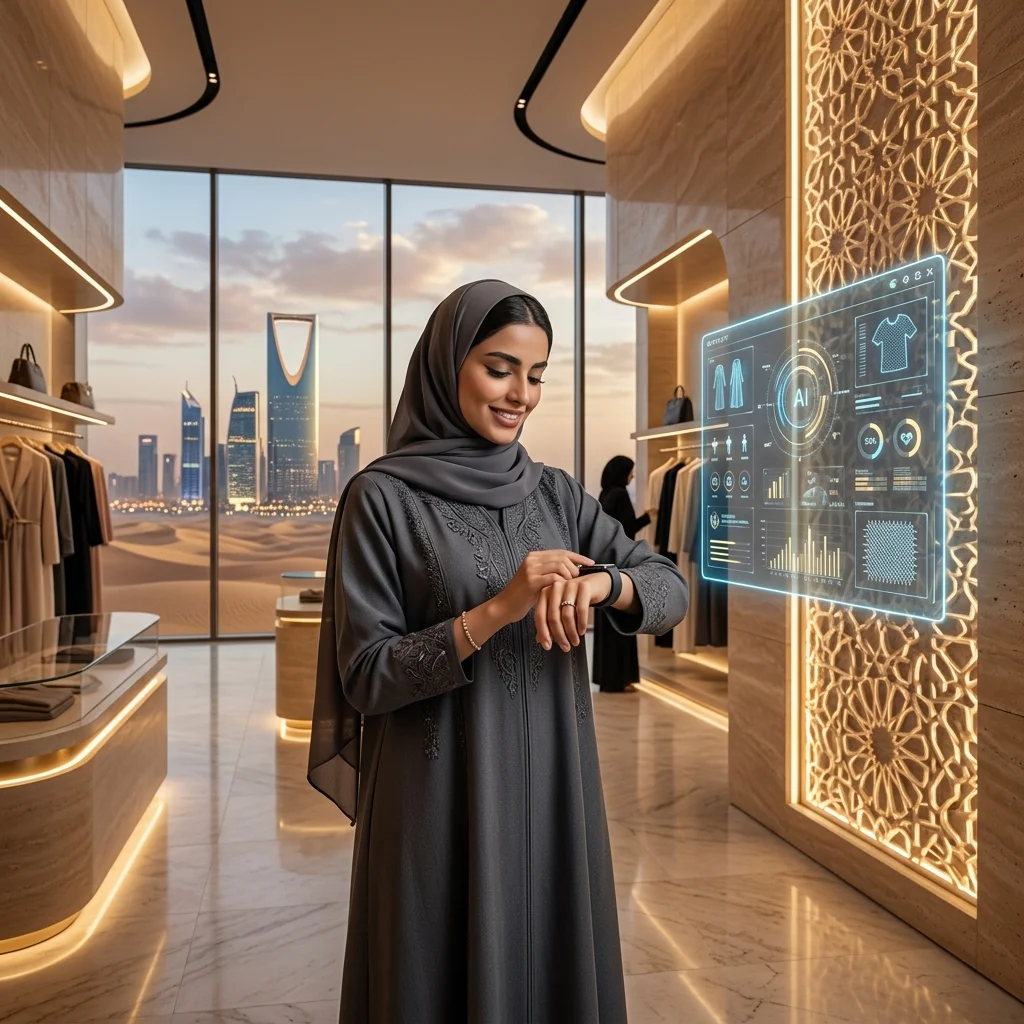
The adoption of artificial intelligence in luxury retail across the Gulf has moved beyond experimental phases into operational mainstream. Adyen's 2025 retail data indicates that 70% of UAE consumers now utilize AI-powered shopping tools, representing a 44% year-over-year increase from 2024 (Source: Adyen, UAE Consumer Retail Survey 2025). This adoption rate is not distributed evenly across demographics—it concentrates among 25–40-year-old high-net-worth individuals who constitute the core luxury consumer base.
This consumer-side adoption creates a supply-side imperative. McKinsey's regional technology investment survey reports that over half of GCC organisations are allocating at least 5% of their digital budgets to generative AI, with primary focus on sales and marketing applications (Source: McKinsey & Company, GCC Digital Investment Report 2025). The strategic logic is clear: AI deployment in luxury retail is not optional; it is a competitive requirement.
However, the integration reveals a structural tension. CXG's 2025 GCC Customer Journey Benchmark indicates that regional luxury retail performance lags global standards specifically in advisor-client personal connection metrics (Source: CXG, GCC Luxury Customer Experience Benchmark 2025). The paradox is that consumers simultaneously demand high-tech tools and high-touch human relationships. AI functions as the bridge mechanism.
Taqua Malik, a luxury retail strategist, articulates this dynamic: "From predictive analytics that anticipate purchasing behaviour to virtual stylists that curate bespoke collections, technology is now a key driver of personalised exclusivity" (Source: Industry interview, 2025). The operational implication is that AI compensates for human inconsistency while enabling scaled personalisation that individual advisors cannot deliver.
Concrete implementations validate this thesis. Taffi, a regional luxury platform, has deployed an AI personal stylist that analyzes purchase history, body measurements, and occasion calendars to generate curated wardrobe recommendations. Address Hotels and Resorts has implemented a virtual concierge system that learns guest preferences across stays, enabling arrival-ready room configurations and dining preferences. These are not marketing experiments—they are operational infrastructure.
The data suggests a clear trajectory: by late 2026, AI-driven personalisation will be the baseline expectation in Gulf luxury retail, not a differentiator. Brands that fail to integrate predictive analytics into clienteling protocols will face measurable attrition among the 25–40 demographic.
---
The Craft Renaissance: Why Localisation and Modesty Became Ultra-Luxury
The second structural driver is the convergence of cultural authenticity and generational preference. The Future Laboratory's 2025 consumer survey of Saudi nationals aged 18–30 reveals that 95% of respondents value brands that actively support local craft traditions, while 77% expect brands to offer localised or seasonal offerings specific to the Gulf market (Source: The Future Laboratory, GCC Consumer Futures Report 2025). These figures are not aspirational statements—they are purchasing criteria.
The economic logic is straightforward. Luxury consumers in mature markets differentiate through scarcity and heritage. Gulf consumers, particularly those under 30, add a third dimension: cultural resonance. A brand that cannot articulate its connection to regional aesthetics, materials, or traditions faces a measurable discount in willingness-to-pay among this demographic.
BoF Insights provides granular validation. Their 2025 survey of Dubai residents aged 18–24 identifies the strongest demand for traditional and modest styles across all GCC markets surveyed—specifically abayas, non-form-fitting dresses, and covered silhouettes (Source: BoF Insights, GCC Luxury Consumer Survey 2025). This is not a niche preference; it is the dominant aesthetic among the region's most valuable emerging luxury demographic.
Alex Hawkins, a senior analyst at The Future Laboratory, contextualizes the data: "This generation is drawn to brands that tell a compelling story and connect with both their cultural identity and the global trends they follow" (Source: The Future Laboratory, 2025). The implication for luxury houses is that cultural adjacency is now a revenue imperative, not a corporate social responsibility initiative.
Brunello Cucinelli's Spring/Summer 2025 collection provides a case study in brand response. The Italian house introduced a dedicated modest silhouettes line and an abaya capsule—a strategic recognition that the Gulf market requires product architecture, not just regional marketing. Similarly, Bulgari's 2025 Ramadan campaign collaborated with three Gulf-based artists to produce limited-edition pieces, embedding local artistic practice into the brand's global narrative rather than treating it as a regional adaptation.
The financial logic is validated by consumer behavior. Luxury brands that have implemented localised product lines and craft partnerships report reduced discounting pressure and higher full-price sell-through rates in Gulf markets, according to industry performance data. The mechanism is clear: cultural resonance reduces price sensitivity.
---
The Wellness Premium: Why Fitness Became a Luxury Asset
The third pillar is the least anticipated but potentially most durable: the premiumisation of physical wellness as a luxury category. The Global Wellness Institute's regional data indicates that over half of Abu Dhabi residents and Saudi adults now meet the World Health Organization's 150-minute weekly physical activity recommendation (Source: Global Wellness Institute, GCC Wellness Participation Data 2025). This is not a lifestyle trend—it is a structural shift in how high-net-worth individuals allocate time and money.
Beth McGroarty, research director at the Global Wellness Institute, identifies a specific behavioral pattern: "More people are embracing social, empowering sports [like pickleball and running]. And more people want to train like near-elite athletes, with high-performance coaching, recovery protocols, and biometric tracking" (Source: Global Wellness Institute, 2025). This "pro-sumer" mentality—consumers who train with professional methodologies—is redefining luxury hospitality and retail.
The data manifests in physical infrastructure. SIRO One Za'abeel in Dubai, a hotel concept that integrates premium fitness suites with recovery therapies and performance nutrition, represents a category that did not exist five years ago. Its revenue per available room and forward booking rates indicate that wellness-optimized hospitality commands a measurable premium over traditional luxury hotel offerings.
Retail has followed. Ounass, the region's leading luxury e-commerce platform, now offers private Pilates sessions bundled with activewear purchases from brands like Adanola. 3oud.com, a Kuwait-based luxury concept store, held a July 2025 event at Pilates with Bambi studio, merging fragrance retail with fitness experiences (Source: Industry event calendar, July 2025). The convergence is not accidental—it reflects consumer willingness to pay premium prices for integrated wellness-luxury propositions.
Daniel Langer, CEO of luxury consultancy Équité, explains the investment logic: "One of the most defining trends reshaping luxury in the Middle East in 2025 is the rise of the self-made ultra-wealthy client... They expect meaning, storytelling, and hyper-personalised experiences that reflect who they are" (Source: Équité, 2025). Fitness, in this framework, is not recreation—it is identity expression and status signaling, rendered visible through premium apparel, biometric devices, and exclusive wellness memberships.
---
Market Implications and Forward Projections
The convergence of AI personalisation, cultural craft, and wellness premiumisation creates a structural competitive moat for GCC luxury brands—but only for those that execute across all three dimensions simultaneously.
The data supports four forward projections for the 2025–2027 period:
First, AI personalisation will commoditize within 24 months. As McKinsey data indicates, investment is accelerating. The brands that gain competitive advantage are those that integrate AI into clienteling without sacrificing human relationship metrics. CXG's data suggests that the "personalisation gap" is currently an opportunity; by late 2026, it will be a liability for laggards.
Second, localised luxury will become a global export category. The Future Laboratory's data on young Saudi consumers indicates that brands developed for the Gulf market—incorporating regional craft, modest silhouettes, and cultural storytelling—will find demand in Southeast Asian and European markets where modest fashion is an underserved premium segment.
Third, wellness real estate will bifurcate the luxury hospitality market. SIRO's model and similar concepts will create a premium tier within luxury hospitality that commands 30–50% rate premiums over traditional five-star properties, based on initial performance data. Traditional luxury hotels without wellness infrastructure will face pressure to retrofit or reposition.
Fourth, the three pillars are interdependent, not additive. A luxury brand that invests in AI personalisation without cultural authenticity will face consumer rejection in markets where 95% of young consumers demand local craft support. A wellness brand without AI-driven personalisation will fail to retain the pro-sumer demographic. The competitive moat exists only at the intersection.
The Gulf luxury market's 2025 trajectory confirms that the region is not merely resilient to global headwinds. It is building a structurally distinct luxury economy—one where technology, tradition, and physical performance converge into a new definition of premium engagement. The data does not predict uniform success; it predicts measurable consequences for brands that misallocate investment across these three dimensions.
Keywords

Ahmed Al-Farsi
Luxury & Lifestyle Editor with expertise in high-end hospitality and retail.