Gulf Luxury Reimagined: How Millionaire Influx and Niche Segments Are Reshaping the $15 Billion Market
The GCC luxury market is not just growing; it''s transforming. With 9,800 new millionaires expected in the UAE and 2,400 in Saudi Arabia in 2025, and 97% of buyers planning to maintain or increase spending, the sector is projected to hit $15 billion by 2027. This article dives beyond headline numbers to reveal a hidden logic: the rise of ''micro-luxury'' segments—Gen Z beauty devotees, Saudi streetwear communities, Emirati HNWIs, and Gen X wellness fans—each with distinct spending patterns. We explore how international brands like Zegna and The Frankie Shop are entering the region, signaling a shift from traditional luxury goods to experiential and lifestyle-driven offerings. A deep industry audit of consumer segmentation, wealth creation, and retail evolution.
Ahmed Al-Farsi
Editorial Analyst
Gulf Luxury Reimagined: How Millionaire Influx and Niche Segments Are Reshaping the $15 Billion Market
The Gulf Cooperation Council (GCC) luxury market is entering a new phase. While headline figures—$12.8 billion in 2024 retail sales, projected to hit $15 billion by 2027—suggest steady growth, the real story lies beneath the surface. A wave of millionaire migration, combined with the rise of distinct micro-segments, is fundamentally altering how luxury brands operate in the region. From Gen Z beauty devotees spending $63 monthly on makeup to Emirati high-net-worth individuals (HNWIs) averaging $58,000 annually in Dubai, the market is no longer a monolithic block of traditional luxury consumers. This article dissects the hidden logic driving the transformation, drawing on fresh data and on-the-ground brand moves to reveal a market that is both fragmenting and maturing.
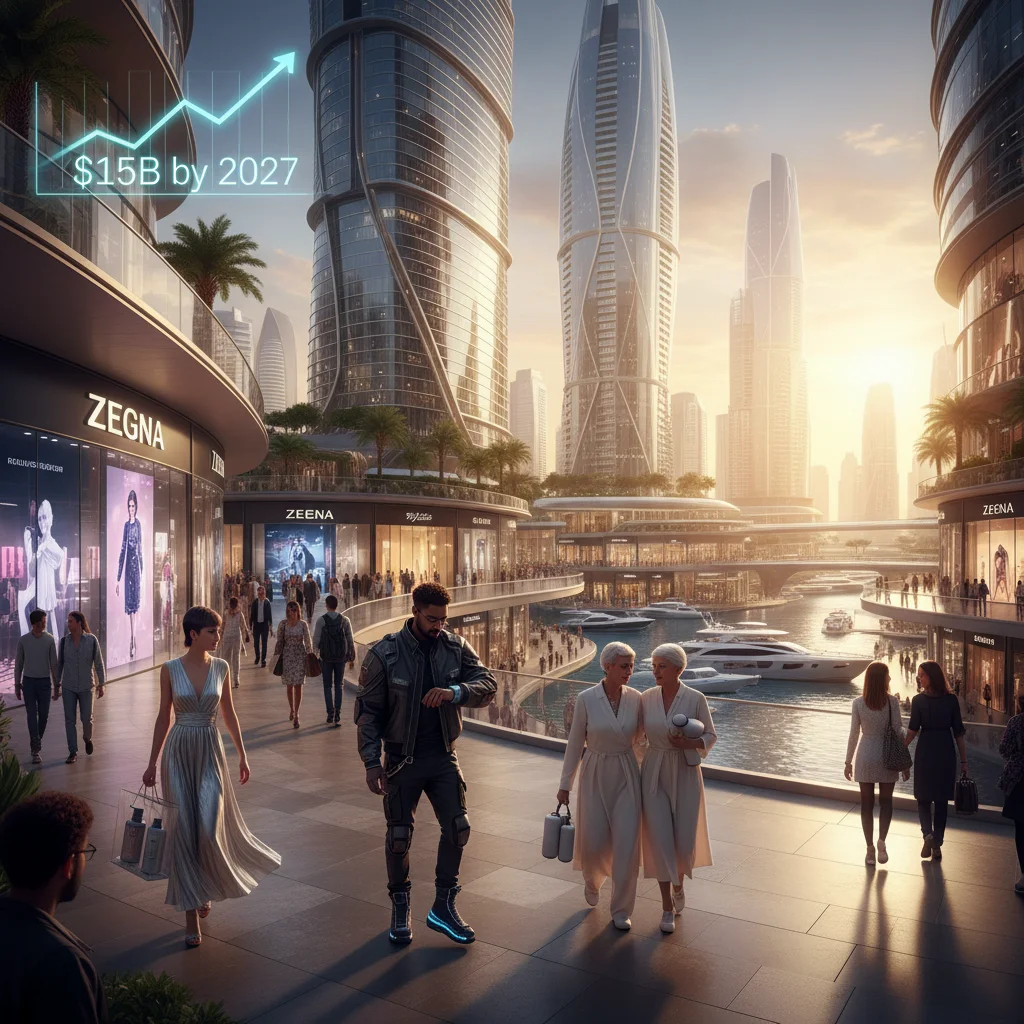
[IMAGE: A futuristic panoramic view of a luxury shopping district in Dubai at golden hour, with diverse well-dressed shoppers (young woman with skincare, man in streetwear, older couple in wellness attire) walking past boutiques like Zegna and The Frankie Shop. Background shows yachts and skyscrapers with a subtle data overlay showing an upward graph and "$15B by 2027". No text. Photorealistic, vibrant colors.]
---
The New Gold Rush: Millionaire Migration and Spending Confidence
GCC personal luxury sales grew by 6% in 2024, with the UAE and Saudi Arabia accounting for the lion’s share of that expansion. According to data from the World Luxury Chamber of Commerce, retail sales in the region are forecast to climb from $12.8 billion to $15 billion by 2027, a compound annual growth rate of roughly 4.5%. Two forces are driving this trajectory: an accelerating influx of high-net-worth individuals and remarkably resilient consumer spending confidence.
The UAE alone is expected to gain 9,800 new millionaires in 2025, while Saudi Arabia will add another 2,400, according to wealth migration reports cited in the timeline. These are not passive investors; they are active luxury consumers who arrive with established tastes and a willingness to spend. The effect is magnified by a broader trend: 97% of GCC luxury buyers plan to maintain or increase their spending in early 2025, per a Jing Daily survey of regional affluent shoppers. This confidence persists despite global economic headwinds, inflation concerns, and geopolitical instability, underscoring the GCC’s unique position as a safe-haven market for both wealth and consumption.
[IMAGE: Infographic showing the UAE and Saudi Arabia millionaire growth numbers for 2025 (9,800 and 2,400) alongside a line graph projecting GCC luxury retail sales from $12.8B (2024) to $15B (2027). Label sources: World Luxury Chamber of Commerce, Jing Daily.]
The practical implication for luxury brands is clear: the GCC is not a secondary market to be served with leftovers from Europe or Asia. It is a primary growth engine where first-mover advantage—and deep understanding of local sub-segments—can yield outsized returns. The millionaire migration is not evenly distributed, however. Dubai continues to attract global wealth, while Riyadh and Jeddah are seeing a surge in domestically generated high-net-worth individuals, creating two distinct spending ecosystems.
---
Decoding the Segments: From Gen Z Beauty to Emirati HNWIs
The most important shift in the Gulf luxury landscape is the fragmentation of the consumer base. Where once luxury brands could rely on a homogeneous group of wealthy, middle-aged shoppers interested in watches, handbags, and jewelry, today’s market is a mosaic of niches, each with its own spending patterns, media habits, and emotional triggers.
Gen Z Beauty Enthusiasts (Women, Ages 13–28)
This cohort is the fastest-growing luxury sub-segment in the GCC. Young women in this age bracket spend an average of $52 per month on skincare and $63 on makeup, according to a 2024 regional consumer panel. While these numbers may seem modest compared to HNWI spending, the demographic is vast and passionate. They are digital natives who discover products through TikTok and Instagram, and they prioritize ingredient transparency, clean beauty, and brand storytelling. Traditional luxury houses that once dismissed this segment as “entry-level” are now launching dedicated skincare lines (e.g., La Mer’s targeted serums, Dior’s Capture Totale for younger skin) and partnering with Gulf-based influencers to capture mindshare early. The beauty niche is also driving foot traffic to physical retail, with pop-up activations and in-store diagnostic tools proving highly effective.
[IMAGE: A young woman in a Dubai mall, holding a luxury skincare product and looking at her phone. Modern store interior with digital mirrors. Style: vibrant, aspirational, but not overtly commercial.]
Saudi Streetwear Community
The notion that Gulf luxury equals formal, opulent dressing is outdated. A vibrant streetwear culture has emerged, particularly in Saudi Arabia, fueled by mega-events like Soundstorm (the Riyadh music festival) and the kingdom’s push for entertainment and youth culture. Luxury brands are taking note: Zegna held its first-ever show outside Italy in Dubai in 2024, debuting a collection that blended tailoring with streetwear influences. The Frankie Shop, a Paris-based label known for its oversized, minimalist streetwear, opened its first Middle East outpost in Abu Dhabi in early 2025. For this segment, luxury is defined by exclusivity, limited drops, and cultural relevance rather than traditional status symbols. The Saudi streetwear consumer is young (18–35), male-skewing but increasingly female, and willing to pay premium prices for pieces that signal membership in a global, fashion-forward tribe.
[IMAGE: Collage of four distinct consumer types: (1) Gen Z woman with skincare products, (2) streetwear-clad youth in front of a concert stage, (3) Emirati couple at a watch boutique, (4) Gen X duo at a wellness retreat. Crisp, portrait-style photography.]
Emirati HNWIs: Dubai vs. Riyadh
The spending gap between Emirati HNWIs in Dubai and those in Riyadh is revealing. Average annual luxury expenditure for an Emirati HNWI in Dubai is approximately $58,000, compared to $24,000 in Riyadh, according to luxury wealth management estimates. This disparity is not about wealth levels but about consumption patterns. Dubai-based HNWIs prioritize experiential luxury: fine dining, exclusive events, luxury travel, and high-end wellness retreats. Riyadh-based HNWIs, on the other hand, allocate a larger share of spending to tangible goods: watches, jewelry, and leather goods. The difference reflects both the maturity of Dubai’s luxury ecosystem (more options for experiences) and the conservative spending culture in Saudi Arabia, where conspicuous consumption is slowly evolving but still more cautious. For brands, this means tailoring offerings: in Dubai, invest in private dining experiences and VIP events; in Riyadh, focus on product curation and personalized service in-store.
Gen X Wellness Devotees
An emerging but underreported segment is the Gen X wellness enthusiast—typically aged 40–60, affluent, and prioritizing health-focused luxury. This group spends on organic skincare, high-end fitness memberships (e.g., reformer Pilates studios in Dubai Marina), luxury spa retreats (such as Six Senses in Saudi Arabia’s AlUla), and biohacking technologies. They are less interested in logo-heavy fashion and more in experiences that promise longevity, vitality, and mental clarity. Brands like Aesop, Tata Harper, and Equinox have expanded aggressively in the Gulf to capture this segment. The wellness trend intersects with the broader “quiet luxury” movement, where quality and provenance matter more than visible branding.
---
Brands Adapting to the New Landscape: Zegna, The Frankie Shop, and Beyond
As the consumer base becomes more diverse, brands are rethinking their go-to-market strategies. Traditional luxury categories—watches, jewelry, and leather goods—still dominate the GCC market, accounting for roughly 60% of total luxury sales. But the growth momentum is shifting toward experiential and niche offerings.
Zegna’s Dubai Show: A Statement of Intent
Zegna’s decision to host its first-ever show outside Italy in Dubai was not a one-off marketing stunt. It signaled a strategic pivot: the brand recognized that the Gulf audience, especially in the UAE, craves exclusivity and immersion. The event, held in a custom-built venue near the Dubai Creek, drew a mix of local royals, international celebrities, and regional fashion editors. The collection itself—a fusion of cashmere tailoring and streetwear silhouettes—was designed to appeal to both the Saudi streetwear community and the Emirati HNWI who values craftsmanship. Zegna’s move is being watched closely by other heritage European houses, many of which are now considering similar “regional firsts” in the Gulf.
The Frankie Shop in Abu Dhabi
The Frankie Shop’s entry into Abu Dhabi is another bellwether. Known for its minimalist, oversized blazers and utilitarian trousers, the brand occupies the “affordable luxury” space—price points that attract both young professionals and aspirational consumers. By choosing Abu Dhabi (not Dubai), the brand signaled confidence in the UAE capital’s growing retail ecosystem, which is less saturated and more oriented toward lifestyle concepts. The store itself is designed as a community space, hosting local artists and musicians, reflecting a shift from transaction-based retail to experience-based engagement.
The Physical Store Endures
Despite the rise of e-commerce, physical stores remain the primary channel for luxury in the Gulf, particularly for HNWIs. According to GCC retail data, over 70% of luxury purchases above $5,000 are still made in physical boutiques. Trust, personal relationships, and the ability to touch and feel products are non-negotiable for high-end consumers. However, direct-to-consumer digital channels are growing rapidly, especially among Gen Z and millennial segments. Brands are adopting an omnichannel strategy: offering virtual appointments, in-store personalization tools, and seamless click-and-collect services. The Frankie Shop, for instance, uses its Abu Dhabi store as a backdrop for TikTok content, blurring the line between physical and digital.
[IMAGE: Interior of Zegna's Dubai show venue, with guests seated in a futuristic setting. Alternatively, a shot of The Frankie Shop's Abu Dhabi storefront with minimalist design and streetwear mannequins.]
The Challenge for Traditional Luxury
Not all brands are adapting equally. The biggest risk is for those that treat the Gulf as a single, homogeneous market. A watch brand that markets the same collection to a 25-year-old Saudi streetwear enthusiast and a 55-year-old Emirati business magnate will miss both. Segmentation requires localised marketing, distinct product assortments, and even different store formats. Some heritage houses have started to introduce capsule collections for the Gulf—such as limited-edition Ramadan specials or gold-accented timepieces—but the approach remains inconsistent.
---
Conclusion: A Market of Niches, Not a Block
The GCC luxury market is entering a period of unprecedented complexity. The influx of 12,200 new millionaires in 2025 alone, combined with 97% spending confidence, ensures the overall pie will continue to grow. But the way that pie is sliced is changing. Gen Z beauty lovers, Saudi streetwear communities, Emirati HNWIs with distinct city-level preferences, and Gen X wellness devotees each demand different products, experiences, and marketing tones.
For brands, the winners will be those that embrace granularity. This means investing in local data analytics, building community-driven stores (like The Frankie Shop), staging exclusive events (like Zegna’s Dubai show), and developing products that speak to specific micro-segments rather than a broad “luxury consumer.”
The $15 billion figure by 2027 is not just a number—it’s a challenge. To capture it, luxury players must reimagine the Gulf not as a market of millionaires, but as a market of million individuals with distinct tastes. Those who do will find the region is not just growing; it is leading the global luxury industry into a new, more nuanced era.
Keywords

Ahmed Al-Farsi
Luxury & Lifestyle Editor with expertise in high-end hospitality and retail.