Beyond the Mall: The New Gulf Luxury Retail Paradigm – From Repatriation to Immersive Experiences
The Gulf luxury retail market is at a tipping point. While the region is valued at $5.2 billion and growing, a critical economic leakage exists: 70% of Saudi luxury spending occurs abroad. This article explores the deep structural shift underway as Saudi Arabia and the UAE seek to repatriate this spending through a dual strategy of monumental physical retail architecture (Solitaire Mall, The Avenues Riyadh) and a radical pivot toward hyper-personalized, technology-driven immersive in-store experiences. We analyze how this not only captures local demand but sets a new global standard for luxury retail, moving from a passive import market to an active creator of lifestyle ecosystems. The underlying logic is a supply chain inversion: the Gulf is no longer just a consumption destination but a production and experience design hub.
Ahmed Al-Farsi
Editorial Analyst
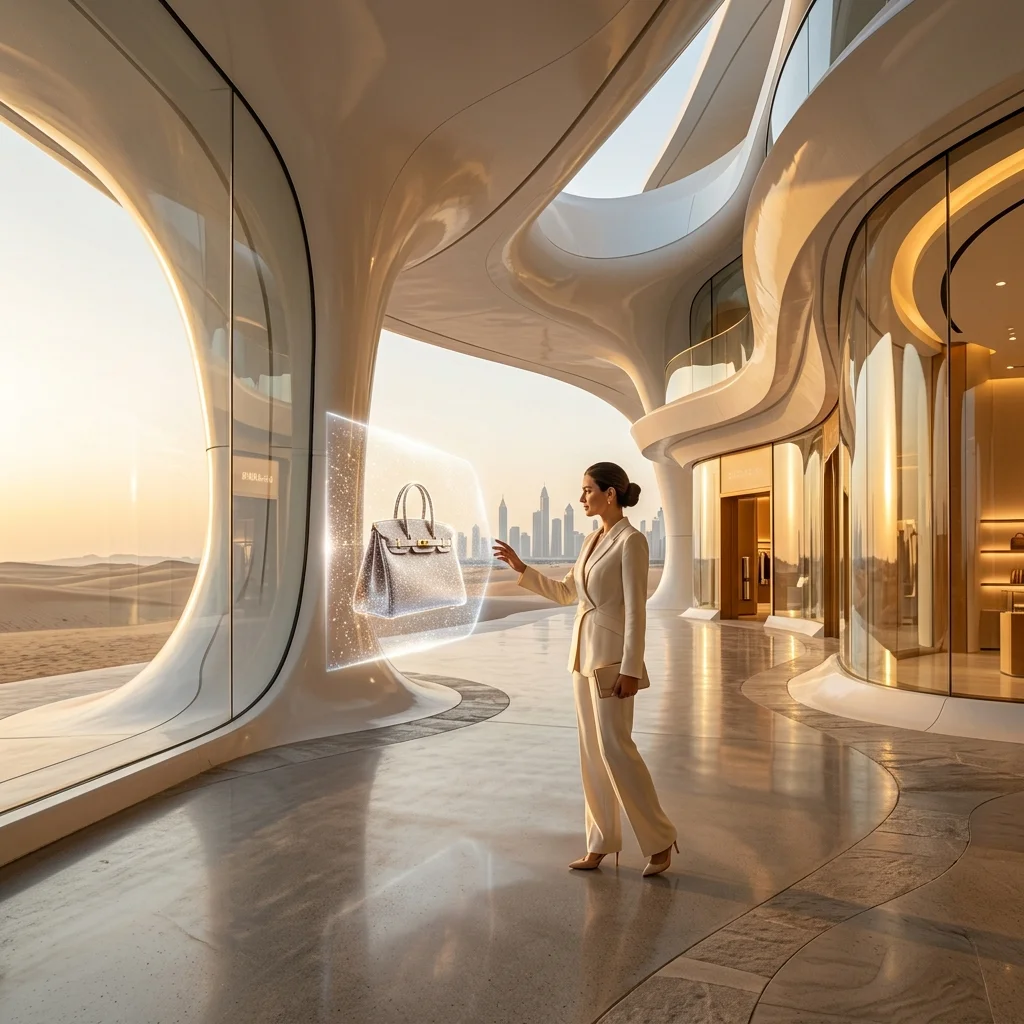
Beyond the Mall: The New Gulf Luxury Retail Paradigm – From Repatriation to Immersive Experiences
The Gulf luxury retail market is at a tipping point. While the region is valued at $5.2 billion and growing, a critical economic leakage exists: 70% of Saudi luxury spending occurs abroad. This article explores the deep structural shift underway as Saudi Arabia and the UAE seek to repatriate this spending through a dual strategy of monumental physical retail architecture and a radical pivot toward hyper-personalized, technology-driven immersive in-store experiences.
---
The $3.6 Billion Exodus: The Economic Logic Behind the Retail Revolution
The Gulf Cooperation Council (GCC) luxury fashion market reached a valuation of $5.2 billion in 2023, tracking 80 brands from accessible to ultra-high-end segments (Source 1: Bain & Co, 2023 Market Data). The year-over-year growth rate of 10% against 2022 figures signals robust regional demand. However, this headline figure masks a structural inefficiency that has persisted for decades.
Cyrille Fabre, Senior Partner at Bain & Co Middle East, identifies the core problem: "We estimate that circa 70 per cent of all the luxury goods bought by Saudi nationals are bought abroad during holidays." (Source 2: Bain & Co Interview Data). This represents approximately $3.6 billion in annual retail value flowing to London, Paris, Milan, and other global capitals—a figure that constitutes both a market failure and a strategic opportunity.
Saudi Vision 2030, announced in 2016, serves as the primary catalyst for addressing this leakage. The economic logic extends beyond mere retail diversification. Each luxury purchase made abroad represents lost VAT revenue, unrealized employment in retail and hospitality sectors, and attenuated cultural soft power. The repatriation of this spending is not aspirational; it is a quantifiable economic imperative.
The maturation of growth rates provides supporting evidence. The 2023 growth of 10% is projected to moderate to 6% in 2024 (Source 1: Bain & Co). This stabilization aligns with a deliberate strategy: transitioning from a high-growth, externally-dependent market to a mature, self-contained luxury ecosystem where demand is satisfied domestically. The market is being engineered to retain value, not merely expand volume.
Image Suggestion: Split image showing tourists shopping on Bond Street, London (left) and architectural rendering of Solitaire Mall, Riyadh (right).
---
The Ultimate Destination: Solitaire, The Avenues, and Architecture as a Competitive Moat
The physical response to this spending leakage takes the form of monumental retail architecture—structures designed not merely as shopping centers but as "experience anchors" engineered to compete directly with global shopping capitals. These developments represent a supply-side intervention to alter consumer behavior.
Solitaire Mall (Riyadh): 60,000 square meters across three levels, expected to open by end of 2024 (Source 3: Project Documentation). The scale positions it as a destination capable of hosting the full spectrum of luxury brands within a single, architecturally significant envelope.
The Avenues Riyadh: A mixed-purpose development slated for 2026, integrating four hotels including a Waldorf Astoria (Source 3: Development Plans). The inclusion of luxury hospitality within the retail complex is a calculated response to consumer psychology: the target customer currently builds entire vacation itineraries around shopping in foreign capitals. The development replicates this total experience within a single geographic node.
The 2025-2026 opening window is strategically synchronized with the peak phase of Vision 2030's economic and social reforms. By the time these developments achieve operational maturity, the regulatory environment, visa liberalization, and social landscape will have completed their transformation, creating maximum demand retention capacity.
Jasmina Banda, Chief Strategy Officer at Chalhoub Group, provides a critical contextual nuance: "Each Gulf market has its own unique characteristics and consumer behaviour, with some similarities but many differences." (Source 4: Chalhoub Group Strategy Documentation). The monolithic "Gulf luxury market" concept obscures significant intra-regional variation. A mall designed for Riyadh's conservative, family-oriented luxury consumer cannot be replicated identically in Dubai's international, tourism-driven market. The architecture must be culturally coded to its specific urban context.
Image Suggestion: Infographic comparing Solitaire Mall scale to a football field, with timeline overlay showing Riyadh mega-mall openings 2024-2026.
---
The Immersion Imperative: The Technological Heart of the New Luxury Store
The macro-level real estate strategy finds its micro-level complement in the transformation of individual store environments. The data reveals a clear consumer preference shift: 79% of UAE-based consumers and 77% of Saudi-based consumers find interactive in-store experiences "important" or "very important" (Source 5: Consumer Survey Data). Furthermore, over 80% of shoppers in both markets indicate they are more likely to visit stores offering immersive experiences (Source 5).
This is not a soft preference but a hard market signal. The future of brick-and-mortar luxury retail in the Gulf depends on technological integration. Fahed Ghanim, CEO of Majid Al Futtaim Lifestyle, articulates the operational principle: "The seamless integration of in-person, in-store encounters and technologically driven experiences is where the future of brick-and-mortar retail lies." (Source 6: Executive Statement).
That Concept Store (Dubai Mall of the Emirates) serves as a functional prototype. At 48,000 square feet, this space is not a conventional retail outlet but a curated environment where sales grew 31% in 2023 over 2022 (Source 7: Operational Data). The growth rate—more than triple the market average—correlates directly with its experiential design.
The technological stack includes:
- Personalization engines: Customer data captured at entry points drives real-time product curation and styling recommendations.
- Augmented reality fitting rooms: Reducing friction in the trying-on process while generating data on consumer preferences.
- Connected inventory systems: Enabling same-day delivery from store to home, converting the store into a logistics node rather than a pure transaction point.
Chalhoub Group, based in Dubai with 8 own brands and over 300 international brands, represents the dominant operational model for this transition (Source 4). The group's strategy functions as a bellwether for the entire regional market: when the largest luxury retailer pivots toward immersion, the entire supply chain follows.
Image Suggestion: Wide-angle photograph of That Concept Store interior showing interactive digital displays and curated product arrangements.
---
Supply Chain Inversion: From Consumption Destination to Production Hub
The most significant structural shift underway is the inversion of the Gulf's role in the luxury value chain. Historically, the region functioned as a passive consumption destination—products were designed in Europe, manufactured globally, and sold in Gulf malls. The current trajectory moves toward active participation in production and experience design.
Saudi Arabia's Ministry of Culture's fashion commission has identified and begun developing 100 local brands (Source 8: Government Documentation). This is not merely a cultural promotion initiative; it represents a strategic supply-chain intervention. Each local brand that achieves commercial viability reduces import dependency, captures more value domestically, and creates employment in design, manufacturing, and distribution.
The economic logic is linear: local brands generate higher margin retention within the domestic economy than imported brands. When a local brand sells a product in a Saudi mall, the entire value chain—from design to retail—generates economic activity within the Kingdom.
Dubai's role evolves in parallel. Cyrille Fabre notes: "The Gulf market is quite advanced [for] global luxury brands, particularly in Dubai, which is second only to London for global fashion brand presence." (Source 2). This existing infrastructure positions Dubai as a testbed and distribution hub for new brand concepts and experiential retail formats before they scale to other Gulf markets.
The 2024 expected growth moderation to 6% (Source 1) reflects this transition. Stable, domestically-served demand is preferable to volatile, externally-dependent growth. The market is being engineered for quality of revenue over quantity of transactions.
---
Market Structure Analysis: The 2025-2026 Inflection Point
The convergence of multiple timeline factors creates a clear inflection point:
| Factor | Current State (2024) | Target State (2025-2026) |
|--------|----------------------|--------------------------|
| Retail Infrastructure | Existing malls + Solitaire opening | The Avenues + additional mega-malls operational |
| Local Brand Ecosystem | 100 brands under development | Commercial maturity for early cohort |
| Consumer Behavior | 70% spending abroad | Reduced leakage (target variable) |
| Technology Integration | Early adoption phase | Standard operational requirement |
The simultaneous maturation of these factors will determine whether the repatriation strategy succeeds. If consumer behavior shifts toward domestic spending by even 10-15 percentage points, the GCC luxury market could grow by an additional $500 million to $750 million annually without any increase in overall consumption.
The competitive dynamics shift accordingly. Brands that invest early in experiential retail infrastructure—holographic displays, personalized concierge services, integrated hospitality—will capture disproportionate market share. Brands that treat the Gulf as a passive distribution market will find themselves excluded from the highest-growth segment.
---
Structural Risks and Constraints
Three structural risks require acknowledgment:
1. Supply-Side Capacity: The 60,000 square meters of Solitaire Mall and the multi-hotel complex of The Avenues represent unprecedented scale for the region. The luxury retail talent pool—from store managers to visual merchandisers to concierge staff—will be stretched thin. Operational excellence at scale is not guaranteed.
2. Consumer Behavior Inertia: The habit of luxury shopping in London or Paris is reinforced by multiple factors—vacation timing, cultural cachet, product availability, and price arbitrage. Repatriation requires overcoming these entrenched behaviors through superior domestic experiences, not merely matching foreign offerings.
3. Regional Competition: Dubai and Riyadh are now direct competitors for the same luxury consumer. While each market has distinct characteristics, the total addressable market for high-net-worth individuals is finite. Overinvestment in retail infrastructure could create excess capacity if population growth or tourism flows underperform projections.
---
Market Predictions for 2026-2028
Based on the structural analysis of current data, three neutral predictions emerge:
Prediction 1: By 2028, the percentage of Saudi luxury spending occurring domestically will increase from the current 30% to between 45-50%. This will be driven not by price competitiveness but by experiential differentiation that domestic consumers find superior to foreign alternatives.
Prediction 2: The number of "phygital" luxury store formats—integrating physical retail with digital interaction layers—will double in the GCC by 2027. Stores without technology integration will experience declining foot traffic and conversion rates.
Prediction 3: Local brands from Saudi Arabia and the UAE will capture 15-20% of the GCC luxury fashion market by 2028, up from negligible current levels. This will represent a genuine supply chain restructuring, with design and production capabilities established within the region.
The Gulf luxury retail paradigm is not merely replicating Western models in a new geography. It is constructing a new operational model where physical architecture, technological immersion, and local production converge to create a self-contained luxury ecosystem. The success of this model will determine whether the region remains a consumption destination or becomes a global standard-setter in luxury retail experience design.
Keywords

Ahmed Al-Farsi
Luxury & Lifestyle Editor with expertise in high-end hospitality and retail.