2026 Commercial Real Estate Outlook: Six Forces Reshaping the Global Market
Based on JLL’s December 2025 report, the 2026 commercial real estate landscape is being transformed by six interconnected forces: a relentless focus on efficiency amid higher costs, acute supply shortages for premium space, the rise of ''experience as a value driver, a shift from AI pilots to full-scale implementation, the convergence of buildings and power systems, and the democratization of real estate investing. These trends signal a structural shift from volume to value, with implications for investment strategies, asset obsolescence, and energy infrastructure. This article provides a deep analysis of each force, supported by key data points from the JLL outlook, and explores hidden economic logics such as the emergence of a two-tier market and the monetisation of building energy assets.
Fatima Al-Zahra
Editorial Analyst
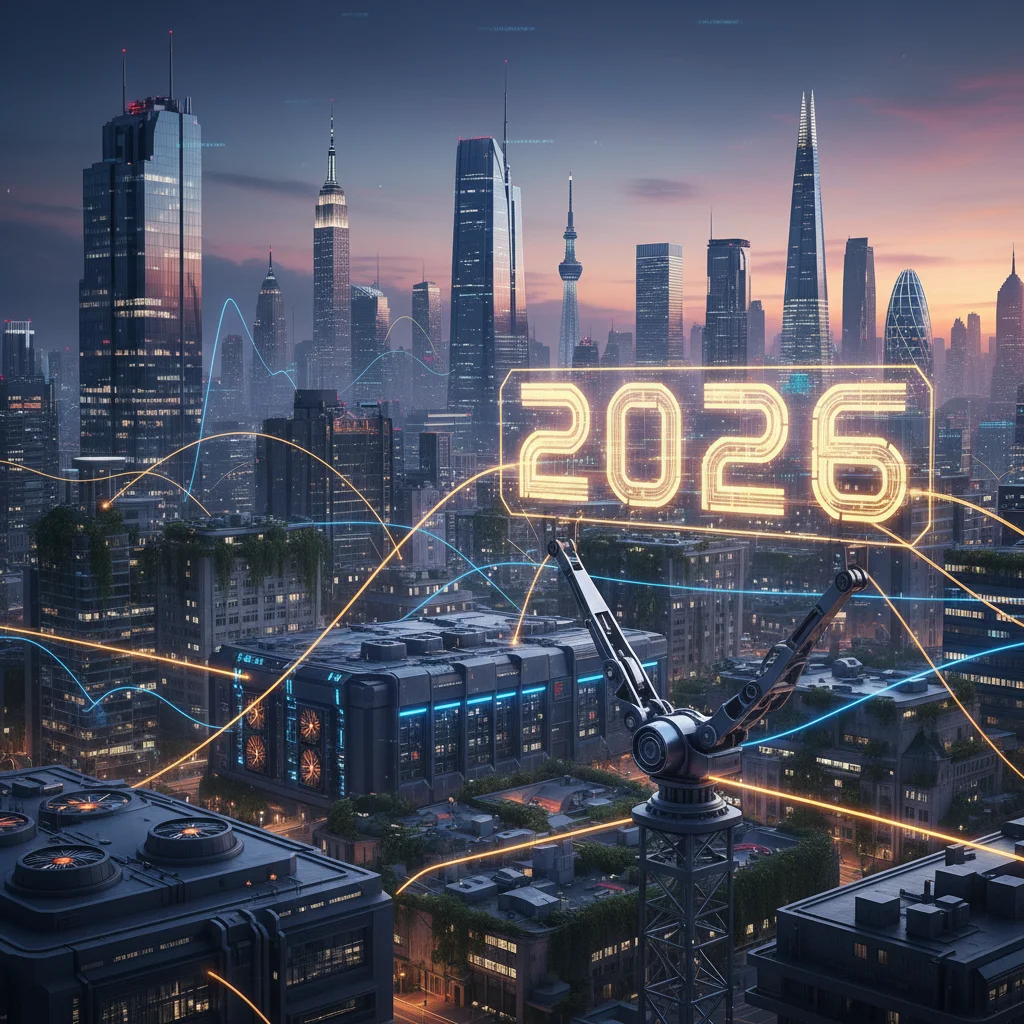
2026 Commercial Real Estate Outlook: Six Forces Reshaping the Global Market
Introduction: The Great Rebalancing
The global commercial real estate market entering 2026 is not experiencing a simple cyclical recovery. It is undergoing a structural reset — one that redefines how property is valued, used, and traded. According to JLL’s report published on December 8, 2025, six interconnected forces are driving this transformation, captured in a single phrase: “the imperative for efficiency … democratization of investing.” These forces reveal a clear shift from volume-driven growth toward value-and-efficiency-centric strategies. Behind the headlines, a hidden logic is emerging: a two-tier market where only top-quality, tech-enabled, energy-efficient assets command premium rents and investor appetite, while older buildings face accelerated obsolescence. This article unpacks each force, supported by key data from the JLL outlook, and explores the economic rebalancing that will define 2026.
[IMAGE: Global map with glowing hotspots in New York, London, Tokyo, Singapore, and key data center locations. Overlay arrows showing capital flows.]
---
Force 1: The Efficiency Imperative in a Higher-Cost Environment
The first force is efficiency — not as a nice-to-have but as a survival mandate. JLL’s survey reveals that 72% of corporate real estate leaders rank cost and budget efficiency as their top priority. This is driven by persistently high construction cost inflation: in the US, costs are rising 3.5–4% annually; in the UK and Germany, 2.7–3%; and in Singapore and Australia, a steep 5–6%. These are not just cost pressures — they are catalysts for operational innovation.
Tenants are demanding smarter, smaller, and more flexible spaces. Companies are rethinking footprints, squeezing more productivity per square foot through space utilization analytics and automation. For landlords, the message is clear: invest in building analytics, energy management systems, and lean operations, or watch vacancy rates climb. The winners will be those who treat efficiency as a strategic asset, not a cost-cutting exercise.
Deep insight: The higher-cost environment is accelerating the adoption of proptech, from sensor-driven occupancy tracking to AI-powered HVAC optimization. This is not a marginal improvement — it is a fundamental shift in how buildings are managed.
[IMAGE: Comparison infographic showing cost inflation rates across regions with icons for energy savings, space utilization, and automation.]
---
Force 2: Supply Shortages Intensify – The Premium for Prime Space
Supply constraints are biting hard. In the US, office completions are set to fall 75% in 2026 compared to recent peaks. In Europe, new construction is at its lowest level since 2010. Critically, 75% of the remaining US pipeline is already pre-leased. The shortage is most acute for “top-quality” space — modern, amenity-rich, and sustainable. Tokyo, New York, and London face the biggest gaps, where tenants with high credit ratings are competing fiercely for a shrinking pool of prime assets.
Hidden economic logic: This shortage creates a stark bifurcation. Class A assets command ultra-high rents, while Class B and C buildings struggle to compete. The result? A wave of repurposing — converting obsolete offices into residential, hospitality, or life sciences space — or outright demolition. The bifurcation is not temporary; it reflects a permanent shift in occupier preferences.
[IMAGE: Graph showing office completions decline from 2023 to 2026 (US, Europe, Asia) with callouts for cities like Tokyo, New York, London.]
---
Force 3: ‘Experience’ as the Value Driver
Rent is no longer the sole arbiter of value. In 2026, the “experience” a building provides — through amenities, design, and services — directly drives leasing decisions and investment yields. JLL notes that properties offering curated tenant experiences see significantly higher retention rates and rent growth. This goes beyond gyms and cafes: it includes wellness certifications, biophilic design, integrated art, and programming that fosters community.
Deep insight: Experience is not decoration — it is a monetizable asset. Buildings that deliver seamless, personalized experiences (e.g., via mobile apps for booking meeting rooms, adjusting lighting, or ordering coffee) create a “stickiness” that reduces churn and justifies premium pricing. For investors, the ability to measure and enhance tenant experience becomes a new due diligence metric.
[IMAGE: Interior of a modern office lobby with green walls, art installations, a café, and people working on laptops. Overlay icons for wellness, community, and technology.]
---
Force 4: From AI Pilots to Full-Scale Implementation
Artificial intelligence in commercial real estate has moved from experimental pilots to mainstream deployment. In 2026, AI is being used across the asset lifecycle — from lease abstraction and underwriting to predictive maintenance and tenant engagement. JLL highlights that leading firms are now scaling AI tools that analyze portfolio performance in real time, identify cost-saving opportunities, and even forecast market movements.
The shift is driven by the need for speed and accuracy in a volatile market. AI models trained on transaction data can now recommend optimal lease structures or flag underperforming assets before they become liabilities. The hidden logic: AI is not replacing human decision-making but augmenting it — enabling smaller teams to manage larger portfolios with greater precision. However, disparities in AI adoption will widen the gap between tech-forward operators and laggards.
[IMAGE: Dashboard interface showing real-time building data, AI-generated alerts, and predictive analytics charts. Abstract digital overlay with data points floating in the background.]
---
Force 5: The Convergence of Buildings and Power Systems
Perhaps the most structural shift is the convergence of commercial real estate with energy infrastructure. As data center demand surges (driven by AI and cloud computing), buildings are becoming both consumers and producers of power. JLL reports that on-site solar, battery storage, and microgrids are now standard considerations for new developments. In markets like Northern Virginia, London, and Singapore, power availability is becoming a constraint on development — and a competitive advantage for sites with grid capacity.
Deep insight: Buildings that can generate, store, and sell energy back to the grid will earn a new revenue stream. This turns energy systems from a cost center into a profit center. The implication for investors: underwriting must now include energy infrastructure assessments alongside location and lease terms. Obsolescence risk is no longer just about physical wear — it is about energy interoperability.
[IMAGE: Cutaway diagram of a smart building showing rooftop solar panels, underground battery storage, electric vehicle charging stations, and data center servers. Arrows indicating energy flows between building and grid.]
---
Force 6: The Democratization of Real Estate Investing
The final force is the democratization of access to commercial real estate investment. Historically the domain of institutions and high-net-worth individuals, the market is opening through real estate tokenization, crowdfunding platforms, and fractional ownership via digital securities. JLL notes that this trend is accelerating in 2026, with regulatory clarity in the US, Europe, and parts of Asia enabling wider retail participation.
Hidden economic logic: Democratization increases liquidity and price discovery in a traditionally illiquid asset class. It also reshapes capital flows — smaller investors gravitate toward high-yield, well-managed assets, further reinforcing the two-tier market. For developers, tapping into retail capital offers an alternative to traditional debt financing. However, it also introduces new risks around investor education and volatility.
[IMAGE: Illustration of a smartphone screen showing a real estate investment app with fractional ownership options for office towers, data centers, and apartment complexes. Background shows a diverse group of people using the app.]
---
Conclusion: A Structural Shift from Volume to Value
Taken together, the six forces point to a structural shift — from a market obsessed with square footage to one defined by efficiency, experience, technology, energy, and access. The two-tier market is not a temporary aberration; it is the new normal. Prime assets that combine sustainability, AI integration, energy self-sufficiency, and tenant appeal will command a scarcity premium. Older, less adaptable buildings face an existential threat — unless they can be repositioned or repurposed.
For investors, the playbook is changing. Underwriting must incorporate energy infrastructure, tenant experience metrics, and AI scalability. For developers, the focus must shift from building more to building better — with flexibility, technology readiness, and power resilience baked into the design. For occupiers, the choice becomes stark: invest in space that drives productivity and retention, or face talent and cost disadvantages.
The 2026 outlook is not about recovery. It is about reset — and those who recognize the six forces early will be best positioned to navigate the new landscape.
[IMAGE: Futuristic cityscape at dusk with high-tech office towers, data centers, and residential buildings. In the foreground, a construction crane holds a glowing '2026' sign. Digital lines representing energy flows and data streams connect buildings. Skyline includes silhouettes of New York, Tokyo, and London.]
Keywords

Fatima Al-Zahra
Real Estate Editor specializing in Dubai and Riyadh mega-projects.