Beyond Transit: How Dubai''s Blue Line Metro Reveals a Strategic Shift in Urban Economics and PPP Models
Dubai's RTA has tendered the 30km Blue Line metro, connecting Al Maktoum and Dubai International Airports. While presented as a transport project, this analysis uncovers its deeper role as a strategic urban development lever. The line's specific routing through academic and tech zones like Dubai Silicon Oasis, its Public-Private Partnership (PPP) structure, and its integration into the 2040 Master Plan signal a calculated move to enhance asset value in developing districts, catalyze a knowledge economy corridor, and de-risk major infrastructure through innovative financing. This project is less about moving people between airports and more about shaping the city's economic geography for the next two decades.
Fatima Al-Zahra
Editorial Analyst
Beyond Transit: How Dubai's Blue Line Metro Reveals a Strategic Shift in Urban Economics and PPP Models
Introduction: More Than a Metro – Decoding the Blue Line's Strategic Mandate
On 23 April 2024, Dubai’s Roads and Transport Authority (RTA) issued a tender for the design and construction of the Dubai Metro Blue Line (Source 1: [Primary Data]). The 30-kilometer line, connecting Al Maktoum International Airport (DWC) and Dubai International Airport (DXB), is formally a transport project under the Dubai 2040 Urban Master Plan. A surface-level analysis would categorize it as an inter-airport link. However, the project's specifications, routing, and procurement model indicate a deeper, more calculated function. The Blue Line’s primary mandate extends beyond passenger movement to encompass strategic urban asset creation, the catalysis of a knowledge economy corridor, and the deployment of a new public-private partnership (PPP) model for de-risking future mega-infrastructure.
The Route as a Real Estate and Economic Catalyst
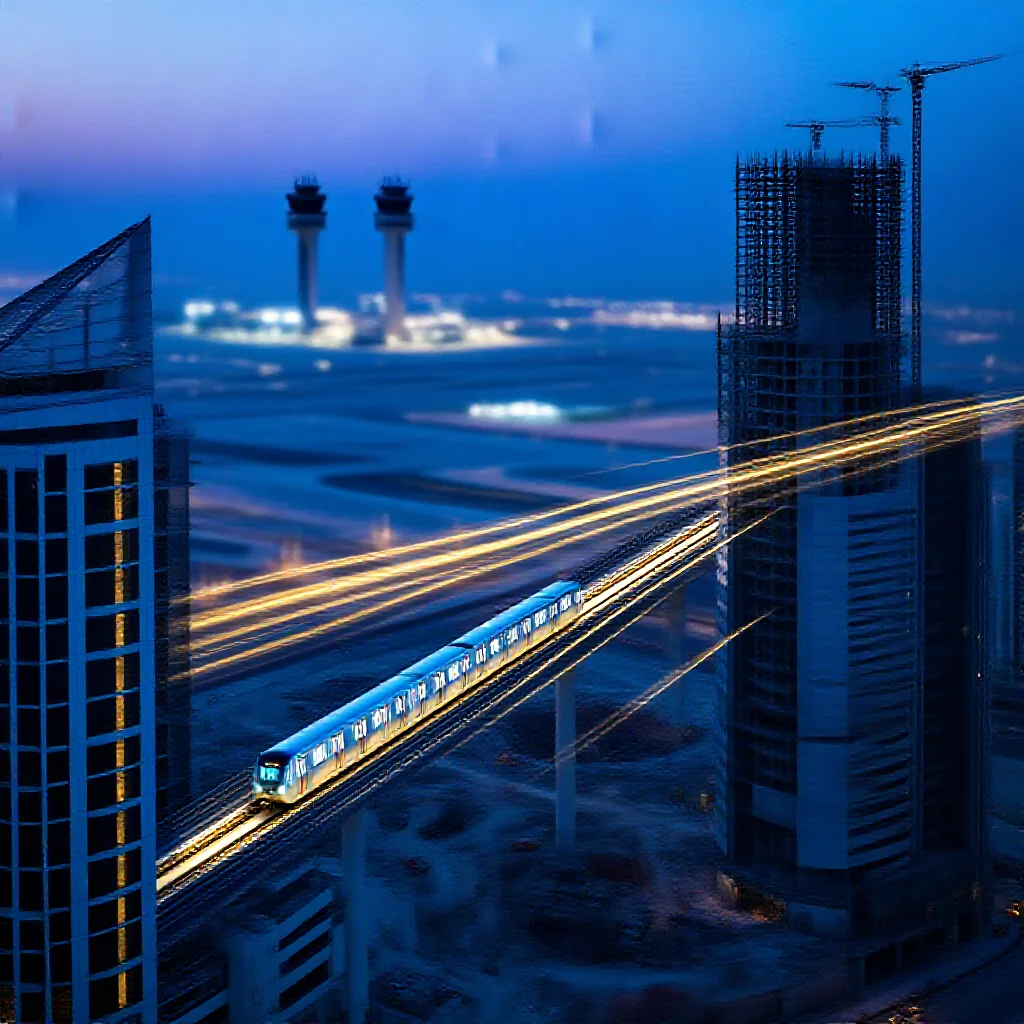
The technical specifications of the Blue Line reveal its role as an urban development lever. The division of the route—14.5km elevated and 15.5km underground—with 9 elevated and 5 underground stations is not arbitrary (Source 1: [Primary Data]). Elevated sections are typically more cost-effective and are strategically deployed in developing, lower-density areas where future growth is anticipated. The routing through zones such as Dubai Silicon Oasis, Dubai Academic City, and Mirdif confirms this thesis.
The line does not chart the most direct path between the two airports. Instead, it deliberately weaves through specific urban fabrics. It connects "production zones" like Academic City and Silicon Oasis—centers for human capital and technology—with established residential "consumption zones" like Mirdif, and finally to global gateways (the airports). This design transforms the metro from a transit utility into a spine for a planned economic corridor. The infrastructure will unlock and significantly enhance the value of land parcels along its path. This anticipated value appreciation represents a latent revenue stream, a form of asset-backed security that can be factored into the project's financial architecture.
The PPP Model: De-risking Sovereign Debt and Aligning Long-Term Interests
The procurement model marks a definitive shift from Dubai’s previous metro development strategy. Unlike the fully government-funded Red and Green Lines, the Blue Line is structured as a public-private partnership (PPP) (Source 1: [Primary Data]). The inclusion of two depots in the tender scope is a critical detail; it transfers long-term operational asset ownership, maintenance liability, and associated performance risk to the private consortium.
This PPP structure represents a strategic evolution in fiscal policy for mega-projects. It enables the deployment of substantial capital without corresponding strain on the sovereign balance sheet. The model aligns private investor returns with the long-term operational success of the line and, by extension, the economic success of the urban corridors it serves. Private capital absorbs construction cost overruns and operational inefficiencies, while the public sector retains control over strategic fare policy and urban planning outcomes. This bifurcation of responsibilities de-risks the project for the government and creates a built-in incentive for the private partner to ensure high system reliability and patronage over the concession period.
Integration as a System: The Network Effect on Dubai's Logistics Dominance
The Blue Line’s interchanges at Centrepoint (Red Line) and Creek (Green Line) are nodes of systemic integration. These connections facilitate more than passenger convenience; they create a closed-loop transit network that enhances Dubai’s logistical proposition. The circuit links DXB, a current global passenger hub, with DWC, the future epicenter of cargo and logistics, via the Expo 2020 site (now connected via the Route 2020 extension).
This integrated network supports a fluid movement of not just passengers but also high-value, time-sensitive air cargo and the skilled labor required to manage it. By seamlessly connecting logistics districts, academic institutions, and residential areas, the metro system reduces urban friction and increases the overall productivity of the city’s economic geography. The Blue Line completes a critical arc in this network, binding the eastern and western flanks of Dubai’s urban expansion into a coherent, accessible whole.
Conclusion: A Blueprint for Future Urban Infrastructure
The Dubai Metro Blue Line is a multidimensional instrument of policy. Its primary output is not mobility, but rather enhanced land value, activated economic corridors, and a tested PPP framework. The project signals a maturation in Dubai’s infrastructure philosophy: from building showcase assets to financing strategic urban capital through models that share risk and align long-term interests.
The market and industry implication is clear. Future large-scale urban infrastructure projects in the region and in similar emerging global cities are likely to adopt this hybrid model, where transit investment is explicitly leveraged for land value capture and economic development. The success of the Blue Line’s PPP structure will be measured not only by its ridership figures but by the rate of commercial and residential development around its 14 stations and the consequent broadening of Dubai’s non-oil economic base over the next two decades.
Keywords

Fatima Al-Zahra
Real Estate Editor specializing in Dubai and Riyadh mega-projects.