Florida Gulf Coast Real Estate 2025: Navigating Normalization After a Decade of Extremes
After a turbulent 2024 marked by historic low sales, three hurricanes, and soaring insurance costs, Florida's Gulf Coast real estate market is entering a phase of recalibration in 2025. Home prices remain 50-60% above five years ago, yet inventory has surged 30-40%, offering buyers more leverage. Condominium owners face new structural reserve requirements, while insurance reforms slowly attract carriers. Forecasts project a 5-7% increase in closed sales as the market shakes off a three-decade sales trough. This analysis dives into the interplay of climate risk, regulatory shifts, and buyer psychology that are reshaping the Gulf Coast housing landscape.
Fatima Al-Zahra
Editorial Analyst
Florida Gulf Coast Real Estate 2025: Market Enters a Phase of Calibration After a Decade of Extremes
Published Jan 6, 2025 | By Budge Huskey, CEO of Premier Sotheby's International Realty
---
Introduction: The Great Recalibration
The Florida Gulf Coast real estate market enters 2025 under an unfamiliar banner: stabilization. After a turbulent 2024 that delivered the weakest home sales in three decades, three hurricane landfalls, and a cascade of insurance cost increases, the region’s housing landscape is undergoing what many analysts call a “great recalibration.” Home prices along the Gulf Coast remain 50 to 60 percent higher than they were five years ago—a staggering post-pandemic premium—yet the dynamics underneath those numbers have shifted decisively.
Inventory has surged 30 to 40 percent compared to early 2024, giving buyers leverage they have not enjoyed since before the pandemic. Meanwhile, condominium owners face a new regulatory environment following the Surfside collapse, and insurance reforms are slowly attracting carriers back to a market that had been bleeding underwriters. The central question for 2025 is whether this combination of forces will produce a price correction or a healthy normalization—a return to transaction volumes that reflect genuine demand rather than speculative frenzy or paralysis.
[IMAGE: Wide-angle shot of a For Sale sign in front of a palm-tree-lined beachfront property with turquoise water in the background.]
The answer matters not only for homeowners and investors but for the broader Gulf Coast economy, where real estate has been the primary engine of wealth creation and local government revenue. After a year in which national existing-home sales fell to approximately 4 million—the lowest since 1995—the Gulf Coast mirrored that slump, with closed sales in many markets hitting multi-decade lows. Yet prices did not collapse, creating a paradox that defined 2024 and sets the stage for 2025.
---
2024 in Review: A Stress Test for the Gulf Coast
To understand where the market is heading, it is necessary to look back at the stress test that was 2024. National existing-home sales were estimated at just over 4 million, marking the weakest year for the U.S. housing market in nearly three decades. The Gulf Coast, including major markets like Tampa, Sarasota, Fort Myers, and Naples, mirrored this slump with transaction volumes that in some areas fell 15 to 20 percent below already depressed 2023 levels.
Three hurricanes—Debby, Helene, and Milton—pummeled the region between August and October, each leaving a trail of flooded homes, damaged roofs, and disrupted insurance markets. The storms did more than cause physical damage; they amplified fears about climate risk and insurability, particularly for older coastal properties and condominiums. Many would-be buyers sat on the sidelines, waiting to see how insurance premiums would adjust and whether new building codes would be enforced.
[IMAGE: Chart overlay showing national home sales trend from 2020-2024 with a dip in 2024, alongside a line indicating Gulf Coast prices relative to 2019 baseline.]
Yet despite the battering, prices did not collapse. The National Association of Realtors reported in November 2024 that existing-home sales posted a second consecutive month of year-over-year growth—a tentative turning point after more than 40 months of declines. That modest rebound, combined with limited inventory of desirable, newer homes, prevented a freefall. The market bifurcated sharply: well-built, newer single-family homes in inland locations saw relatively stable demand, while older coastal properties and condominiums in need of repairs languished.
One broker in the Sarasota luxury segment captured the mood succinctly: “Normalcy returns to the Sarasota Luxury Real Estate market in 2025.” That statement, made cautiously in late 2024, reflected a belief that the worst of the dislocation was over. Buyers who had been waiting for clarity on insurance and taxes began to re-engage, and sellers who had held out for pandemic-era prices started to adjust expectations.
---
The Inventory Surge: Buyer's Market or Temporary Glut?
The most telling shift entering 2025 is inventory. Across the Florida Gulf Coast real estate 2025 landscape, the number of homes for sale is 30 to 40 percent higher than it was a year ago. This surge is driven largely by sellers who delayed listings during the pandemic and then through the stormy 2024 season, finally deciding to test the market. Some are motivated by rising carrying costs—higher insurance, property taxes, and HOA fees—while others are retiring or relocating out of the region entirely.
For buyers, this represents a rare window of opportunity. Inventory is particularly elevated in the $500,000 to $1 million segment, where new construction and existing homes compete directly. Sellers are increasingly offering concessions: closing cost assistance, rate buydowns, and even price reductions after 30 to 60 days on the market. The negotiating power that buyers have missed since 2020 is back.
[IMAGE: A street in a Gulf Coast town with multiple For Sale signs visible, indicating increased inventory. Palm trees and blue sky in the background.]
However, the glut may be temporary. Forecasts for 2025 predict a 5 to 7 percent increase in closed sales, as the market shakes off its three-decade trough. If those projections materialize, the current inventory overhang could be absorbed within six to nine months. Moreover, supply remains constrained at the top end: luxury and waterfront properties are still tight, with very limited new construction on vulnerable coastlines. Builders are hesitant to develop oceanfront parcels given rising insurance costs and stricter elevation requirements, meaning that high-end buyers will continue to compete for a limited pool of homes.
The question is whether the 5 to 7 percent sales growth forecast is realistic. It hinges on several factors: mortgage rates staying in the 6 to 7 percent range, continued job growth in the region, and—critically—whether insurance reforms begin to stabilize premiums. If the hurricanes of 2024 push insurers to further pull back, even modestly lower rates may fail to revive demand. As one economist put it, “The market is walking a tightrope between affordability and availability of insurance.”
---
Condominium Crossroads: New Rules Reshape the Market
Perhaps the most consequential structural change in the Florida housing market outlook for 2025 is happening in the condominium sector. Following the tragic Surfside collapse in 2021, Florida enacted stringent new laws requiring condominium associations to conduct structural integrity reserve studies and fund long-term reserves accordingly. These rules took full effect in 2024 and are now reshaping buyer and seller behavior along the Gulf Coast.
The impact is twofold. First, many older condominium buildings—especially those built before the 2000s and located within two miles of the coast—are facing significant special assessments or dramatic HOA fee increases. In some cases, monthly fees have doubled or tripled as associations scramble to meet reserve requirements. Second, a two-tier market has emerged: well-funded, newer buildings with robust reserves are attracting buyers, while underfunded, older buildings are seeing values drop and listings pile up.
[IMAGE: A modern high-rise condominium building with a pool and beach access, contrasted in the background with an older, lower-rise condo building with faded paint and visible rust.]
This regulatory shift is driving a flight to quality. Buyers increasingly demand to see a building’s reserve study and financial statements before making an offer. Properties with deferred maintenance or inadequate reserves are finding it difficult to sell, even at discounted prices. Real estate agents report a growing number of listings where the seller is “motivated by special assessment”—a phrase that signals financial distress.
For the Florida Gulf Coast real estate 2025 market, the condo regulation changes are likely to depress sales volume in older buildings while boosting activity in single-family homes and newer condominium developments. Some buyers who might have considered a beachfront condo are now choosing inland single-family homes with a pool, where they can control maintenance costs and avoid surprise fees. This trend could accelerate in 2025 as more buildings complete their reserve studies and the true cost of ownership becomes transparent.
Insurance, of course, remains the other side of the coin. Florida’s property insurance market has been in crisis for years, with premiums rising 40 percent or more annually in some coastal zip codes. However, recent legislative reforms—including measures to limit attorney fees and reduce frivolous litigation—have begun to attract new insurers back to the state. Three new carriers entered the Florida market in 2024, and the state-backed Citizens Property Insurance Corporation saw its policy count decline slightly for the first time in years. If this trend continues, it could provide a crucial tailwind for Gulf real estate markets in 2025.
---
Conclusion: A Market Finding Its Footing
The Florida Gulf Coast real estate market in 2025 is not the market of 2023 or 2024. It is a market in transition—emerging from a period of extreme volatility into something closer to equilibrium. Prices remain elevated by historical standards, but the combination of higher inventory, regulatory clarity on condominiums, and early signs of insurance stabilization should support a gradual recovery in transaction volume.
Risks remain. Another active hurricane season could reverse the insurance progress. A spike in mortgage rates could choke off demand. The full impact of the condo reserve requirements may take years to play out, and some older buildings may face financial insolvency. But for a region that has weathered storms both literal and figurative, 5 to 7 percent sales growth represents not a boom but a welcome return to normalcy.
For buyers, the message is clear: leverage is better than it has been in years, especially in the mid-market segments. For sellers, patience and realistic pricing will be essential. And for the Gulf Coast itself, this recalibration offers an opportunity to build a more resilient housing market—one that balances the allure of coastal living with the reality of climate risk.
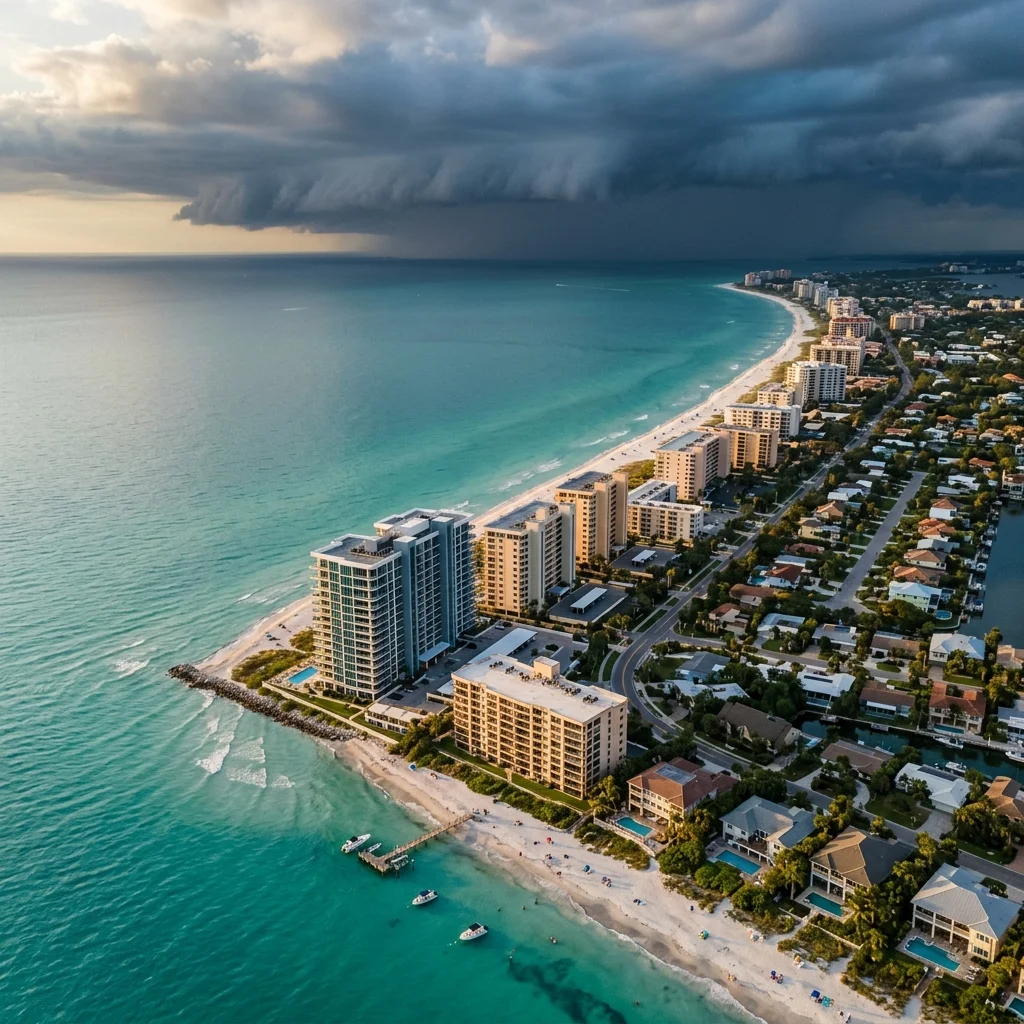
[IMAGE: Aerial shot of Sarasota’s coastline with a mix of luxury homes and condos, golden hour lighting, clear water, and a few clouds on the horizon—no text.]
Keywords

Fatima Al-Zahra
Real Estate Editor specializing in Dubai and Riyadh mega-projects.