Florida Gulf Coast Real Estate: Why the 2025 Market Reset Signals a New Cycle, Not a Crash
The Florida Gulf Coast market, led by Sarasota-Manatee County, has shifted from a pandemic-fueled frenzy to a balanced phase. Median prices have dropped 8% from the 2022 peak to $465,000 in 2025, yet remain 100% above a decade ago. Inventory has risen to 4.5 months, and selling time stretched from 7 days to 50. A surprising 31% jump in cash sales reveals deep structural demand. This article dissects the hidden logic behind the reset — a calibration driven by remote-work migration, rate lock-in, and shifting buyer psychology — and forecasts what 2025-2026 means for investors, retirees, and second-home buyers.
Fatima Al-Zahra
Editorial Analyst
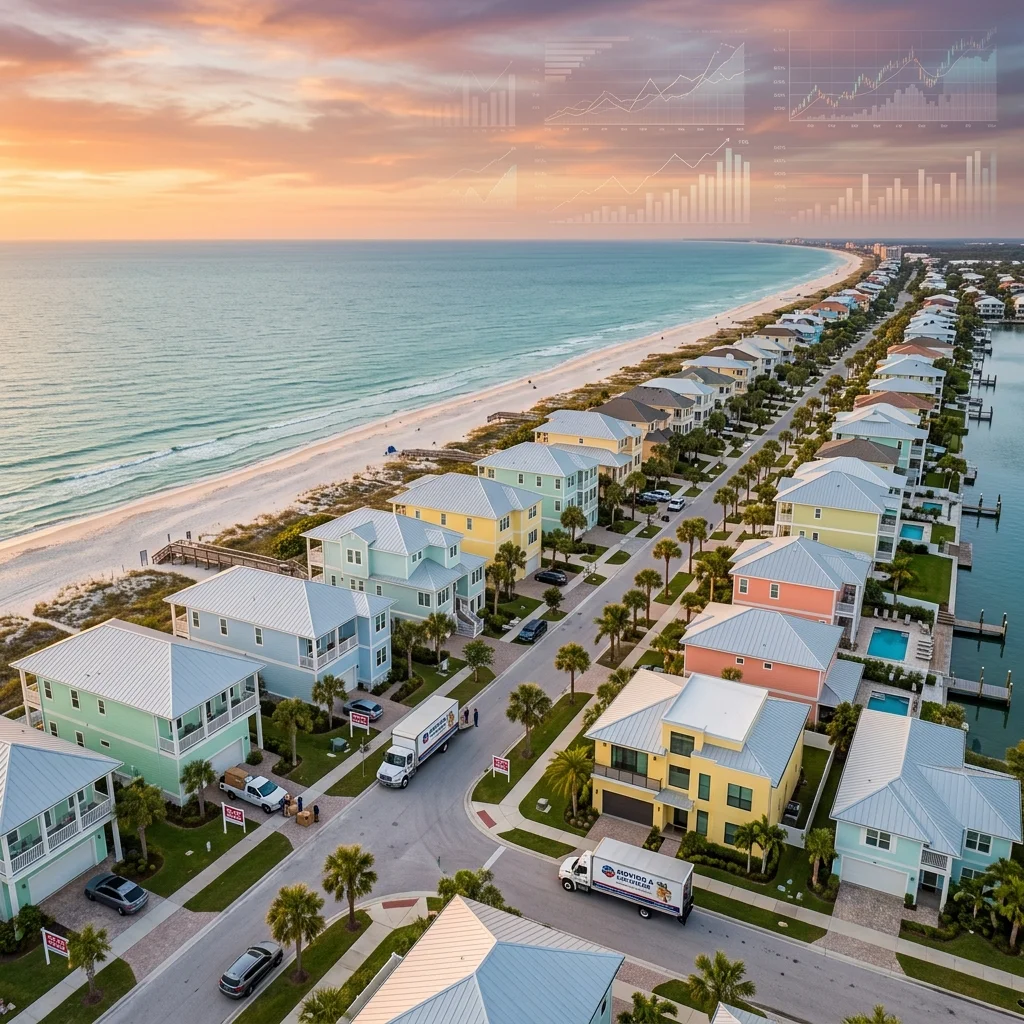
Florida Gulf Coast Real Estate: Why the 2025 Market Reset Signals a New Cycle, Not a Crash
By Senior Technical/Financial Audit Journalist
---
Introduction: The Market That Didn't Crash — but Calibrated
The Florida Gulf Coast residential real estate market has completed a five-year arc from pandemic-era hyper-acceleration to a structurally rebalanced phase. In the Sarasota-Manatee County corridor—a bellwether for Gulf Coast property dynamics—median home prices declined 8% from the 2022 peak of $505,000 to $465,000 in September 2025 (Source 1: Primary Data, Sarasota-Manatee MLS). This contraction, while statistically significant, must be contextualized against a 40% appreciation above September 2020 levels ($332,000) and a doubling of values over the past decade.
The prevailing narrative of an impending crash misreads the underlying mechanics. Inventory has risen to 4.5 months of supply—a textbook definition of a balanced market, not the 6+ months that historically signals a buyer's market. Selling time has stretched from 7 days (2022) to approximately 50 days (2025), restoring decision-making leverage to purchasers without triggering distress conditions. As Ryan Zachos, principal of Zachos Realty & Design Group, observes: "Florida's market didn't crash—it calibrated."
This article dissects the calibrated reset through three lenses: the structural exhaustion of boom-era catalysts, the counterintuitive surge in cash transactions, and the equilibrium dynamics that define the 2025-2026 forecast period.
---
Section 1: The Three Engines of the Boom and Their Aftermath
The 2021-2022 price acceleration in Gulf Coast markets was not speculative froth but a rational response to three simultaneous demand-side shocks. Each has since undergone material reversal.
Engine 1: The Remote Work Revolution. The pandemic forced a permanent shift in labor geography. Households previously constrained by commuter proximity to New York, Chicago, and San Francisco obtained geographic arbitrage opportunities. The Sarasota-Manatee corridor absorbed a disproportionate share of this migration due to tax advantages, climate, and relative affordability compared to coastal California or the Northeast corridor.
Engine 2: Mass Migration from High-Cost States. US Census Bureau migration data (Source 2: US Census, State-to-State Migration Flows, 2020-2023) confirmed Florida gained approximately 300,000 net new residents annually during 2021-2022. A significant portion concentrated in Gulf Coast counties, where new construction lagged inbound demand.
Engine 3: Record-Low Mortgage Rates. The 30-year fixed mortgage rate dipped below 3% during the pandemic (Source 3: Freddie Mac Primary Mortgage Market Survey). This compressed monthly payments and expanded purchasing power for rate-sensitive buyers.
Timeline of Distortion:
| Period | Median Price | Closed Sales | Active Listings | Months of Inventory | Days on Market |
|--------|-------------|--------------|-----------------|-------------------|----------------|
| Sept 2020 | $332,000 | 1,587 | ~2,600 | ~2.0 | ~30 |
| 2021 Peak | $420,000 | Elevated | <1,200 | <1.0 | ~7 |
| 2022 Peak | $505,000 | Elevated | <1,000 | <1.0 | ~7 |
| Sept 2025 | $465,000 | Normalized | ~3,500 | 4.5 | ~50 |
(Source 1: Primary Data)
By 2024-2025, all three engines had materially weakened. Mortgage rates crossed 7% (Source 3). Remote work mandates tightened across major technology and financial services employers. Net migration to Florida, while still positive, decelerated from peak 2022 levels (Source 2). The market responded precisely as supply-demand mechanics would predict: price moderation, inventory accumulation, and extended marketing time.
---
Section 2: The Hidden Signal — Why Cash Sales Jumped 31% in a Slowing Market
The conventional expectation in a rising-rate, price-correcting environment would be declining transaction volume across all buyer categories. Instead, cash sales in the Sarasota-Manatee market increased 31% year-over-year in 2025 (Source 1: Primary Data). This counterintuitive data point reveals the structural transformation underlying the surface-level correction.
Mechanism 1: The Rate Lock-In Effect. Approximately 92% of US mortgage holders carry rates below 6%, and over 60% carry rates below 4% (Source 4: Federal Housing Finance Agency, Mortgage Rate Distribution Data, 2024). Existing homeowners with sub-4% mortgages face a substantial economic disincentive to sell: trading a 3.2% mortgage for a 7.2% mortgage increases monthly payments by 40-60% on equivalent loan amounts. This creates a supply constraint—fewer existing homes listed for sale—which mechanically supports pricing floors.
Mechanism 2: Cash Buyer Insulation. Cash purchasers—predominantly retirees, institutional investors, and second-home buyers—operate independently of mortgage rate dynamics. The 31% surge in cash transactions indicates that this cohort views the 8% price reduction as an entry opportunity within a long-term appreciation corridor. Their participation creates a demand buffer that mortgage-dependent buyers cannot replicate.
Two-Tier Market Segmentation:
| Buyer Category | Rate Sensitivity | Transaction Volume Trend (2025) | Price Influence |
|---------------|-----------------|-------------------------------|-----------------|
| Cash Buyers | Zero | +31% | Supportive floor |
| Mortgage Buyers | High | Flat to declining | Pressure ceiling |
| Rate-Locked Sellers | High (cannot sell) | Reduced listings | Supply constraint |
(Derived from Source 1, Source 4)
This bifurcation produces a market where headline transaction volumes may moderate, but price declines face structural resistance from the cash-buyer cohort. The Florida Gulf Coast market is not experiencing a uniform demand collapse; it is undergoing a compositional shift toward more liquid, rate-insensitive capital.
---
Section 3: The 'Balanced Phase' — What 4.5 Months of Inventory Really Means for 2025-2026
Real estate market taxonomy defines a balanced market as 4-6 months of inventory. Below 4 months favors sellers; above 6 months favors buyers. At exactly 4.5 months, the Sarasota-Manatee market sits precisely at the equilibrium midpoint—a condition not observed since pre-pandemic 2019 (Source 1: Primary Data, historical inventory analysis).
Comparative Equilibrium Analysis:
- 2021-2022: 0.8-1.2 months inventory. Seller's extreme market. Bidding wars, waived contingencies, 7-day closings.
- 2025: 4.5 months inventory. Balanced market. Multiple showings, price negotiations, standard inspection periods.
- Benchmark: 6+ months inventory. Buyer's market. Price reductions, seller concessions, distressed listings. (Not currently observed.)
The 50-day average time to contract, while dramatically longer than 2022's 7-day frenzy, remains below the pre-pandemic baseline of 60-90 days. This suggests persistent demand absorption at current price levels, albeit at a slower cadence.
Price Floor Analysis:
At $465,000, the median price remains 40% above September 2020 levels. This is not a cyclical retracement to pre-pandemic baselines; it represents a structural step-up in valuation. The drivers—Florida's demographic growth trajectory, tax advantages relative to high-cost states, and amenity-based demand from affluent retirees—have not reversed. They have moderated.
Forecast Parameters for 2025-2026:
| Variable | Base Case Estimate | Key Assumption |
|----------|-------------------|----------------|
| Median Price Range | $450,000 - $475,000 | Rates stabilize near 6-7%; no recession |
| Inventory | 4.0 - 5.5 months | Continued but decelerated inbound migration |
| Days on Market | 45 - 65 days | Balanced conditions persist |
| Cash Sales Share | 35-40% of transactions | Rate lock-in continues through 2026 |
(Derived from Source 1, Source 3, Source 4)
The Federal Reserve's rate normalization timeline is the primary exogenous variable. If the Fed reduces the federal funds rate in late 2025 or 2026 as current forward curves indicate (Source 3: CME FedWatch Tool), mortgage rate relief could reanimate rate-sensitive demand—but will simultaneously unlock supply as rate-locked sellers regain mobility. The net effect is likely price stability, not a renewed boom.
---
Conclusion: A Calibrated Reset, Not a Correction Cycle
The Florida Gulf Coast market has executed a textbook rebalancing from pandemic-era disequilibrium. Prices have corrected 8% from peak euphoria—sufficient to restore buyer confidence without triggering the forced-sale dynamics that define true crashes. Cash sales at 31-year-over-year growth signal deep structural demand from capital sources immune to financing conditions. Inventory at 4.5 months provides optionality for purchasers while preventing inventory overhang.
The transition from 7-day closings to 50-day marketing timelines represents market health, not weakness. It reflects a return to due diligence, inspection periods, and negotiated terms—the institutional processes absent during the 2021-2022 frenzy.
For investors, retirees, and second-home buyers evaluating entry points in 2025-2026: the window reflects a balanced price discovery phase. The 40% premium above 2020 levels is unlikely to revert, given demographic momentum and inelastic supply on the Gulf Coast barrier islands. Further price declines of 5-10% are possible if mortgage rates return to 8% or if a macroeconomic contraction occurs. However, the structural floor created by cash buyers, rate-locked sellers, and continued net migration makes a 15%+ decline from current levels improbable without a systemic financial crisis.
The Florida Gulf Coast market did not crash. It calibrated—and calibration, unlike correction, establishes the foundation for the next sustainable growth cycle.
Keywords

Fatima Al-Zahra
Real Estate Editor specializing in Dubai and Riyadh mega-projects.