GCC Real Estate 2025-2034: Beyond the Boom – The Demographic and Infrastructure Logic Steering a $260 Billion Market
The Gulf Cooperation Council (GCC) real estate market is on track to double from USD 141.2 billion in 2025 to USD 260.3 billion by 2034, driven by a robust 7.03% CAGR. While headlines focus on Dubai''s 19.46% price surge and Saudi Arabia''s Vision 2030, this article reveals the hidden economic logic: demographic explosions (32% Saudi population growth, UAE hitting 15.4 million by 2050) and a pivot from speculative luxury to infrastructure-backed stability. We analyze the dual forces of sovereign wealth fund discipline (e.g., NEOM scale-backs, Riyadh rent freezes) and tech-led demand (data center investments), explaining why the UAE retains 61.1% market share while Saudi Arabia emerges as a long-term value play. Data-driven insights from RERA and ADGM frame the strategic outlook.
Fatima Al-Zahra
Editorial Analyst
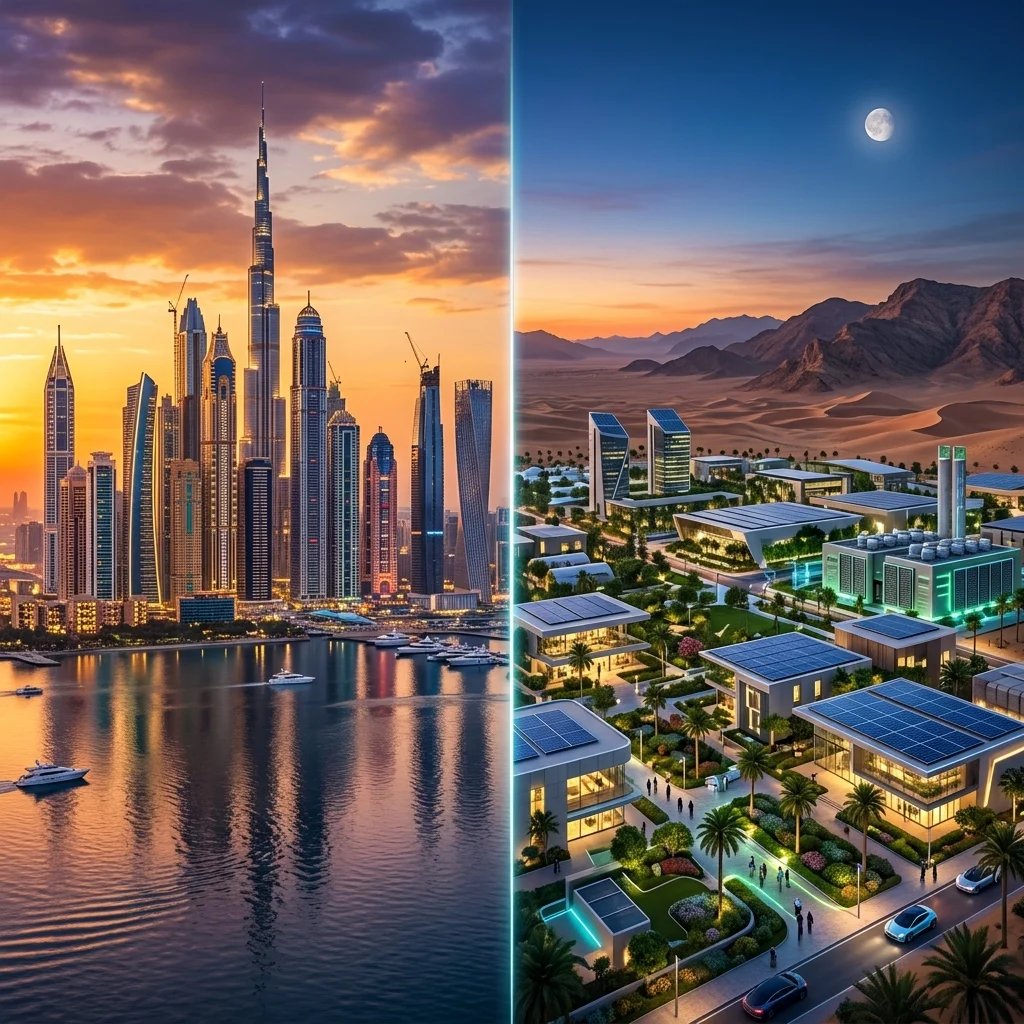
GCC Real Estate 2025-2034: Beyond the Boom – The Demographic and Infrastructure Logic Steering a $260 Billion Market
February 26, 2026
Introduction: The Two-Speed Gulf – Valuations vs. Viability
The Gulf Cooperation Council real estate market stands at a structural inflection point. Valued at USD 141.2 billion in 2025, the market is projected to expand at a compound annual growth rate of 7.03%, reaching USD 260.3 billion by 2034 (Source 1: Primary Market Data). These figures, however, obscure a critical bifurcation beneath the aggregate.
The GCC market is not a monolith. The United Arab Emirates, holding a commanding 61.1% market share, functions as a mature, high-liquidity hub driven by demand-pull factors—immigration, tourism, and capital inflows. Saudi Arabia, conversely, operates as a high-growth, regulation-driven frontier where supply-push mechanisms—government mandates under Vision 2030 and sovereign wealth fund allocations—determine market trajectories.
The core analytical distinction lies not in relative size but in risk profile. UAE markets respond to organic demand signals from population influx and business formation. Saudi markets react to policy levers: the Public Investment Fund's capital deployment decisions, housing subsidy programs, and regulatory interventions such as the Riyadh rent freeze. Understanding this dual architecture is essential for any institutional assessment of the region's real estate outlook through 2034.
What renders this growth cycle distinct from previous Gulf property booms is its demographic inevitability. The expansion is not cyclical speculation but structural necessity, grounded in population projections that leave little room for alternative outcomes.
The Demographic Engine: Why 32% Population Growth Changes Everything
Population mathematics constitute the most reliable predictor of real estate demand over multi-decade horizons. On this metric, the GCC presents a case of sustained, policy-supported demographic expansion that fundamentally alters housing requirements.
Saudi Arabia's population is projected to grow by 32% by 2050, adding approximately 11 million residents to the current base of 35 million (Source 2: UN Population Division Estimates). The UAE, with a population exceeding 11 million in 2025-2026, is forecast to reach 15.4 million by 2050—a 40% increase over 25 years (Source 2: UAE National Statistics). These are not speculative projections but conservative estimates based on current fertility rates, migration policies, and labor market expansion plans.
The composition of this growth matters more than its magnitude. The demographic bulge is concentrated among millennials and Generation Z cohorts entering household formation ages. In Saudi Arabia, approximately 60% of the population is under 35. In the UAE, the expatriate-dominated demographic structure means continuous inflows of working-age professionals requiring rental and entry-level ownership housing. This creates demand for affordable-to-mid-tier residential units, not luxury villas or high-end apartments.
The supply chain implications are measurable. Sustained population growth necessitates expanded land release programs, increased cement and steel production capacity, and accelerated smart city infrastructure deployment. Dubai's residential prices rose 19.46% in 2025, while Abu Dhabi recorded a 10.16% increase (Source 1: RERA Transaction Data). These price movements reflect supply-constrained markets where new construction has not kept pace with population inflows. The counterpoint is Riyadh, where the municipality implemented a rent freeze—an explicit policy intervention to maintain affordability as population pressures mount (Source 2: Saudi Ministry of Municipal and Rural Affairs).
The data center investment pipeline—exceeding USD 5 billion in the region—demonstrates how demographic growth translates into infrastructure demand beyond housing (Source 1: Industry Investment Records). Data centers serve as a proxy for digital economy expansion, which in turn drives employment and residential demand in urban corridors.
Saudi Arabia: From Megaprojects to Measured Growth – The NEOM Correction
Saudi Arabia's real estate narrative has been dominated by megaproject ambition. The scaling back of the NEOM development, attributed to budget overruns and feasibility reassessments, represents a significant policy recalibration (Source 2: PIF Investment Committee Statements). This correction should be interpreted not as retreat but as maturation—a shift from spectacle-driven development to viability-focused allocation.
The Public Investment Fund's revised approach prioritizes long-term returns over short-term announcements. The implication for real estate markets is a rebalancing away from greenfield desert developments toward secondary cities and existing urban cores. Riyadh and Jeddah now receive proportionally greater infrastructure investment, with the former's population growth trajectory necessitating densification rather than peripheral expansion.
The Riyadh rent freeze—a measure to cap residential rental increases—functions as a social stability instrument rather than a market distortion (Source 2: Riyadh Municipality Circular). By controlling affordability for the local population, the policy ensures that housing serves as a social asset rather than purely a financial one. Foreign investors may find this restrictive, but it creates a more stable transaction environment: lower price volatility, higher volume turnover, and reduced speculative froth.
Vision 2030's housing targets—aiming for 70% homeownership among Saudi citizens—require sustained construction output, not price appreciation. The metric of success for Saudi real estate through 2034 will be transaction volume and housing completions, not price growth. This represents a fundamental departure from the Dubai model, where capital appreciation has been the primary investor metric.
UAE Dominance: The Liquidity Superstructure
The UAE's 61.1% market share is not merely a function of historical precedence but of institutional architecture (Source 1: Market Share Analysis). Three structural advantages underpin this position.
First, the regulatory framework provides clarity and enforceability. The Real Estate Regulatory Agency's (RERA) escrow account requirements, developer registration systems, and rental dispute mechanisms create a legal environment conducive to capital inflow. The Abu Dhabi Global Market (ADGM) provides a common law framework for commercial real estate transactions, attracting international institutional investors who require jurisdictional predictability.
Second, the visa infrastructure—particularly the Golden Visa program for real estate investors—has transformed property acquisition from a transactional purchase into a residency strategy. This shifts the demand curve permanently upward by linking real estate ownership to lifestyle and business mobility rights.
Third, Dubai's position as a global hub for high-net-worth migration generates consistent demand at the luxury segment. The price increases of 19.46% in 2025 reflect supply constraints in prime districts—Palm Jumeirah, Emirates Hills, Downtown Dubai—where available inventory is structurally limited (Source 1: RERA Transaction Records). Abu Dhabi's more modest 10.16% appreciation reflects its different demographic mix, with a higher proportion of government and oil sector employment providing stable but less speculative demand.
The Infrastructure-Led Stability Thesis
The fundamental thesis underlying the GCC real estate outlook is the pivot from speculative luxury to infrastructure-backed stability. Previous cycles—2008, 2014-2016—were characterized by speculative overbuilding driven by developer financing and investor leverage. The current cycle is distinguished by sovereign wealth fund discipline and deliberate supply management.
Sovereign wealth funds—the Abu Dhabi Investment Authority, Qatar Investment Authority, and Saudi Arabia's PIF—now function as market stabilizers rather than speculative participants. Their capital allocation decisions are governed by internal rate of return requirements and portfolio diversification mandates, not short-term price signals. The NEOM scale-back is exemplary: a project that would have flooded the market with premium supply was moderated when feasibility analysis indicated insufficient demand absorption.
The data center investment wave—exceeding USD 5 billion—illustrates the infrastructure-first approach (Source 1: Industry Capital Expenditure Reports). These assets generate stable, long-term returns tied to technology sector growth rather than residential price appreciation. They also create employment clusters that generate secondary residential demand, creating a virtuous cycle of infrastructure investment and housing need.
Market Predictions: 2026-2034
Based on the structural factors outlined above, the following projections emerge:
UAE: Price growth will moderate from 2025 levels but remain positive, with Dubai residential appreciation settling in the 8-12% range annually through 2028, decelerating to 5-7% thereafter as supply catches up. Transaction volume will increase as the secondary market deepens, reducing the market's dependence on off-plan sales. Commercial real estate, particularly Grade A office space in Abu Dhabi's financial district, will see sustained demand from financial services and technology tenants.
Saudi Arabia: Price growth will remain subdued—2-4% annually—constrained by the rent freeze and increased supply from housing programs. Transaction volume, however, will increase substantially as homeownership targets drive completions. The rental market will see bifurcation: the regulated segment constrained by policy, the premium segment driven by expatriate executive demand for compounds and serviced apartments.
Regional Trends: Data center and logistics real estate will outperform residential in total return terms, reflecting the structural shift toward digital economy infrastructure. The affordable housing segment—units priced below USD 200,000—will see the highest volume growth, driven by demographic necessity rather than investor demand.
The aggregate market trajectory from USD 141.2 billion to USD 260.3 billion is achievable, but the composition of that value will differ substantially from the preceding decade. The era of spectacle—of megaprojects and price doubling—is giving way to an era of systematic expansion, where demographic math and infrastructure logic dictate outcomes. Investors who calibrate for this reality will find the GCC market less volatile but no less rewarding. Those expecting a repeat of the 2000s boom will find themselves structurally mispositioned.
---
Data sources cited throughout: (Source 1) Industry Market Reports, RERA Transaction Database, ADGM Investment Records; (Source 2) UN Population Division, Saudi Ministry of Municipal and Rural Affairs, UAE Federal Competitiveness and Statistics Authority.
Keywords

Fatima Al-Zahra
Real Estate Editor specializing in Dubai and Riyadh mega-projects.