GCC Residential Real Estate Market Outlook 2025-2034: Growth Drivers, Supply Gaps, and the New Demand Cycle
The GCC residential real estate market reached USD 78.8 billion in 2025 and is projected to grow to USD 152.0 billion by 2034 at a CAGR of 7.35%. This article will explain the hidden economic logic behind the expansion: population inflows, urbanization, foreign ownership reforms, higher disposable incomes, and the rise of luxury, smart, and sustainability-led housing. It will also explore a deeper, less-covered angle: how residential demand is reshaping infrastructure investment, construction supply chains, and city planning across Gulf real estate markets. Verification points from market reports and external sources will be embedded early to establish timeline, valuation, and growth assumptions before moving into structural analysis.
Fatima Al-Zahra
Editorial Analyst
GCC Residential Real Estate Market Outlook for 2025–2034: Growth Drivers, Supply Gaps, and Demand Shifts
According to the market outlook used for this analysis, the GCC residential real estate market was valued at USD 78.8 billion in 2025 and is projected to reach USD 152.0 billion by 2034, implying a 7.35% CAGR over the forecast period. The timing used here separates the historical period of 2020–2025 from the forecast period of 2026–2034. These figures provide the baseline for assessing how housing demand is evolving across the Gulf real estate markets, and why the next decade is likely to be shaped not only by population growth, but also by policy, urban planning, and delivery constraints.
[IMAGE: Clean market chart showing historical and forecast growth curve for GCC residential real estate]
Market Snapshot: Size, Timeline, and Growth Trajectory
The GCC housing market is entering 2025 with a higher structural demand base than in previous cycles. The cited valuation of USD 78.8 billion in 2025 and the projected USD 152.0 billion by 2034 indicate that residential real estate is expanding faster than simple demographic replacement demand. A 7.35% CAGR is significant because it signals sustained growth rather than a one-off rebound.
This trajectory matters for two reasons. First, the growth window extends across almost a full decade, which suggests developers, lenders, and planners are dealing with a medium-term market shift rather than a short-term spike. Second, the forecast period coincides with continued urban expansion in major GCC cities, where new supply must compete with rising expectations around location, connectivity, amenities, and unit quality.
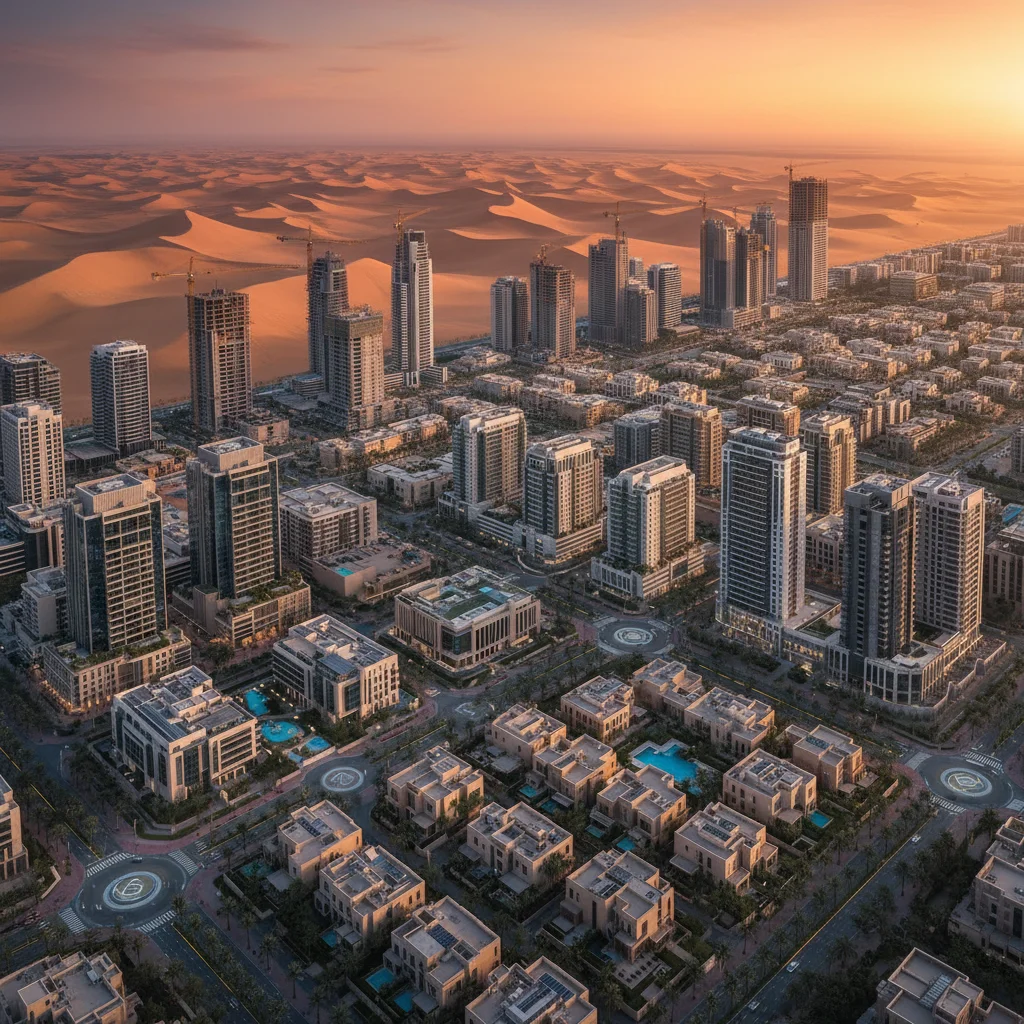
[IMAGE: Residential skyline with new tower clusters and road infrastructure across a GCC city]
Why Residential Demand Keeps Compounding
The basic economic logic is straightforward: as populations rise and cities expand, the need for homes rises with them. In the GCC, that demand is amplified by expatriate inflows, natural population growth, and urbanization. These forces are not evenly distributed, but they are persistent across the region.
In markets such as Dubai, Abu Dhabi, Riyadh, Doha, and parts of Manama, housing demand is increasingly tied to labor mobility, business formation, and long-term household formation. Many residents are no longer looking only for rental accommodation near employment centers; they are also evaluating ownership options, longer tenure, and larger homes. This is particularly visible in cities where residency rules, financing availability, and foreign ownership frameworks have made ownership more practical for non-citizens.
Disposable income growth also matters. As household incomes rise, the housing decision becomes less about access alone and more about product differentiation. Buyers and tenants increasingly compare neighborhoods, school access, transport links, security, and digital infrastructure. That shifts residential demand from a purely cyclical response to a more structural requirement.
At the same time, supply is not always able to adjust quickly. Land availability, zoning, infrastructure timing, and approval processes can slow delivery even when demand is strong. That creates a recurring gap between what households want and what the market can deliver on schedule.
A Market Analysis Built on Structural Evidence
This is best understood as a slow analysis rather than a headline-driven one. The reason is simple: the headline forecast is only the starting point. The more important question is whether growth is broad-based across the GCC residential real estate market or concentrated in a few premium districts and capital cities.
The available evidence suggests that the answer is mixed. Demand is clearly present across the region, but it is not uniform. Premium apartment towers, branded residences, master-planned villa communities, and waterfront projects often absorb demand faster than older stock. That does not mean the entire market is equally strong. It means that capital, household preference, and infrastructure quality are increasingly concentrated in specific submarkets.
This distinction is important for investors and planners. A market can grow at a healthy aggregate rate while still experiencing local shortages in prime areas and oversupply in less competitive locations. In other words, the forecast is not just about more housing; it is about the right housing in the right place.
Policy and Ownership Reform: Expanding the Buyer Base
Regulation is one of the clearest demand multipliers in the region. Over the last several years, GCC governments have expanded the role of foreign property ownership laws, long-term residency frameworks, and investor-friendly property rules. These changes affect buyer behavior by making homeownership more accessible to expatriates and international investors.
The effect is especially visible in markets where ownership rights are linked to residency certainty. When a resident believes they can remain for the long term, the housing decision changes from rental flexibility to asset accumulation. That shift supports end-user demand and can reduce reliance on short-term leasing cycles.
Country-level examples are relevant here. In the UAE, foreign ownership zones have long supported international demand in Dubai and Abu Dhabi. In Saudi Arabia, broader economic diversification efforts and urban development plans have increased interest in residential ownership, particularly in large projects tied to the transformation agenda. In Qatar, ownership and long-term residency frameworks have helped reinforce demand in designated areas. Across the region, regulation is not just a legal backdrop; it directly shapes the buyer base.
[IMAGE: Property deed documents overlaid with a modern GCC skyline and apartment buildings]
Luxury, Smart Homes, and Sustainability Are Changing the Product Mix
A key feature of the current cycle is that demand is not only growing in volume; it is also changing in composition. Developers are responding to a stronger preference for luxury housing, smart homes, and sustainability-led residential products.
Luxury demand is particularly visible in districts where buyers seek larger units, privacy, premium finishes, concierge services, and lifestyle amenities. This is not limited to a single city. Across the GCC, higher-income households and international buyers often prioritize branded residences, villa communities, and projects with integrated retail and leisure features.
At the same time, smart homes are moving from a niche feature to an expected standard in many new projects. Buyers increasingly look for app-controlled security, energy monitoring, access systems, and remote climate management. These features are becoming especially relevant in a region where cooling costs, comfort, and convenience are central to the homeownership decision.
Sustainability is also more visible in new supply. Developers are under growing pressure to incorporate energy efficiency, water management, shading, and lower-carbon materials. In practice, that means the market is no longer defined only by unit count. The product mix now includes performance expectations tied to operating cost, resilience, and long-term value retention.
[IMAGE: Interior of a smart apartment with digital controls, natural lighting, and energy-efficient design]
Supply Gaps, Land Constraints, and Delivery Bottlenecks
The demand story would be incomplete without the supply side. Across the GCC, residential growth is being shaped by constraints that are operational rather than purely financial.
One recurring issue is land availability in prime urban areas. Central districts in high-demand cities often face limited developable plots, which pushes new supply outward into master-planned communities or reclaimed land corridors. That can support expansion, but it also increases dependence on roads, schools, transit, utilities, and public services.
Another issue is approval timelines. Large residential projects can require coordination across multiple authorities, particularly when infrastructure upgrades are needed before handover. Even when financing is available, permitting and utility sequencing can delay delivery.
A third constraint is the construction supply chain. The region has seen stronger demand for labor, materials, fit-out services, and specialist contractors. When multiple large projects are launched simultaneously, pressure builds on procurement schedules and completion timelines. This matters because residential demand is not satisfied by announcements; it is satisfied by delivered units.
Infrastructure investment is therefore part of the real estate story. New housing communities need transport links, drainage, utilities, schools, and healthcare access. In several GCC cities, the pace of residential growth is now influencing public capital allocation and municipal planning. Housing demand is no longer a downstream effect of urban development; it is helping shape the next phase of infrastructure investment.
Where the Demand Is Most Visible
The strongest residential demand is typically found in submarkets that combine three factors: strong employment access, policy support, and lifestyle infrastructure. In practical terms, that means high-interest districts in Dubai, expanding corridors in Riyadh, selected zones in Abu Dhabi, and planned communities in Doha and other GCC capitals.
Demand also differs by product type. Apartments often capture younger professionals and mobile households, while villas and townhouses draw families seeking space and long-term stability. Premium and branded projects continue to benefit from international buyer interest, but affordable and mid-market housing remain essential for broader market depth.
That segmentation is important because it shows that the GCC residential real estate market is not one market, but several overlapping ones. Growth in luxury assets does not automatically resolve shortages in middle-income housing. Likewise, a strong rental market does not always translate into broad ownership absorption.
Outlook for 2026–2034
Looking ahead, the forecast to USD 152.0 billion by 2034 assumes that current demand drivers remain intact: population inflows, urbanization, regulatory openness, and rising household purchasing power. It also assumes that developers continue to adapt to changing expectations around smart technology, sustainability, and location quality.
The main risk is not demand disappearance. It is delivery mismatch. If approvals slow, land becomes harder to assemble, or construction capacity remains tight, the market may continue to grow in value while failing to meet demand evenly across price bands and geographies.
For policymakers, the implication is clear: housing growth cannot be viewed in isolation. It affects infrastructure budgets, utility planning, workforce housing, and transportation design. For developers, the key question is not simply where demand exists, but which segments are supported by long-term household formation and which rely on short-term investor sentiment.
Conclusion
The GCC residential real estate market is projected to expand from USD 78.8 billion in 2025 to USD 152.0 billion by 2034, supported by a 7.35% CAGR. The underlying drivers are identifiable: population growth, expatriate inflows, urbanization, higher disposable incomes, ownership reform, and a shift toward luxury, smart, and sustainability-led homes. But the broader significance of the market lies in what it is doing to the region’s cities. Residential demand is reshaping land use, infrastructure planning, construction capacity, and policy priorities across the GCC.
The next phase of growth will depend less on whether people want homes and more on whether the market can deliver the right homes, in the right locations, at the right speed.
Keywords

Fatima Al-Zahra
Real Estate Editor specializing in Dubai and Riyadh mega-projects.