Gulf Coast Luxury Real Estate 2026: The Two-Tier Market Reshaping Sarasota and Naples
2025 confirmed a stark divide in U.S. housing: luxury homes above $1 million grew nationally while lower-priced segments contracted. On Florida''s Gulf Coast, Sarasota and Naples saw single-family sales rise, but condos stalled due to uncertainty over future holding costs. Local prices have surged roughly 50% since 2020, yet an economist warns that restoring pre-COVID affordability would require a 35% price drop or a 50% wage increase. With national forecasts projecting a 5% uptick in sales and 2% price appreciation in 2026, this article diagnoses the decoupling of luxury from the broader market, the role of insurance and HOA fees, and what the two-tier landscape means for buyers, sellers, and investors in these prime markets.
Fatima Al-Zahra
Editorial Analyst
Gulf Coast Luxury Real Estate 2026: The Two-Tier Market Reshaping Sarasota and Naples
Introduction: The Tale of Two Markets
2025 marked the third consecutive year national home sales barely cleared the 4 million-unit mark (Source: [Primary Data]). Yet within that stagnant aggregate, a striking divergence emerged: the only segment to record growth was homes priced above $1 million, while sales below $500,000 contracted. On Florida’s Gulf Coast, Sarasota and Naples finished 2025 with gains in single-family home sales, but a deeper analysis reveals a bifurcation that is structural, not cyclical. Luxury properties are thriving; mid-range and entry-level homes are treading water; and condominiums are lagging due to buyer hesitation over future holding costs. This article examines the forces driving the Gulf Coast luxury decoupling—wealth migration, escalating insurance and HOA fees, and a persistent affordability gap—and assesses what these trends portend for 2026.
National Context: Stagnation and the Exception of Luxury
The 2025 housing market, by any measure, was one of low volume. The final tally of roughly 4 million closed sales matched the subdued levels of 2023 and 2024 (Source: [Primary Data]). When disaggregated by price tier, the imbalance becomes clear: homes priced above $1 million were the only category to record year-over-year growth, while more moderately priced segments declined. This pattern signals a market that has become structurally biased toward affluent buyers, who are less sensitive to mortgage rates and more able to pay cash.
Looking ahead, national forecasts for 2026 vary widely, but an average of the most credible projections points to a roughly 5 percent increase in closed sales and continued, though more muted, price appreciation of about 2 percent (Source: [Quote from industry forecasts]). However, these aggregate numbers obscure the widening chasm between luxury and non-luxury. The 2 percent appreciation projection is heavily weighted by activity at the high end; lower-priced segments may see flat or declining values as affordability constraints intensify.
Local Dynamics: Sarasota vs. Naples – Divergent Price Trajectories
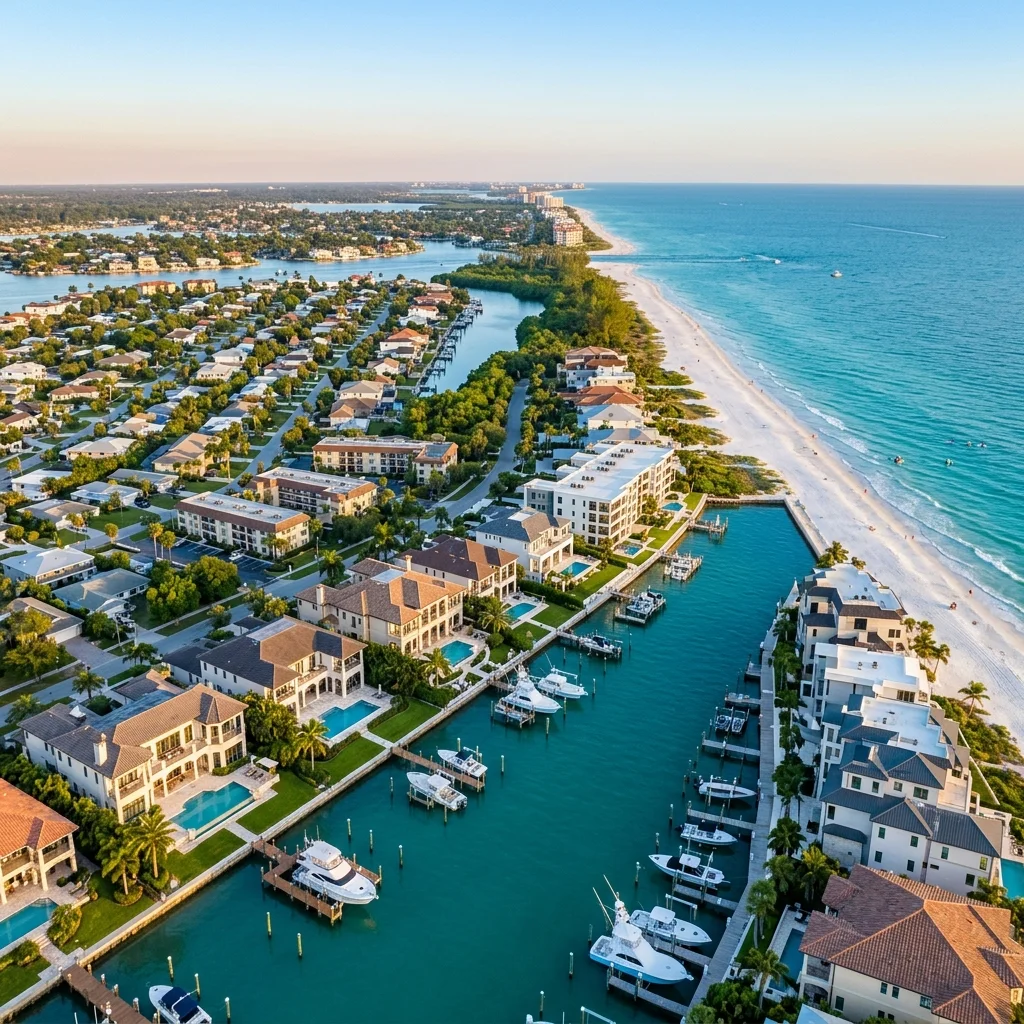
Both Sarasota and Naples finished 2025 with gains in the number of homes sold, particularly in single-family inventory. Late in the year, both markets posted several consecutive months of notable increases in sales (Source: [Primary Data]). Yet price behavior diverged. According to Budge Huskey of Premier Sotheby’s International Realty, “Average prices continued to rise in Naples, while Sarasota experienced modest softening” (Source: [Quote from Budge Huskey]). This divergence reflects different buyer profiles and inventory balances. Naples, with its heavier concentration of ultra-high-net-worth individuals and stricter development limits, maintained upward price pressure. Sarasota, which has seen more new construction and a broader mix of second-home buyers, experienced a mild correction as supply caught up with demand.
Since 2020, prices in these local Gulf Coast markets have risen by roughly 50 percent (Source: [Primary Data]). That cumulative gain has fundamentally reset entry thresholds. A prominent economist noted that to restore affordability to pre-COVID levels, wages would need to increase more than 50 percent, interest rates would need to fall to the low 2 percent range, or home prices would need to decline approximately 35 percent (Source: [Primary Data]). None of those scenarios appear probable in 2026, meaning the market is structurally locked into a high-price equilibrium that favors existing homeowners and cash buyers over first-time entrants.
The Condo Conundrum: Fear of Future Holding Costs
Condominium sales lagged significantly in 2025, especially in coastal areas. The primary driver, according to market participants, was “buyer hesitation around the predictability of future holding costs” (Source: [Quote from Budge Huskey]). This is not merely a reaction to elevated mortgage rates. It reflects a systemic uncertainty about two rapidly rising expenses: property insurance and homeowners association (HOA) fees. Florida’s property insurance market has seen double-digit premium increases for three consecutive years, driven by litigation costs, reinsurance rates, and climate risk. Meanwhile, condominium associations, particularly for older buildings, are facing mandatory reserve funding and structural inspections following the 2021 Surfside collapse—resulting in special assessments that can exceed $100,000 per unit.
In contrast, single-family luxury homes on the Gulf Coast are often owned free and clear by buyers who can absorb insurance increases without leverage. This asymmetry reinforces the two-tier market: the rich buy luxury single-family homes with cash; the less wealthy, or those seeking lower entry points, hesitate to commit to condos where future costs are unpredictable. Florida continues to set records at the ultra-luxury end (Source: [Primary Data]), but the condo segment remains a drag on overall transaction volume.
The Two-Tier Landscape: Implications for 2026
The Gulf Coast market entering 2026 is not a single market but two parallel markets operating under different rules. The luxury segment—defined loosely as homes above $1 million, and especially those above $3 million—will continue to benefit from in-migration of affluent households, low inventory of waterfront properties, and the absence of storm disruptions during the 2025 season (Source: [Primary Data]). The non-luxury segment, particularly condos and older single-family homes priced below $750,000, faces headwinds from insurance costs, HOA fee uncertainty, and the diminished purchasing power of middle-income buyers.
For sellers, the implication is clear: pricing expectations must be calibrated to the tier. Luxury sellers in Naples can command premiums; Sarasota sellers may need to adjust expectations if their property does not occupy the top quartile. For buyers, the rational strategy is to focus on assets with predictable holding costs—newer construction, low-rise condos with well-funded reserves, or single-family homes on fee-simple land. For investors, the decoupling suggests that capital should flow to the luxury single-family segment, while condo investments require deep due diligence on insurance, reserves, and regulatory compliance.
National forecasts for 2026 project a ~5% increase in closed sales and ~2% price appreciation (Source: [Primary Data]). On the Gulf Coast, these aggregates are likely to be exceeded at the luxury end and missed at the lower end. The market is not healing; it is restructuring. The two-tier landscape is not a temporary anomaly but a structural feature that will persist as long as the gap between wealth concentration and wage growth remains unbridged.
Keywords

Fatima Al-Zahra
Real Estate Editor specializing in Dubai and Riyadh mega-projects.