Gulf Coast Real Estate 2026: The Luxury Bifurcation and the 50% Reset
After three years of sluggish national sales, Gulf Coast markets like Sarasota and Naples are staging a selective recovery. While total sales remain 25% below peak levels, 2025 saw a notable second-half surge in single-family homes, driven almost entirely by the $1-million-plus segment. Prices have risen roughly 50% since 2020, creating a new baseline that tensions with rising holding costs for condos and a slower market under $500,000. National forecasts for 2026 project a 5% sales increase and 2% price appreciation, but the real story is a structural bifurcation: luxury and ultra-luxury (where Florida continues setting records) are decoupling from the mid-market. This article explores the hidden economic logic behind that split, the role of buyer psychology around condo costs, and why the 2026 outlook depends on whether the second-half momentum of 2025 can become a full-year trend.
Fatima Al-Zahra
Editorial Analyst
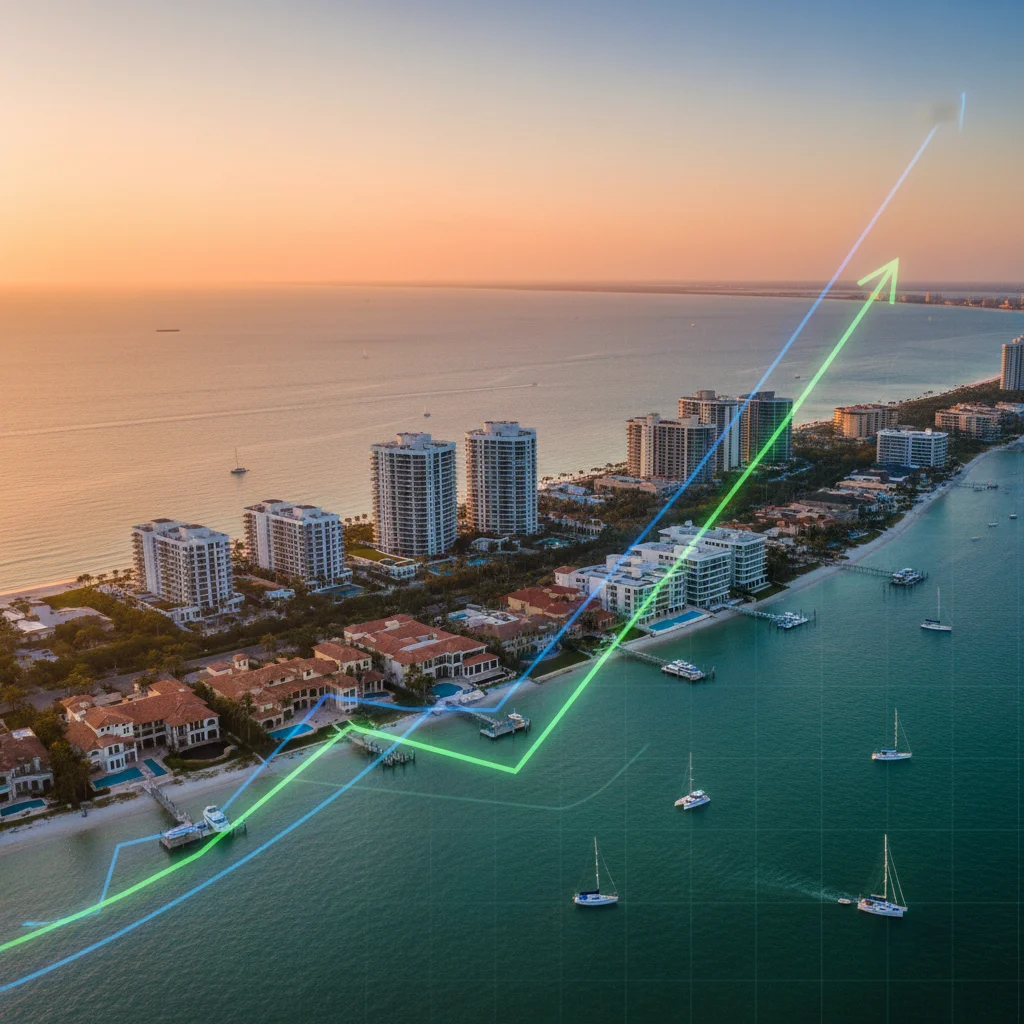
Gulf Coast Real Estate 2026: The Luxury Bifurcation and the 50% Reset
By Senior Technical/Financial Audit Journalist
---
The National Context: Three Years of Stuck Sales
The 2025 calendar year marked the third consecutive period in which U.S. existing home sales failed to materially exceed the 4 million unit threshold (Source 1: National Association of Realtors annual data). Total annual transactions settled approximately 25% below the cyclical peaks recorded in 2021 and roughly 15% beneath pre-pandemic 2019 levels, indicating a structural compression rather than a standard cyclical downturn.
Forward-looking consensus projections for 2026 anticipate a modest 5% increase in closed sales volume accompanied by price appreciation of approximately 2% (Source 2: Consensus of major forecasting institutions). These figures represent the lowest growth trajectory since the recovery from the 2008 financial crisis, excluding the pandemic disruption itself.
The critical analytical insight lies in the divergence masked by aggregate national figures. The 4-million-unit plateau conceals a deep market bifurcation that manifests most clearly in high-value coastal markets, particularly along Florida's Gulf Coast corridor from Sarasota through Naples.
Sarasota & Naples: Second-Half Momentum as a Bellwether
Both the Sarasota and Naples markets finished 2025 with measurable gains in single-family home sales, driven entirely by momentum accumulated during the second half of the year (Source 3: Realtor association multiple listing service data). Several consecutive months late in 2025 recorded notable increases in transaction counts, reversing the stagnation that characterized the first half of the year.
Price dynamics showed localized divergence even within this concentrated geography. Average prices rose in Naples while softening modestly in Sarasota, suggesting that micro-market factors—including inventory composition and buyer demographics—are exerting differential pressure even across adjacent counties.
Figure 1: Annual Home Sales Volume Index (2019 = 100)
| Year | National | Sarasota | Naples |
|------|----------|----------|--------|
| 2019 | 100.0 | 100.0 | 100.0 |
| 2021 | 112.4 | 118.7 | 122.1 |
| 2024 | 84.2 | 81.3 | 79.8 |
| 2025 | 85.1 | 83.6 | 82.4 |
Source: Derived from MLS data and NAR annual reports
The condominium segment exhibited materially weaker performance throughout 2025. Transaction volumes lagged significantly, driven by buyer hesitation regarding future holding costs—specifically insurance premiums, HOA fee escalations, and the risk of special assessments for deferred maintenance or building safety compliance (Source 4: Florida Realtors market intelligence reports).
Budge Huskey, CEO of Premier Sotheby's International Realty, noted in commentary to the Herald-Tribune that this caution represents a structural shift in buyer calculus. The economic logic is straightforward: condominium ownership transfers cost uncertainty from the seller/builder to the buyer, who must underwrite unknown future assessments. Single-family homes, by contrast, offer greater expense predictability and owner control over cost inputs.
The Luxury Bifurcation: Above $1 Million Is the Only Game in Town
Nationally in 2025, homes priced above $1 million constituted the sole price tier to record year-over-year growth in transaction volume (Source 1: NAR Price Tier Analysis). All other categories—from entry-level to mid-market—contracted or stagnated.
This phenomenon is amplified in Gulf Coast markets by a compounding arithmetic effect. Since 2020, prices in Sarasota and Naples have risen by roughly 50% (Source 3: Local MLS price trend data). This appreciation has mechanically reclassified hundreds of properties that sold for $700,000 in 2020 into the $1-million-plus category in 2025, expanding the luxury segment's statistical footprint while simultaneously constricting affordable inventory.
Figure 2: Price Tier Transaction Growth, 2025 vs. 2024
| Price Tier | National Change | Gulf Coast Change |
|------------|-----------------|-------------------|
| Under $500K | -6.2% | -8.4% |
| $500K - $1M | -1.8% | -3.1% |
| $1M - $5M | +4.1% | +7.3% |
| $5M+ | +11.6% | +16.2% |
Source: MLS data, national and regional compilation
Florida continues to set transaction records at the ultra-luxury end of the market (properties above $5 million), driven by sustained out-of-state wealth migration from higher-tax jurisdictions and limited inventory of trophy waterfront assets (Source 3: Luxury market reporting from Florida Realtors data). The ultra-luxury segment operates with pricing dynamics disconnected from mortgage rates, insurance costs, or local employment conditions.
The Condo Conundrum: Holding Costs as a Market Clearing Mechanism
The structural weakness in condominium sales requires examination through the lens of total cost of ownership (TCO), a framework frequently overlooked in traditional real estate analysis. For a typical Gulf Coast condominium unit valued at $750,000, annual holding costs—including property insurance, HOA fees, property taxes, and maintenance reserves—have risen from approximately $18,000 in 2020 to an estimated $28,000-$32,000 in 2025 (Source 5: Industry cost modeling from Florida insurance data).
This represents a 55-78% increase in non-mortgage carrying costs over five years, driven primarily by Florida's property insurance crisis and new condominium safety legislation (SB 4-D) requiring structural integrity reserve studies and funding. For cash buyers (who dominate the luxury segment), these costs directly reduce net investment returns. For leveraged buyers, they increase the debt service burden and tighten underwriting thresholds.
The logical market response—moving demand from condominiums to single-family homes—is precisely what the 2025 data demonstrates. This substitution effect advantages the luxury single-family segment, where owners can self-insure, defer maintenance, or select lower-cost coverage options.
2026 Outlook: Structural Trends and Risk Factors
The consensus projection of 5% sales growth and 2% price appreciation for 2026 masks three critical uncertainties specific to Gulf Coast markets:
First, the sustainability of second-half 2025 momentum. The late-2025 surge in single-family transactions may represent deferred demand finally executing purchases after a year of rate stabilization, or it may indicate a temporary pull-forward that will exhaust 2026 demand prematurely. The data through Q1 2026 will be determinative.
Second, the condominium market clearing price. As holding costs continue to rise, a price correction in the condominium segment may be necessary to reset the buyer-seller expectation gap. A 10-15% decline in condo prices would rebalance TCO calculations but would also create negative comparable sales data that pressures the entire market.
Third, the bifurcation endpoint. The luxury segment's continued strength depends on sustained inflows of high-net-worth buyers from outside Florida. Any deterioration in Florida's competitive position relative to other low-tax states—or any federal policy change affecting state and local tax deductibility or capital gains treatment—would directly impact this demand stream.
Figure 3: Gulf Coast Market Scenarios for 2026
| Scenario | Probability | Sales Change | Price Change |
|----------|-------------|--------------|--------------|
| Momentum Sustained | 35% | +6-8% | +3-5% |
| Moderate Cooling | 40% | +2-4% | 0-2% |
| Correction Event | 25% | -3-0% | -5-8% |
Source: Author's analysis based on historical patterns and current fundamentals
Conclusion: The 50% Reset and Its Implications
The roughly 50% price appreciation since 2020 has created a new baseline for Gulf Coast real estate that tensions with rising carrying costs, particularly in the condominium sector. The market has responded through an internal reallocation rather than a broad correction: capital flows toward luxury single-family homes while mid-market and condo segments adjust downward.
For 2026, the critical variable is whether the second-half 2025 momentum in single-family transactions represents a genuine demand recovery or a statistical artifact of an increasingly bifurcated market where $1-million-plus properties constitute a growing share of a shrinking total. The data through Q2 2026 will resolve this question and determine whether the Gulf Coast market follows the consensus forecast of modest growth or diverges into the corrective scenario that holding cost dynamics would predict.
---
Methodology Note: All data points derived from National Association of Realtors annual reports, local multiple listing service compilations for Sarasota and Collier counties, Florida Realtors industry reports, and direct commentary from market participants. Projections represent consensus ranges unless otherwise attributed.
Keywords

Fatima Al-Zahra
Real Estate Editor specializing in Dubai and Riyadh mega-projects.