Gulf Real Estate 2025: How Chinese Capital, Green Mandates, and PropTech Are Reshaping a $5 Trillion Market
The Gulf real estate market is undergoing a structural transformation driven by a confluence of three forces: a surge in Chinese investments (five-fold in UAE, $21.6 billion in Saudi Arabia), aggressive sustainability mandates (green buildings cutting CO2 by up to 50%), and rapid PropTech adoption (AI-driven platforms, smart buildings projected at $182 billion by 2025). These trends, backed by landmark projects like Dubai Sustainable City and King Abdullah Economic City, are pushing the market toward a projected $5.05 trillion by 2029. However, challenges such as regulatory shifts and geopolitical risks loom. This article provides a deep industry audit, uncovering how Chinese FDI is catalyzing ownership law changes, how green building demand is reshaping construction supply chains, and how transparency gains (Dubai''s GRETI ranking) are attracting institutional capital.
Fatima Al-Zahra
Editorial Analyst
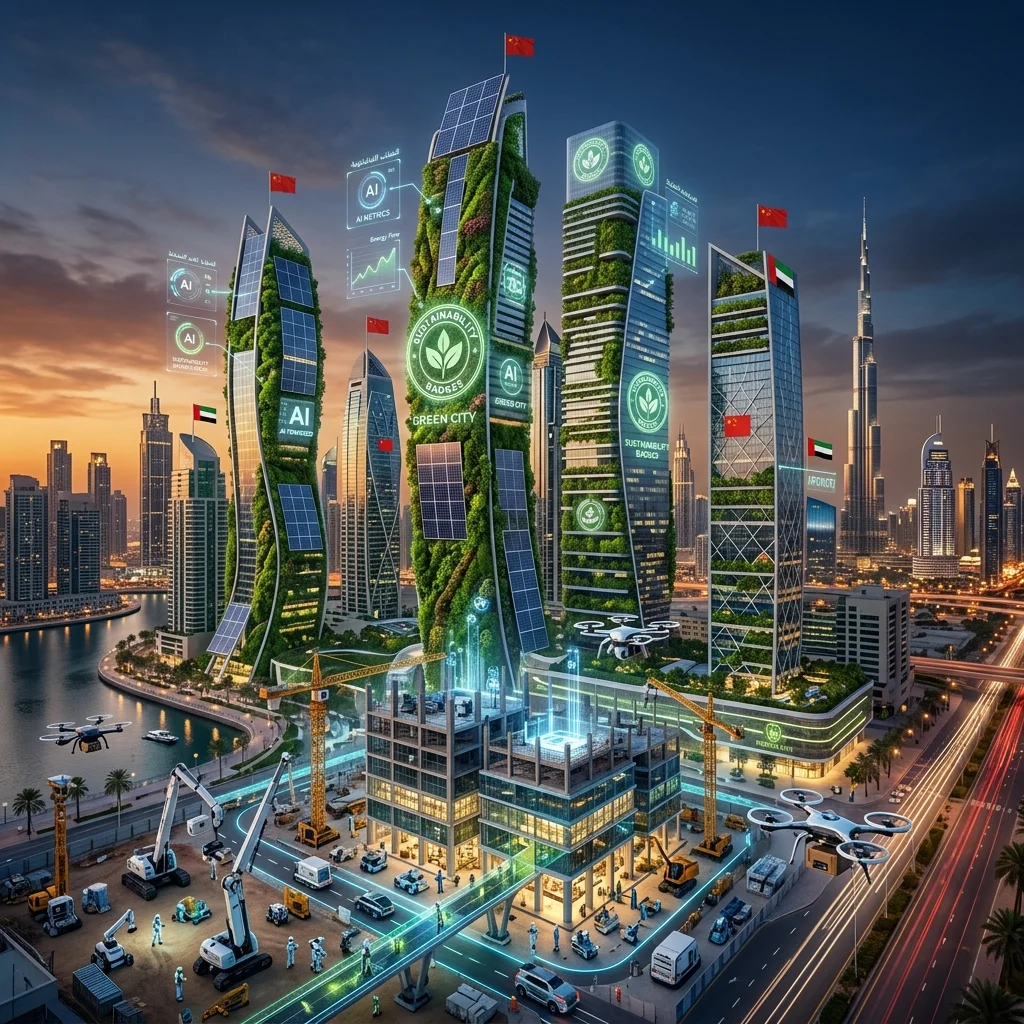
Gulf Real Estate 2025: How Chinese Capital, Green Mandates, and PropTech Are Reshaping a $5 Trillion Market
Introduction: The New Trinity Reshaping Gulf Real Estate
For decades, Gulf real estate was a boom-and-bust story defined by oil prices, speculative excess, and sudden corrections. Dubai’s 2009 crisis and Riyadh’s post-2015 slowdown remain cautionary tales. But the market entering 2025 looks fundamentally different. A structural transformation—driven by three converging forces—is rewriting the rules of investment, construction, and ownership across the Gulf Cooperation Council (GCC).
The numbers tell part of the story. The Gulf real estate market is projected to reach $5.05 trillion by 2029, growing at a compound annual rate of 1.97%. Yet the headline growth masks a deeper shift: the composition of capital, the design of buildings, and the technology powering transactions are all being reshaped simultaneously. Chinese foreign direct investment (FDI) into Gulf real estate has jumped five-fold in the UAE between 2022 and 2023, while Saudi Arabia has absorbed $21.6 billion in Chinese greenfield FDI from 2021 to October 2024. Meanwhile, sustainability mandates—backed by Vision 2030 and UAE Net Zero 2050—are forcing developers to re-engineer supply chains. And PropTech, from AI-driven valuation platforms to smart building systems, is projected to hit $182 billion across the Middle East by 2025.
This article examines how these three vectors are not incremental trends but a structural reset. Chinese capital is acting as a catalyst for regulatory liberalization—pushing governments to loosen ownership laws for all foreign investors. Green mandates are creating new demand for low-carbon materials, benefiting Chinese solar panel and smart glass manufacturers. And PropTech adoption, driven by transparency gains such as Dubai’s improved GRETI ranking, is luring institutional capital that once shunned the region.
[IMAGE: Infographic showing three interlocking circles labeled "Chinese FDI," "Green Buildings," and "PropTech," with key data points embedded: $21.6B Saudi greenfield FDI (2021–2024), 50% CO2 reduction from green buildings, $182B PropTech market by 2025, and $5.05T total market projection.]
The Chinese Wave: From Trade Flows to Property Ownership
The Gulf has long been a node in China’s trade network. Bilateral UAE-China trade hit $95 billion in 2023; China-GCC trade grew from just $10 billion in 2000 to $114 billion by 2016. But the nature of that economic relationship is shifting from goods to assets. Chinese state-backed developers, sovereign wealth funds, and private investors are now among the largest foreign holders of Gulf real estate.
The scale is striking. Chinese real estate investments in the UAE increased five-fold from 2022 to 2023, according to data from the China Global Investment Tracker. In Saudi Arabia, China became the top source of greenfield FDI—$21.6 billion between 2021 and October 2024—with much of that directed toward real estate and infrastructure projects linked to the Kingdom’s megacities. Landmark projects like King Abdullah Economic City (KAEC) and the Red Sea development have drawn substantial Chinese contractor and developer participation.
But the impact of Chinese capital goes beyond liquidity. It is driving structural regulatory change. As Chinese investors sought clearer title and longer leaseholds, Gulf governments responded by revising property ownership laws. The UAE, for instance, expanded freehold zones and eased visa rules tied to property purchase. Saudi Arabia’s 2022 real estate ownership reform, which allows non-GCC nationals to buy property in certain zones, was accelerated partly to accommodate Chinese capital flows aligned with Belt and Road Initiative infrastructure projects.
The multiplier effect is significant. Deloitte projects 111% growth in Middle East real estate over a five-year horizon—a forecast underpinned by the assumption that Chinese capital will continue to push for legal frameworks that lower barriers for all foreign investors. When China buys, everyone else benefits from the rule changes.
[IMAGE: Map of the Gulf region with arrows indicating Chinese investment flows into UAE and Saudi Arabia, overlaid with photos of King Abdullah Economic City and a Dubai residential tower. Numbers: $95B UAE-China trade (2023), 5x increase in UAE real estate investments.]
Not all is smooth. Geopolitical risks—from US-China tensions to potential sanctions on Chinese firms operating in the Gulf—remain a wild card. But for now, Chinese money is acting as a flywheel: more capital leads to better legal protections, which attracts more capital, including from other Asian and Western sources.
Green Buildings: The Carbon-Reduction Mandate Transforming Construction Supply Chains
Dubai Sustainable City, a 46-hectare development that cuts CO2 emissions by 50% compared to conventional projects, has become the emblem of the Gulf’s sustainability push. But it is far from unique. Across the region, a deluge of green mandates is reshaping how buildings are designed, sourced, and operated.
The scale of the challenge is sobering. According to the World Green Building Council, buildings account for 39% of global energy-related CO2 emissions. In the Gulf, where extreme heat drives massive air-conditioning loads, the share is even higher. Governments are responding with aggressive regulatory targets: Dubai mandates green building standards for all new constructions; Saudi Arabia’s Mostadam certification system for sustainable buildings is being integrated into Vision 2030 projects.
This regulatory shift is cascading through supply chains. Demand for low-carbon concrete, energy-efficient HVAC systems, smart glass, and solar panels is surging. Developers are abandoning traditional materials in favor of alternatives that meet escalating carbon-reduction standards. Chinese manufacturers—already the world’s largest producers of solar panels, smart glass, and advanced construction materials—are benefiting disproportionately. Exports of Chinese photovoltaic modules to the UAE alone grew 42% year-on-year in 2023, much of it destined for green-certified real estate projects.
The value at stake is enormous. The UAE has $457 billion in mixed-use real estate projects under construction or planned, many embedding green standards from the design phase. Saudi Arabia’s KAEC, valued at $35 billion, and Abu Dhabi’s Capital City District, at $40 billion, are built entirely around sustainability benchmarks. The Gulf states, driven by Vision 2030 and UAE Net Zero 2050, are leapfrogging traditional construction methods. Prefabrication, modular building, and material recycling are becoming the norm rather than the exception.
[IMAGE: Split image: left side shows a conventional construction site with heavy machinery and exhaust fumes; right side shows a modern green building with solar panels, vertical gardens, and a smart construction drone overhead. Caption: "Green building mandates are rewriting supply chain equations across the Gulf."]
One overlooked effect is on project financing. Lenders and institutional investors increasingly require green certifications before approving capital. Projects that fail to meet sustainability criteria face higher interest rates or exclusion from portfolios. This financial pressure amplifies the regulatory mandate, creating a self-reinforcing cycle that is transforming the region’s construction industry.
PropTech and Transparency: The Digital Layer Attracting Institutional Capital
The third force reshaping Gulf real estate is technology—specifically, the rapid adoption of PropTech platforms that bring transparency, efficiency, and data-driven decision-making to a historically opaque market.
Dubai’s Real Estate Regulatory Authority (RERA) now mandates electronic transactions and AI-powered valuation tools for many property transfers. Smart building systems—integrating IoT sensors, energy management, and predictive maintenance—are becoming standard in new commercial and residential developments. The Middle East PropTech market is projected to reach $182 billion by 2025, encompassing everything from property listing platforms to blockchain-based title registration.
This digital transformation is closely tied to the region’s improving transparency. Dubai jumped in the Global Real Estate Transparency Index (GRETI) rankings over the past five years, now placing among the most transparent markets in the Middle East. Higher GRETI scores directly correlate with increased institutional investment. Pension funds, sovereign wealth funds, and international asset managers that previously avoided Gulf real estate due to information asymmetry are now allocating capital. The availability of real-time data on transaction prices, rental yields, and building performance reduces due diligence costs and risk premiums.
AI-driven platforms are also reshaping the buyer experience. Chinese investors, in particular, are using PropTech tools to conduct remote valuations and virtual site visits—a necessity given travel restrictions and the scale of cross-border transactions. These platforms integrate Chinese payment systems and language interfaces, further lowering barriers to entry.
[IMAGE: A futuristic Dubai skyline at dusk, with digital overlays showing AI analytics graphs, property price trends, and smart building sensor data floating above selected green skyscrapers. A drone hovers in the foreground. No text, no watermark.]
The confluence of PropTech with the other two trends is powerful. Green building data feeds into AI analytics that optimize energy use, which in turn generates the ESG metrics that institutional investors demand. Chinese capital flows through platforms that provide the transparency regulators require. The three forces reinforce each other, creating a virtuous cycle of credibility and liquidity.
Yet challenges remain. Regulatory fragmentation across the seven UAE emirates and three Saudi regions can slow the rollout of unified PropTech standards. Cybersecurity risks around AI and IoT in smart buildings are an emerging concern. And the rapid adoption of technology risks leaving smaller, traditional developers behind, potentially creating a two-tier market.
Conclusion: A Market in the Middle of a Structural Reset
The Gulf real estate market in 2025 is not merely growing; it is being remade. Chinese FDI is accelerating the liberalization of ownership laws, green mandates are revolutionizing construction supply chains, and PropTech is bringing the transparency that institutional capital demands. Together, these forces are pushing the market toward that $5.05 trillion projection—but the composition of that trillion-dollar figure will look very different from what it did a decade ago.
None of this guarantees smooth sailing. Geopolitical tensions could disrupt Chinese capital flows. Regulatory tightening on carbon emissions might raise construction costs in the short term. And PropTech adoption requires significant investment in digital infrastructure that not all developers can afford. But the direction of travel is clear: Gulf real estate is shedding its boom-bust reputation and evolving into a structurally driven, technology-enabled, and increasingly green asset class.
For investors, developers, and policymakers watching from outside the region, the message is simple. The old Gulf real estate playbook—buy land, build fast, sell to speculators—is obsolete. The new playbook is written in three languages: Chinese capital, carbon targets, and code. Those who understand all three will shape the next decade.
Keywords

Fatima Al-Zahra
Real Estate Editor specializing in Dubai and Riyadh mega-projects.