Beyond Traffic Flow: How Hessa Street''s Upgrade Reveals Dubai''s Strategic Urban Mobility Blueprint
The completion of Hessa Street's upgrade by Dubai's RTA, featuring new lanes, junctions, and pedestrian bridges, is more than a traffic solution. This analysis uncovers the project as a strategic node in Dubai's long-term urban planning, designed to unlock economic value in adjacent districts like Al Barsha and Dubai Hills. By examining the hidden logic behind the 3,200 new parking spaces and integrated pedestrian infrastructure, we reveal how such projects are calibrated to boost real estate accessibility, support retail and commercial growth, and systematically increase the city's overall transport network capacity. This move signals a shift from isolated roadworks to holistic urban development engines.
Fatima Al-Zahra
Editorial Analyst
Beyond Traffic Flow: How Hessa Street's Upgrade Reveals Dubai's Strategic Urban Mobility Blueprint
Introduction: The Surface-Level Facts and the Hidden Blueprint
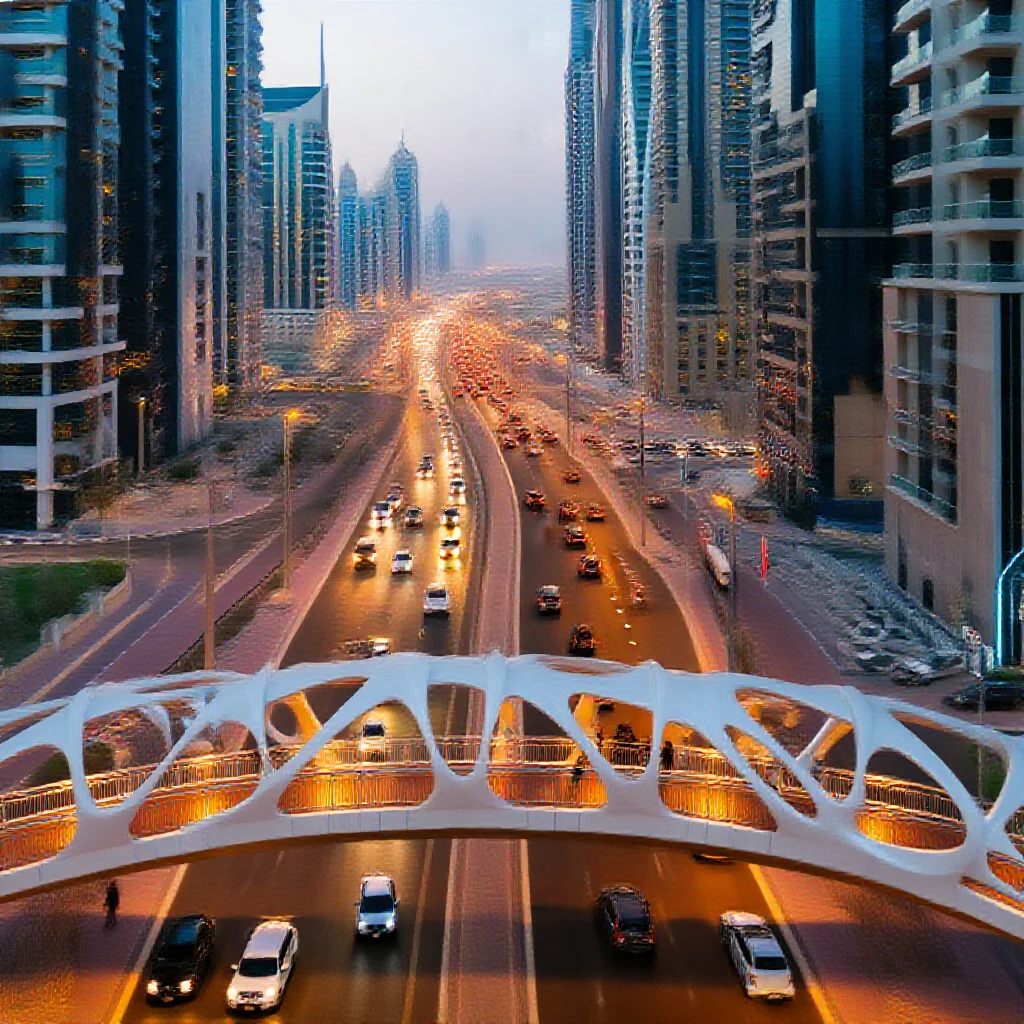
The Road and Transport Authority (RTA) has completed and opened a comprehensive upgrade of Hessa Street. The announced deliverables include the addition of a fifth lane in each direction, the construction of four new signalised junctions, eight pedestrian crossings, two footbridges, and 3,200 new parking spaces (Source 1: [Primary Data]). The stated objective is the improvement of traffic flow and increased capacity.
This project, however, represents more than an isolated traffic mitigation effort. Its scale and specific components indicate a calibrated intervention within Dubai’s broader urban framework. The upgrade functions as a strategic investment designed to unlock latent economic value and catalyze development in adjacent residential and commercial corridors, including Al Barsha and Dubai Hills Estate.
Decoding the Infrastructure: Each Element as an Economic Catalyst
Lanes & Junctions as Capacity Injectors
The expansion to five lanes in each direction and the new junctions constitute a direct capacity injection into the local transport network. This enhanced throughput is not merely for current demand but is engineered to serve the projected growth of high-density districts like Dubai Hills Estate. Improved vehicular access directly influences property valuation and commercial viability by reducing a key friction point: congestion. The upgrade systematically increases the effective service area of major employment and retail hubs, including those along Sheikh Zayed Road.
Parking as a Commercial Enabler
The addition of 3,200 parking spaces is a strategically significant component (Source 1: [Primary Data]). In urban economic terms, parking is a critical utility that supports retail footfall and office occupancy. Its provision addresses a major constraint for commercial growth, particularly in areas within proximity to the Mall of the Emirates and Al Barsha’s business clusters. By reducing search time and congestion caused by circulating vehicles, this infrastructure supports higher turnover for businesses and enhances the district's overall attractiveness as a destination.
Pedestrian Infrastructure as Livability Signals
The construction of eight pedestrian crossings and two footbridges signals a shift toward the concept of "complete streets." This infrastructure elevates pedestrian safety and network connectivity, which are key metrics in urban livability indices. Enhanced walkability contributes to longer-term asset values by making neighborhoods more attractive for residential investment and supporting higher-quality, mixed-use urban environments.
!Split image showing a busy commercial plaza parking lot and the new footbridge in use.
The Strategic Context: Connecting to Dubai's Supreme Committee Vision
The Hessa Street project aligns with the integrated planning mandate of Dubai’s Supreme Committee of Urban Planning. The Committee’s published framework emphasizes the synchronization of land use and transportation planning to drive sustainable urban growth. This upgrade operationalizes that principle.
Functionally, Hessa Street acts as a critical feeder and distributor for Dubai’s primary arterial network, including Sheikh Zayed Road and Al Khail Road. By increasing its capacity and efficiency, the project enhances the resilience and total throughput of the entire metropolitan transport system. It transforms a local corridor into a more robust link within the city-wide mobility matrix, a move consistent with the Supreme Committee’s goal of developing integrated urban corridors.
The Deep Audit: Long-Term Impacts on Real Estate and Supply Chains
The Unreported Angle: Catalyzing Adjacent Sectors
Beyond immediate traffic relief, the upgrade’s long-term impact will manifest in adjacent economic sectors. Improved access and reduced congestion directly influence commercial real estate demand in Al Barsha’s office and retail segments. Furthermore, the enhanced road network benefits the logistics and warehouse operations in the area’s industrial zones. More efficient freight movement supports just-in-time supply chains, reducing operational costs and increasing the competitiveness of businesses reliant on those corridors.
Pattern Recognition: From Isolated Projects to Development Engines
The Hessa Street upgrade fits an established pattern of RTA infrastructure projects that precede and enable significant urban development. These projects are not reactive but proactive, designed to create the conditions for planned economic activity. The methodology involves a multi-variable calculus incorporating projected population growth, real estate master plans, and commercial zoning.
Future Trajectory and Market Implications
The logical deduction from this pattern indicates that similar strategic upgrades will target other emerging or congested corridors identified in Dubai’s urban master plan. The measurable outcomes will include stabilized or increased property values in directly serviced districts, higher retail sales densities due to improved accessibility, and an incremental increase in the city’s aggregate transport network capacity. This approach systematically de-risks future development by ensuring mobility infrastructure is not a subsequent bottleneck but a foundational enabler.
The completion of the Hessa Street development works, therefore, is a discrete event within a continuous strategic process. It provides a concrete case study in how transport infrastructure is deployed as a precise instrument of urban economic policy, moving beyond traffic flow to shape the city’s growth trajectory.
Keywords

Fatima Al-Zahra
Real Estate Editor specializing in Dubai and Riyadh mega-projects.