Beyond the $718M Tender: How Kuwait''s Umm al-Hayman Project Signals a Strategic Shift in Gulf Infrastructure
Kuwait's Public Authority for Housing Welfare (PAHW) has set an April 2024 tender deadline for the $718 million Umm al-Hayman wastewater and treated water conveyance system. While the project details—including new networks, pumping stations, and a 20,000 cubic meter storage tank—are significant, the deeper story lies in its strategic implications. This article analyzes the project not just as a construction tender, but as a critical node in Kuwait's long-term economic diversification and water security strategy. It examines the underlying market patterns, the strategic choice of UK consultant AtkinsRéalis, and the project's potential to reshape regional supply chains and set new benchmarks for sustainable urban development in arid climates.
Fatima Al-Zahra
Editorial Analyst
Beyond the $718M Tender: How Kuwait's Umm al-Hayman Project Signals a Strategic Shift in Gulf Infrastructure
The Surface Facts: Decoding the $718M Umm al-Hayman Tender
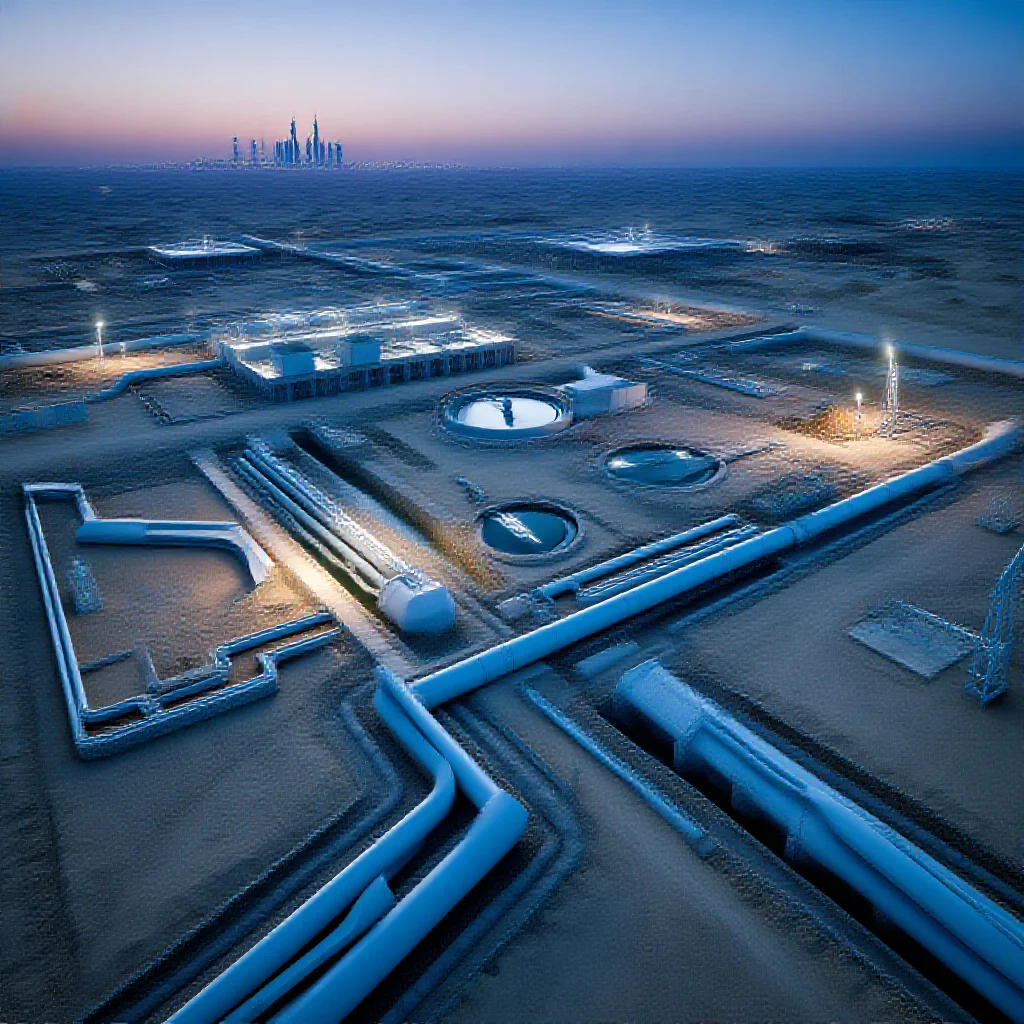
Kuwait's Public Authority for Housing Welfare (PAHW) has established a tender submission deadline of April 2024 for the Umm al-Hayman wastewater and treated water conveyance system, a project with an estimated value of $718 million (Source 1: [Primary Data]). The scope of work extends beyond conventional drainage, encompassing the construction of new networks and pumping stations for both wastewater and treated water. A critical component is a treated water storage tank with a capacity of 20,000 cubic meters (Source 1: [Primary Data]).
The client, PAHW, operates under a mandate to develop residential infrastructure. The selection of the United Kingdom's AtkinsRéalis as the main consultant (Source 1: [Primary Data]) introduces an international engineering firm with a significant portfolio in complex water and urban development projects. This initial layer of data presents a substantial public works tender, but its strategic weight becomes apparent upon deeper examination of its context and specifications.
Fast Analysis vs. Slow Audit: Why This is a 'Slow Burn' Strategic Move
A fast analysis would categorize this project as a large-scale utility upgrade. A slow audit, however, reveals its function as enabling infrastructure for long-term national development. The project's scale and its client—the housing authority—directly link it to Kuwait's capacity for future residential and economic expansion. Inefficient or insufficient water management infrastructure acts as a hard constraint on urban growth, particularly in arid environments.
The project aligns with the strategic objectives of Kuwait's Vision 2035, which aims to transform the country into a regional financial and commercial hub. This vision necessitates the development of new housing cities and economic zones, all of which are predicated on reliable, modern utility networks. The Umm al-Hayman system is therefore not merely a response to existing need but a calculated investment to unlock future land value and economic activity. It transitions water management from a reactive public service to a proactive strategic asset.
The Hidden Economic Logic: Water as a Strategic Commodity in the Gulf
The inclusion of a dedicated treated water conveyance network and a large-scale storage tank is a significant detail. It indicates an operational model where treated effluent is not merely disposed of but is managed as a recoverable resource. In a region of extreme water scarcity, this infrastructure creates the potential for revenue generation through the sale or allocation of treated water for non-potable uses, such as district cooling, industrial processes, or landscape irrigation for new urban developments. This shifts the project's financial calculus from a pure cost center to a potential contributor to a circular water economy.
The project's scale will impact regional supply chains. A contract of this magnitude requires specialized materials, technology, and expertise, potentially fostering a localized hub for advanced water infrastructure services within Kuwait. Furthermore, the client's choice of AtkinsRéalis as consultant signals specific priorities. The selection of a UK-based firm with a global reputation for sustainability and lifecycle cost engineering suggests that PAHW is prioritizing international Environmental, Social, and Governance (ESG) standards and long-term operational efficiency. This decision may influence financing conditions, as international lenders and partners increasingly mandate such benchmarks, and could set a precedent for technical specifications in future Gulf infrastructure projects.
Evidence and Verification: Anchoring the Analysis in Credible Context
The strategic analysis is anchored in verifiable market patterns and policy frameworks. The tender's $718 million valuation (Source 1: [Primary Data]) places it within the upper tier of Gulf infrastructure projects, attracting scrutiny from major international contractors and financiers. The involvement of PAHW directly ties the project to Kuwait's documented housing and urban development goals, which are publicly outlined in its national vision documents.
The consultant selection provides empirical evidence of technical ambition. AtkinsRéalis's project history includes master planning and sustainable infrastructure development across the Middle East, indicating a client demand for integrated, future-proof design rather than standalone construction. This pattern is consistent with a broader regional trend, observed in Saudi Arabia's NEOM and the UAE's Masdar City, where utility infrastructure is designed from inception to support ambitious urban and economic models.
Neutral Market and Industry Predictions
The issuance of this tender will intensify competition among global and regional engineering, procurement, and construction (EPC) consortia. Bidding strategies will likely emphasize technological solutions for energy efficiency and smart network management. The project will serve as a reference case for integrating water reuse infrastructure into large-scale housing projects, potentially establishing new technical benchmarks for the region.
Successful execution of the Umm al-Hayman project may accelerate similar strategic investments across the Gulf Cooperation Council (GCC) states, as nations prioritize water security as a non-negotiable foundation for economic diversification. The long-term industry impact will be measured by the degree to which this project's design and operational principles are adopted in future tenders, reinforcing the shift from viewing water infrastructure as a public cost to managing it as a core component of national economic resilience.
Keywords

Fatima Al-Zahra
Real Estate Editor specializing in Dubai and Riyadh mega-projects.