Middle East Real Estate Market 2026-2034: Growth, Affordability Gaps, and Sustainability Constraints
The Middle East real estate market is projected to surge from USD 937.85 billion in 2026 to USD 1.78 trillion by 2034, driven by government mega-projects, visa liberalization, and foreign investment. However, structural challenges—including a 60% homeownership affordability gap among young Saudis, soaring prime prices in Dubai, and severe environmental costs from water desalination and energy use—threaten long-term stability. This article analyzes the dual-track dynamics of rapid expansion and emerging constraints, highlighting co-living trends, regulatory risks, and the need for sustainable urban planning in Gulf markets.
Fatima Al-Zahra
Editorial Analyst
Middle East Real Estate Market 2026-2034: Growth, Affordability Gaps, and Sustainability Constraints
The Middle East real estate market is on a trajectory that few global regions can match. According to projections from Market Data Forecast Ltd and BMI Research, the market value is expected to surge from USD 937.85 billion in 2026 to USD 1.78 trillion by 2034, representing a compound annual growth rate of 8.31%. This expansion is fueled by ambitious government urbanization programs, visa liberalization policies, and a steady influx of foreign capital. Yet beneath these headline figures lie structural challenges—a stark affordability gap among young locals, soaring luxury prices in prime districts, and mounting environmental costs from water-intensive development—that could undermine long-term stability. This article examines the dual-track dynamics propelling rapid expansion while exposing the constraints that industry stakeholders must navigate.
[IMAGE: Map of Middle East with bubble sizes representing market value by country, 2026 vs 2034]
The Big Picture: A Market Set to Double
The region's real estate boom is not a single story but a convergence of national strategies. Saudi Arabia's Vision 2030 remains the most powerful engine: the Kingdom delivered over 700,000 housing units in 2023 alone, with plans to accelerate further. The UAE's Centennial 2071 framework similarly prioritizes urban development as a pillar of post-oil economic diversification. Egypt's New Administrative Capital, a sprawling megaproject east of Cairo, is designed to relieve pressure on the congested metropolis while creating a new government and business hub.
Expatriate demand is another critical driver. In Dubai, Property Finder Middle East reported more than 18,000 expatriate property purchases in 2023, a 35% year-on-year increase. This trend reflects both lifestyle appeal and the perception of Gulf real estate markets as safe havens amid global uncertainty. The combination of government-backed supply and international buyer appetite creates a potent growth formula—but one that introduces risks of overheating and misallocation.
Demand Drivers: Visas, Megaprojects, and Foreign Capital
The liberalization of residency and visa regimes has fundamentally altered the demand landscape. The UAE's Golden Visa, offering a 10-year renewable residency for property investments exceeding AED 2 million (approximately USD 545,000), has attracted high-net-worth individuals from Russia, China, India, and Europe. Saudi Arabia's Premium Residency program, though more restrictive, provides a pathway for affluent foreigners to own real estate in the Kingdom. Qatar's permanent residency pathways for property investors further deepen the region's appeal.
These policies are not merely administrative tweaks; they represent a strategic pivot from transient labor markets to settled communities. As a result, Gulf real estate markets are evolving from rental-dominated ecosystems to owner-occupier and investor-driven landscapes.
[IMAGE: Infographic showing visa types and property investment thresholds for UAE Golden Visa, Saudi Premium Residency, and Qatar permanent residency]
Megaprojects amplify this demand. NEOM's THE LINE, a 170-kilometer linear city in Saudi Arabia, is projected to eventually accommodate 9 million residents, creating speculative demand that ripples through adjacent markets. Riyadh's Smart District and the Red Sea Project are generating new supply chains for construction materials, engineering services, and property management. However, these projects also absorb enormous capital and require sustained political will to deliver on their ambitious timelines.
Government subsidies further stoke demand. Saudi Arabia's Sakani initiative provides subsidized mortgages and down payment assistance to Saudi citizens, enabling homeownership that would otherwise be unattainable. While this addresses a social need, it also artificially inflates demand, potentially exacerbating price pressures in the medium term.
The Affordability Paradox: Young Locals vs. Luxury Prices
Perhaps the most troubling contradiction in the Middle East real estate market is the affordability gap. Data from Saudi Arabia's Central Department of Statistics and Information reveals that nearly 60% of Saudi adults under 35 cannot afford homeownership without financial assistance. This is despite massive construction volumes and government subsidies. The problem is structural: wages for young Saudis have not kept pace with rising land costs, construction expenses, and developer margins.
In Dubai, the picture is even more polarized. Prime residential prices reached AED 2,800 per square foot in 2023, according to the Knight Frank Wealth Report, pricing out middle-income residents who form the backbone of the city's labor force. The result is a bifurcated market: luxury properties for wealthy foreigners and a subsidized housing stock for locals, with little in between for expatriate professionals who are not ultra-high-net-worth.
[IMAGE: Chart comparing homeownership rates by age group in Saudi Arabia vs. UAE, highlighting the 60% gap among under-35 Saudis]
This affordability paradox has real-world consequences. It fuels a "rentier" dynamic where housing wealth is concentrated among a minority, while younger generations remain dependent on family support or state programs. World Bank data shows that several Middle Eastern economies rank below global averages in the ease of registering property, adding transactional friction that further disadvantages first-time buyers.
The gap is also reshaping housing models. Developers are increasingly targeting the mid-market segment with smaller units, payment plans, and community-focused amenities. But without fundamental changes to land policy, mortgage accessibility, and construction costs, the affordability crisis is likely to persist.
Co-Living and the Shift to Flexible Housing
One of the most notable market responses to affordability pressures is the rise of co-living. In Dubai, co-living occupancy reached 92% in 2023, outperforming conventional apartments, according to Colliers International. These developments offer shared common spaces, all-inclusive rents, and flexible lease terms—appealing to young professionals, digital nomads, and students who cannot afford or do not desire traditional housing.
Co-living rental yields in Dubai range from 7% to 9%, significantly higher than the 4% to 5% average for conventional apartments. This yield premium attracts investors seeking stable returns in a low-interest-rate environment, and it encourages developers to convert underperforming office buildings or hotels into co-living spaces.
The trend extends beyond Dubai. In Riyadh and Doha, similar models are emerging, though at a smaller scale. Governments are cautiously supportive, recognizing that flexible housing can alleviate pressure on traditional rental markets while accommodating a more transient workforce. However, regulatory frameworks remain nascent. Issues around zoning, tenant rights, and building safety standards for shared accommodations need to be addressed to sustain this growth.
The Sustainability Paradox: Water, Energy, and Urban Form
Rapid real estate expansion in the Middle East carries severe environmental costs. The region is among the most water-scarce on Earth, yet its urban development relies heavily on desalination—an energy-intensive process that contributes to carbon emissions. A single luxury villa in Dubai can consume 50% more water per square meter than a comparable property in London, according to Emirates Environmental Group data. With desalination capacity already strained, continued growth without efficiency improvements is unsustainable.
Energy use in Gulf buildings is equally problematic. Air conditioning accounts for up to 70% of peak electricity demand in cities like Riyadh and Dubai. While newer buildings incorporate better insulation and smart cooling systems, the existing stock remains inefficient. The UAE has mandated green building standards (Estidama in Abu Dhabi, Al Sa'fat in Dubai), but enforcement is uneven and retrofitting of older properties is costly.
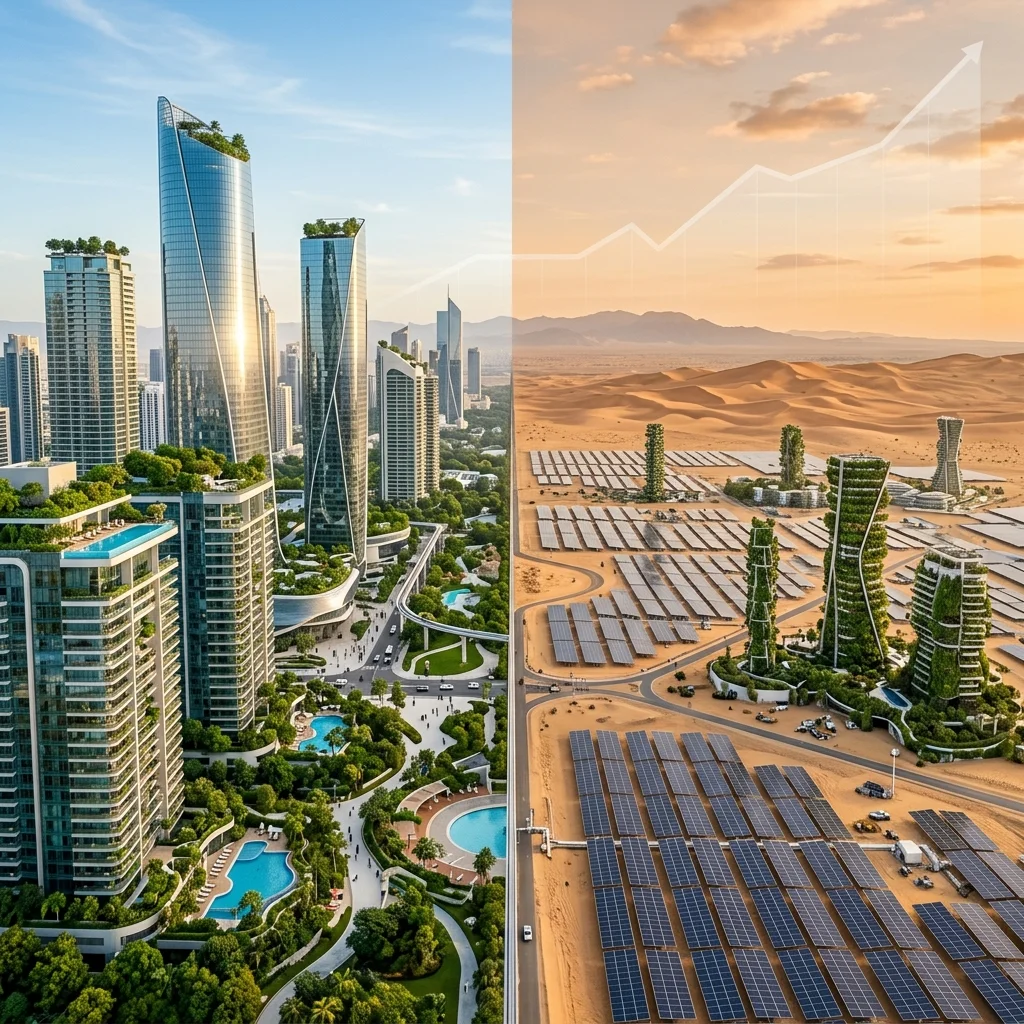
[IMAGE: A futuristic split-view cityscape: left side showing luxurious glass towers with lush green landscaping and swimming pools, right side showing arid desert with solar panels and vertical gardens, with a subtle upward trend line overlaid in the sky]
Water scarcity real estate challenges go beyond operational costs. Developers are increasingly required to submit sustainability reports and water management plans as part of permitting. However, the economic logic favors short-term profits over long-term resilience. Many projects continue to feature lush landscaping, swimming pools, and water features that are environmentally unsustainable in an arid climate.
The real estate sustainability middle east agenda is gaining traction, but progress is slow. The Dubai Clean Energy Strategy 2050 and Saudi Arabia's Green Initiative set ambitious targets, but integration into real estate development remains piecemeal. Solar panels, greywater recycling, and vertical gardens are showcased in flagship projects like The Sustainable City in Dubai, but they have not been adopted at scale.
Regulatory Risks and the Path Forward
As the market approaches the USD 1 trillion mark, regulatory risk becomes more pronounced. Several countries have introduced cooling measures to prevent overheating: the UAE tightened mortgage caps in 2023, Saudi Arabia increased transaction fees for non-Saudis, and Qatar imposed rental caps in certain zones. These measures can dampen short-term demand but do not address underlying structural imbalances.
More fundamental reforms are needed. Land registration digitization could reduce transaction costs and improve transparency. Broader mortgage access for middle-income expatriates could expand the buyer pool beyond the wealthy. And sustainability standards should be linked to property valuations and insurance premiums to create financial incentives for greener construction.
For investors, the Middle East property forecast remains positive but requires careful sector selection. Residential markets in Dubai and Riyadh are likely to see continued price appreciation in prime segments, while secondary markets in Abu Dhabi, Doha, and Jeddah may offer better value. The co-living segment presents a compelling risk-return profile, but regulatory clarity is needed.
For policymakers, the challenge is to sustain growth while addressing affordability and sustainability. Without action on these fronts, the region's real estate boom may follow a familiar boom-bust cycle—or worse, lock in environmental liabilities that future generations will bear.
Conclusion
The Middle East real estate market is poised for remarkable expansion through 2034, driven by visionary government programs, open-door visa policies, and global capital flows. Yet the triple challenge of affordability gaps, water scarcity, and energy inefficiency demands urgent attention. The market's long-term stability will depend on how well stakeholders—developers, regulators, and investors—can align growth with sustainability and inclusion. For now, the region offers both immense opportunity and profound risk, and the next decade will determine which narrative prevails.
Word count: ~1,820
Keywords

Fatima Al-Zahra
Real Estate Editor specializing in Dubai and Riyadh mega-projects.