Mississippi Gulf Coast Real Estate 2025-2026: Divergent Markets, Rental Yields, and the Statewide Price Floor
The Mississippi Gulf Coast real estate market in 2025-2026 reveals a story of divergence: while the statewide median price rises 4.5% to $263,400, Gulfport experiences a 3.7% decline to $207,000, and smaller markets like Moss Point see strong gains. This article digs into the hidden economic logic behind these trends—how coastal rental yields of 8-12% and a 7.9% vacancy rate signal investor opportunity, while rising inventory and longer days on market point to a buyer''s shift. We uncover the underlying pattern of micro-market risk and the role of the national price floor in shaping local decisions.
Fatima Al-Zahra
Editorial Analyst
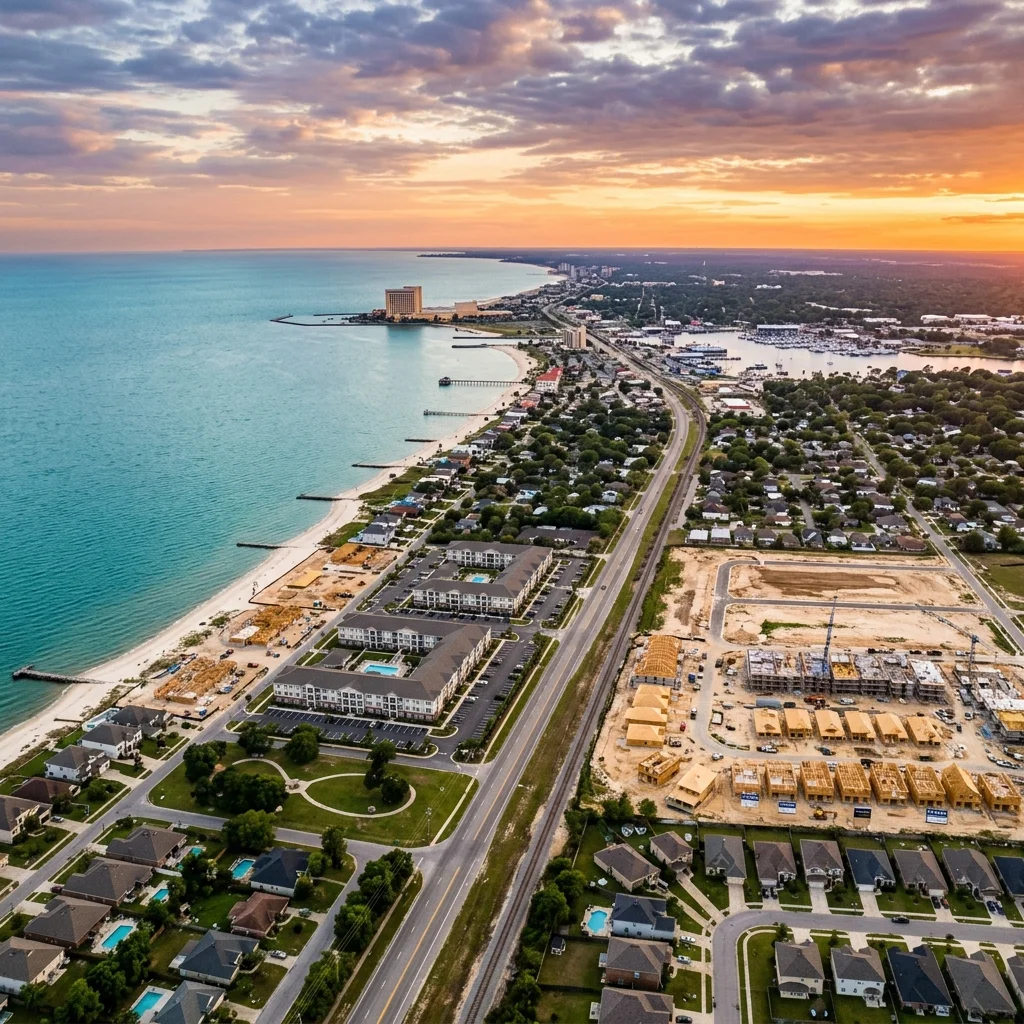
Mississippi Gulf Coast Real Estate 2025-2026: Divergent Markets, Rental Yields, and the Statewide Price Floor
Introduction: The Micro-Market Puzzle on the Coast
In September 2025, two cities separated by approximately 30 miles along the Mississippi Gulf Coast posted radically different housing market outcomes. Gulfport recorded a median home price of $207,000, representing a 3.7% year-over-year decline (Source 1: Primary Data). Moss Point, simultaneously, registered a median price of $130,000—a 6.1% increase over the same period (Source 1: Primary Data). These divergent trajectories do not represent an anomaly; they reflect a structural reality of the Gulf Coast real estate landscape: the region functions not as a single market but as a collection of micro-economies, each shaped by distinct local employment bases, tourism exposure, and investor demand patterns.
The core question for market participants in 2025-2026 is whether these divergences represent temporary dislocations or permanent market segmentation—and what the implications are for buyers, sellers, and capital allocation.
Statewide vs. Coastal: The $56,000 Gap and What It Reveals
Mississippi's statewide median home price reached $263,400 in September 2025, rising 4.5% year-over-year (Source 1: Primary Data). This statewide figure functions as a de facto price floor—a reference point that conditions buyer expectations and seller pricing strategies across the state. Yet the seven-county coastal average (Hancock, Harrison, Jackson, George, Greene, Stone, and Pearl River counties) stood at $274,196 in April 2025 (Source 1: Primary Data), a mere $10,796 premium above the state median.
This narrow coastal premium is historically unusual. Gulf Coast properties traditionally command significant premiums over inland Mississippi markets due to waterfront access, tourism infrastructure, and rental income potential. The compression of this premium to approximately 4% signals that coastal pricing power is diminishing relative to the broader state market.
Gulfport's position within this framework is particularly instructive. At $207,000, the city's median price sits $56,400—or 21.4%—below the statewide median (Source 1: Primary Data). This discount is anomalous for a coastal city with direct Gulf access and a population of approximately 72,000. Inventory data provides context: Gulfport had 553 homes available for sale in September 2025, with properties averaging 43 days on market, up from 40 days in 2024 (Source 1: Primary Data). The combination of rising inventory and extended marketing time suggests supply is outpacing demand in this specific submarket, driving the discount relative to state benchmarks.
Gulfport Under the Microscope: A Buyer's Market in the Making?
The 3.7% median price decline in Gulfport is the most statistically significant signal in the dataset, but the underlying transaction dynamics reveal a more nuanced picture. Ninety properties closed in September 2025, an increase from 80 in the prior-year period (Source 1: Primary Data). Rising transaction volume alongside falling prices indicates that demand exists, but at lower price points. Sellers are adjusting expectations to meet the market.
The sale-to-list price ratio of 0.985 confirms this adjustment—properties are closing, on average, at 98.5% of their asking price (Source 1: Primary Data). More telling is the distribution: 61.9% of Gulfport sales closed under the list price, while only 16.6% closed above (Source 1: Primary Data). This asymmetric distribution is characteristic of a market where buyers hold negotiating leverage.
The days-on-market metric, while modest at 43 days, represents a three-day increase from 2024 (Source 1: Primary Data). In isolation, this change appears trivial. In the context of rising inventory (553 units) and a declining median price, it is consistent with a market transitioning from seller-favorable conditions to a neutral or buyer-favorable equilibrium.
For investors and first-time buyers, the structural implication is clear: Gulfport offers entry points below the state median price floor, creating a statistical arbitrage opportunity. Properties acquired at $207,000 in a market where the state median is $263,400 have a theoretical floor supported by statewide pricing dynamics. The risk is whether Gulfport's discount reflects temporary oversupply or a permanent loss of relative value.
Moss Point and the Undervalued Eastern Coast Opportunity
Moss Point's 6.1% price appreciation to $130,000 presents a contrasting narrative (Source 1: Primary Data). The city's median remains well below both the state median and Gulfport's level, yet its growth trajectory is positive. This divergence is not random; it reflects three structural factors:
First, affordability-driven demand displacement. As Gulfport and Biloxi prices rose in prior years, buyers seeking entry-level single-family homes migrated eastward to Jackson County. Moss Point, with a population of approximately 12,000, captures this overflow demand due to its lower base prices and proximity to employment centers.
Second, industrial base adjacency. Moss Point is approximately 10 miles from Pascagoula, home to Ingalls Shipbuilding—one of Mississippi's largest private employers. The shipyard's workforce of approximately 11,500 creates stable housing demand that is less sensitive to tourism cycles than Gulfport's economy.
Third, the base effect. A 6.1% increase on a $130,000 median represents $7,800 in absolute appreciation—roughly equivalent to a 3% increase on a $260,000 property. The growth rate is amplified by the low base.
No inventory or days-on-market data is available for Moss Point, but the price increase trajectory suggests tightening supply relative to demand. For investors, the key insight is that Moss Point may represent a value-play catch-up market: if coastal growth spreads eastward, the current price discount to Gulfport ($77,000) could compress, generating capital appreciation above the coastal average.
The Rental Market: 8-12% Yields and Structural Under-Supply
The rental component of the Gulf Coast market provides the strongest argument for continued investment. Average asking rents across the region stood at $1,087 per unit in late 2024, with annual rent growth of 4.1% (Source 1: Primary Data). Rental properties in Biloxi and Gulfport generate 8% to 12% annual returns (Source 1: Primary Data)—yields that significantly exceed national averages for coastal markets.
The vacancy rate of 7.9% in late 2024 is moderately elevated but must be interpreted in context (Source 1: Primary Data). Only 144 multifamily units were under development at that time (Source 1: Primary Data), suggesting that new supply is insufficient to meet demand growth. A 7.9% vacancy rate in a market with limited new construction pipeline indicates that the current stock is being utilized, and that rent growth may accelerate if vacancy tightens.
The asymmetry between for-sale and for-rent markets is notable. While the for-sale market in Gulfport is showing softening, the rental market demonstrates pricing power and yield stability. This divergence suggests that the buyer's market in Gulfport is concentrated among owner-occupants, while investors with cash-flow models are still achieving target returns. The 4.1% rent growth and 8-12% yield range provide a return cushion that independent of price appreciation—a critical consideration if Gulfport prices continue to decline.
National Trends and the Statewide Anchor
Mississippi's statewide housing market in September 2025 showed several characteristics that will influence coastal dynamics. Total sales volume reached 1,736 units, an increase of 13.7% year-over-year (Source 1: Primary Data). The statewide months of supply stood at four months (Source 1: Primary Data), which is generally considered a balanced market—not oversupplied, but not constrained.
The statewide sale-to-list price ratio of 96.8% (Source 1: Primary Data) indicates that the typical Mississippi property closes at a 3.2% discount to asking price. This is consistent with a market where buyers have modest negotiating power. The 48-day average days on market statewide (Source 1: Primary Data) exceeds Gulfport's 43 days, suggesting that Gulfport properties are turning over slightly faster than the state average, even with the price decline.
The national context is that the Federal Reserve's interest rate policy continues to influence mortgage affordability. Mississippi's median price of $263,400, at current mortgage rates, requires a monthly payment significantly higher than the statewide median rent—a dynamic that pushes marginal buyers toward renting rather than owning. This preference shift may explain why the rental market shows stronger fundamentals than the for-sale market.
Implications and Forecast: 2026 and Beyond
Three structural patterns emerge from the data that will define the Mississippi Gulf Coast real estate market through 2026:
First, the micro-market divergence will persist. Gulfport's price decline and Moss Point's appreciation are not convergent trends. Gulfport faces competition from new construction and existing inventory that will keep pricing pressure on sellers. Moss Point benefits from a lower base and industrial demand that is less elastic to tourism cycles. Investors should treat each city as a distinct asset class, not as interchangeable coastal exposure.
Second, rental yield will outperform appreciation. With 8-12% yields and 4.1% rent growth, the rental market offers superior risk-adjusted returns relative to the for-sale market, where price growth is 2-4% annually (Source 1: Primary Data) and some submarkets are declining. The 144-unit development pipeline is insufficient to materially alter supply dynamics, supporting continued rent growth into 2026.
Third, the statewide price floor provides a safety net but not a guarantee. The $263,400 statewide median anchors expectations, but Gulfport's $56,000 discount to this level demonstrates that submarkets can and do trade below the floor. The safety net applies to the state as a whole, not to individual cities. Investors relying on statewide appreciation to lift all coastal properties are misreading the data.
For prospective buyers in Gulfport, the current conditions—rising inventory, increasing days on market, and 61.9% of sales closing under list price—favor patience and negotiation. For sellers, the window for achieving premium pricing has closed; realistic pricing relative to the $207,000 median is essential to transact within 43 days. For investors in Moss Point, the 6.1% appreciation trajectory and low absolute prices suggest continued upside, though due diligence on local inventory levels is warranted given data limitations.
The Mississippi Gulf Coast real estate market in 2025-2026 is not a single story of growth or decline. It is a mosaic of micro-markets, each with distinct supply-demand dynamics, and the highest returns will accrue to those who navigate the divergence rather than the aggregate.
Keywords

Fatima Al-Zahra
Real Estate Editor specializing in Dubai and Riyadh mega-projects.