MS Gulf Coast Real Estate Market Trends: Prices, Rents, Inventory, and What the Data Really Means
The MS Gulf Coast real estate market is best understood as a two-speed system: for-sale pricing is stabilizing unevenly across cities, while rental conditions remain supported by modest supply, growing rents, and still-healthy yields. Gulfport shows a softer resale market with rising inventory and slower turnover, while Moss Point reflects a lower-priced segment with year-over-year appreciation. At the regional level, average home prices, rents, vacancy, and multifamily development point to a market being reshaped by affordability pressure, migration patterns, and investment returns. This article will connect city-level pricing, county-wide averages, and statewide benchmarks to explain where demand is strongest, where affordability is improving, and what the next phase of Gulf Coast growth may look like.
Fatima Al-Zahra
Editorial Analyst
MS Gulf Coast Real Estate Market Trends: Prices, Rents, Inventory, and What the Data Really Means
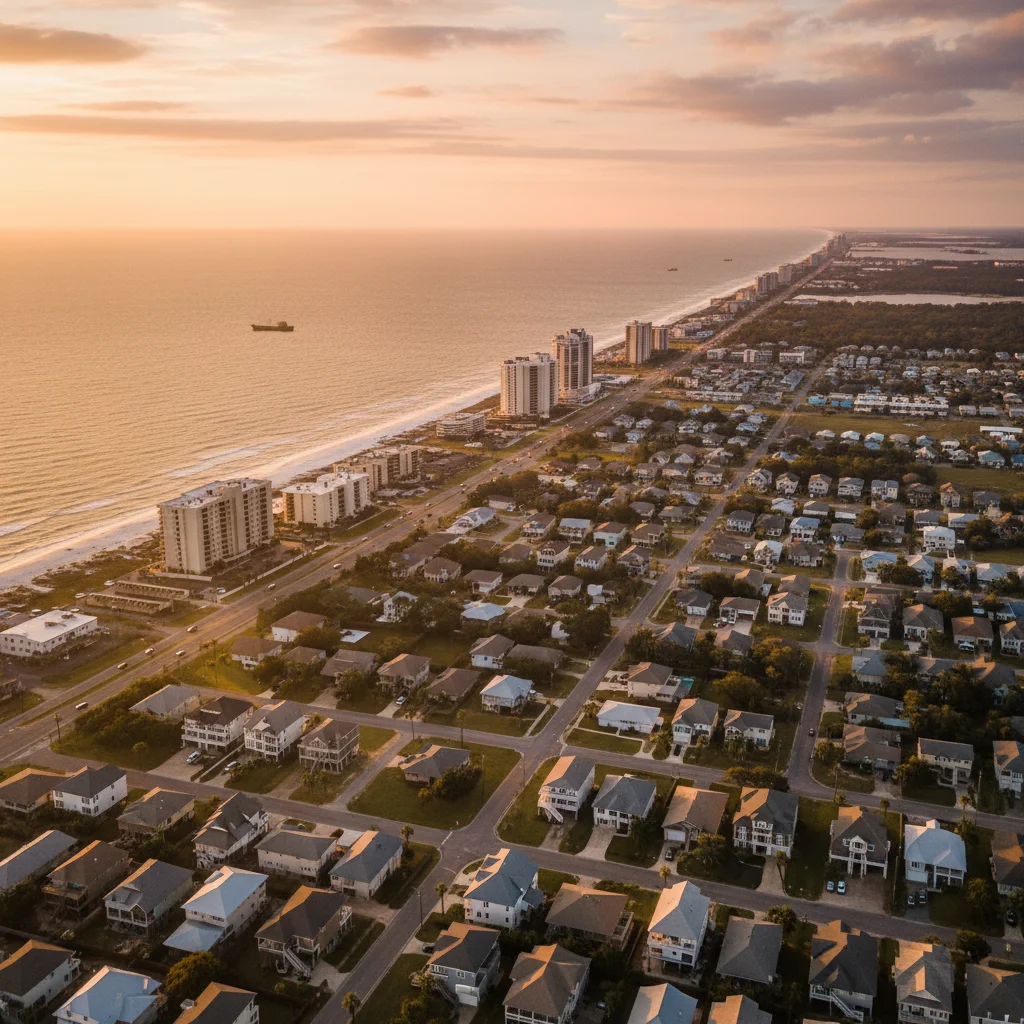
[IMAGE: A wide-angle aerial view of the Mississippi Gulf Coast showing a mix of coastal homes, suburban neighborhoods, apartment buildings, and shoreline at golden hour, with no text overlay]
The Mississippi Gulf Coast real estate market is not behaving like a single, unified market. It is moving as a collection of submarkets, each shaped by different levels of affordability, inventory, rental demand, and buyer urgency. That matters because a headline about “the Gulf Coast market” can hide very different conditions from one city to another.
In September 2025, statewide Mississippi data showed a median sale price of $263,400, up 4.5% year over year, with 1,736 homes sold and a 48-day median time on market. Those figures suggest a market that has moved past the sharpest phase of post-pandemic adjustment and into a slower, more selective kind of normalization. But that statewide picture does not map neatly onto every coastal city.
On the Mississippi Gulf Coast, the data points in different directions at once: Gulfport is softer, Moss Point is still posting price growth from a lower base, and the rental market remains supported by modest supply and healthy yields. For readers tracking Gulf real estate markets or the broader MS Gulf Coast real estate landscape, the key question is not whether the market is up or down. It is where demand is strongest, where pricing is still adjusting, and what kind of housing product is absorbing fastest.
The Gulf Coast is several markets, not one
[IMAGE: Map-style visualization of the Mississippi Gulf Coast with price bands by city and county]
The first thing the data makes clear is that the Gulf Coast should be read as a set of connected but distinct markets. Gulfport, Moss Point, the surrounding counties, and Mississippi overall are not moving at the same speed.
That matters because affordability, inventory, and rent momentum are not changing in lockstep. In some places, buyers have more options and more negotiating power. In others, lower entry prices are still attracting steady demand. And in the rental sector, supply constraints are helping support rent growth even where home sales have softened.
This is a market-structure story, not just a price-update story. A simple month-to-month or year-over-year price change does not explain whether demand is broad-based, whether inventory is accumulating, or whether a city is functioning as an owner-occupant market, a rental market, or both.
2025 marked a shift from rapid adjustment to selective normalization
By late 2025, the statewide Mississippi housing picture looked more stable than volatile. The median sale price of $263,400 and 4.5% annual growth show continued appreciation, but not the kind of sudden escalation that defined earlier cycles. The 48-day median time on market suggests homes are still selling at a reasonable pace, though buyers are taking more time and sellers are facing more competition than in tight-supply periods.
The Gulf Coast region is following that same broad transition, but unevenly. Gulfport, in particular, has shown signs of softer resale conditions. That does not mean the market is weak in a broad sense; it means the balance of bargaining power has shifted somewhat toward buyers. Meanwhile, lower-priced submarkets such as Moss Point are still posting gains.
For anyone watching Mississippi housing trends, this is the central takeaway: the market is normalizing, but not uniformly. Some cities are adjusting through pricing, others through time on market, and others through the type of homes that are getting attention.
Gulfport: a useful test case for liquidity and buyer behavior
[IMAGE: Residential street scene in Gulfport with a subtle overlay of inventory and days-on-market indicators]
Gulfport offers one of the clearest examples of how a coastal market can remain active while still showing signs of softness. In September 2025, the city recorded 553 homes for sale, 90 closed sales, and a 43-day median time on market. That is enough inventory to give buyers choices, but not so much that the market is detached from demand.
What stands out more is pricing behavior. Gulfport’s home prices were down 3.7% year over year, which indicates a softer resale market relative to the state average. The 0.985 sale-to-list ratio also points to mild negotiation pressure: on average, homes are selling slightly below asking price.
The distribution of outcomes reinforces that point. Only 16.6% of sales closed over list price, while 61.9% sold under list price. That tells us the market is functioning, but not uniformly competitive. Buyers are selective. Sellers who price well can still move property. But overpricing is likely being punished.
This is important for the Gulfport housing market because it shows that liquidity is present, but not automatic. Homes do sell. They just do not sell with the same level of urgency seen in hotter segments.
Moss Point: affordability still drives demand at the lower end
If Gulfport reflects a more balanced or slightly soft market, Moss Point represents the affordability end of the spectrum. In early 2025, the median home sale price in Moss Point was $130,000, up 6.1% year over year. That combination is notable: a lower-priced market that is still appreciating.
This matters for several reasons. First, it suggests that lower-cost housing remains in demand even when broader markets are more cautious. Second, it highlights the role of Moss Point as an entry-level ownership market, where first-time buyers may be more active and where local workforce housing needs remain strong. Third, it offers a different lens for investors, who often look for lower basis costs and potential rental stability.
In many ways, Moss Point can function as an early signal of demand from cost-sensitive households. When affordability pressure rises elsewhere, households often move toward lower-priced submarkets. That does not always produce rapid price jumps, but it can support steady appreciation and relatively resilient absorption.
For the Gulf Coast rental market, this also matters because lower purchase prices can improve the economics of owning rental property, especially if rents remain stable or continue to rise modestly.
Rentals remain a separate story from for-sale pricing
One of the most important features of the Gulf Coast market is that rental conditions are not moving in the same way as resale pricing. Across the region, rental supply has remained modest, and that has helped support rents and yields even when home sales have softened.
That separation is critical. A weaker for-sale market does not automatically mean a weak rental market. In fact, when affordability gets tighter for would-be buyers, rental demand can remain strong or even increase. Households that would have bought in a more affordable environment may stay in rentals longer, which supports occupancy and rent levels.
At the regional level, the picture points to a market shaped by three forces:
- Affordability pressure is redirecting some demand from ownership to rental housing.
- Migration patterns are influencing where households choose to live within the Gulf Coast.
- Investment returns are still attractive enough to keep interest in multifamily and small-scale rental assets.
This is why the rental side deserves separate attention in any analysis of Gulf real estate markets. It often tells a different story than home sales, and in coastal Mississippi that difference is especially important.
What county-wide and statewide averages can hide
County-wide averages are useful for context, but they can also blur significant variation. A county may show stable pricing overall while one city inside it is slowing and another is still climbing. The same is true at the state level.
Mississippi’s $263,400 median sale price and 4.5% annual growth are useful benchmarks, but they do not explain why Gulfport is softer or why Moss Point is still rising. Nor do they capture how quickly a specific neighborhood may be turning over, or whether a housing type is under pressure from rental competition.
That is why the best reading of the data combines city-level, county-level, and statewide metrics. The statewide figures tell us the general direction of travel. City-level figures show where pressure is building or easing. Rental data fills in the part of the story that sales data alone cannot explain.
What the data suggests about the next phase
The next phase of Gulf Coast growth is likely to be shaped less by dramatic price acceleration and more by selective demand. The market appears to be rewarding accuracy: accurate pricing, accurate property condition, and accurate positioning relative to local income levels.
For sellers, that means the era of broad, automatic appreciation is not the right assumption. In markets like Gulfport, inventory levels and negotiation patterns show that buyers have options. In lower-priced areas like Moss Point, demand may remain more durable, but it is still tied to affordability.
For buyers, the data suggests that opportunities exist where the market is softer or where affordability remains favorable. But timing and product type matter. A single “Gulf Coast” strategy is too broad.
For investors, the combination of modest rental supply, supported rents, and lower-cost acquisition in some submarkets keeps the region relevant. But returns will depend on local fundamentals, not just regional momentum.
Conclusion
The Mississippi Gulf Coast real estate market is best understood as a two-speed system. For-sale pricing is stabilizing unevenly across cities, while rental conditions remain supported by modest supply and still-healthy demand. Gulfport shows a softer resale market with higher inventory and slower turnover, while Moss Point reflects how lower-priced housing can still appreciate.
At the broader level, the data points to a region being reshaped by affordability pressure, migration, and investment economics. That is the real story behind the numbers. The market is not moving in one direction. It is sorting itself into different conditions by city, price point, and housing type.
For anyone following MS Gulf Coast real estate, the lesson is straightforward: the headline number matters, but the submarket details matter more.
Keywords

Fatima Al-Zahra
Real Estate Editor specializing in Dubai and Riyadh mega-projects.