Inside GULF’s Innovation Ecosystem: Workplace, Operational & Business Tech Trends Driving a Sustainable Future
GULF’s innovation strategy spans three distinct pillars: workplace digitization, operational technology, and strategic business investments. From paperless offices and facial recognition to AI-driven predictive maintenance and renewable energy integration, the company is systematically transforming from a traditional utility into a data-centric, low-carbon enterprise. This article provides a deep industry audit of each pillar, exposing the hidden economic logic: these innovations are not isolated improvements but an interconnected ecosystem that reduces costs, enhances resilience, and creates new value streams. By analyzing the underlying technology trends—such as machine learning in operations and climate-focused venture investments—we reveal how GULF is positioning itself for long-term supply chain and competitive advantage. A must-read for understanding how energy firms can adapt to the digital and ESG era.
Layla Ibrahim
Editorial Analyst
``markdownInside GULF’s Innovation Ecosystem: How Workplace, Operational and Business Tech Drive a Sustainable Future
By [Staff Writer]
When a traditional utility company begins talking about facial recognition for office access, machine learning for turbine maintenance, and venture capital for climate tech startups, it is no longer just an energy provider—it is becoming a technology-driven enterprise. GULF, one of Thailand’s leading power generation and energy infrastructure firms, has quietly built a comprehensive innovation strategy that reaches far beyond the control room.
The company manages innovation across three distinct pillars: workplace digitization, operational technology, and strategic business investments. Each pillar addresses a different challenge—ranging from internal efficiency to external competitiveness—and together they form a cohesive blueprint for sustainable growth. This article examines the technology trends, the hidden economic logic, and the long-term implications behind each category, revealing how GULF is systematically transforming from a traditional utility into a data-centric, low-carbon enterprise.
[IMAGE: A conceptual diagram showing three interconnected pillars labeled 'Workplace', 'Operational', and 'Business' with icons for paperless office, wind turbine, and investment portfolio.]
---
Workplace Innovations: Digitizing the Human Experience
The first pillar focuses on the 3,000+ employees who keep GULF’s operations running. In many energy companies, back-office processes remain stubbornly analog—paper memos, manual approvals, and fragmented HR systems. GULF has set out to change that with a suite of digital tools designed to improve efficiency, transparency, and safety.
From Paper to Pixels: The E-Document Revolution
The most visible change is the shift from paper-based filing to a fully digital E-Document system. Documents that once required physical signatures, cabinet storage, and courier delivery are now stored in the cloud with role-based access controls. The reduction in physical waste is significant, but the real gain is accessibility: engineers in the field, finance teams in headquarters, and auditors from regulatory bodies can retrieve the same version of a contract or technical report within seconds. This is not just an administrative upgrade; it is a foundation for data-driven decision-making across the organization.
People Connect: HR in Your Pocket
On the human resources front, GULF launched “People Connect,” a mobile platform that consolidates leave applications, payroll inquiries, benefits redemption, and internal training registrations. Employees no longer need to navigate multiple systems or submit paper forms. The result is higher engagement and lower administrative overhead. For a company where field technicians may be stationed at remote power plants, having a one-stop app for all HR services is a genuine productivity booster.
Safety Through Gamification
Perhaps the most creative workplace innovation is the Behavior-Based Safety (BBS) Application. Traditional safety programs rely on top-down directives and mandatory training. GULF’s app flips that model by using gamification—scoring, badges, and team-based rewards—to encourage proactive safety reporting and hazard identification. Employees earn points for spotting risks, reporting near-misses, and participating in safety drills. The data collected feeds into a company-wide dashboard that helps managers identify recurring issues before they become accidents. It is a smart example of how digital tools can change workplace culture, not just automate tasks.
Transparent Procurement with E-Bidding
Suppliers and contractors are also part of the workplace ecosystem. The E-Bidding System digitizes the entire procurement cycle, from tender publication to bid evaluation and contract award. By moving transactions online, GULF ensures transparency, reduces corruption risk, and speeds up the purchasing process. For a company that spends billions of baht annually on equipment, fuel, and services, even modest efficiency gains translate into significant cost savings.
Security and Safety: Facial Recognition Goes Mainstream
Security upgrades are another visible component. GULF has deployed a Facial Recognition System at multiple office buildings, facility entrances, and project sites. The system allows employees to enter without keycards or passwords, reduces the risk of unauthorized access, and provides an audit trail of who is on-site at any given time. During emergencies, this real-time tracking can be vital for evacuation and accountability.
Monthly SH&E E-newsletter: Keeping Everyone Informed
To tie these initiatives together, GULF publishes a monthly Safety, Health and Environment (SH&E) E-newsletter. Distributed digitally to all employees, it highlights recent innovations, shares best practices from different sites, and includes quiz-style engagement features. It is a low-cost but effective tool for reinforcing the culture of continuous improvement.
[IMAGE: A split-screen: left side shows a traditional paper-filled office with stacked documents and a fax machine; right side shows a digital interface with a facial recognition icon and a mobile app displaying employee attendance data.]
---
Operational Innovations: Smart, Green, and Efficient
If the workplace pillar is about improving how people work, the operational pillar is about improving how GULF produces energy and manages its assets. This is where the company’s industrial heritage meets modern data science.
The Smart Operation System: End-to-End Production Oversight
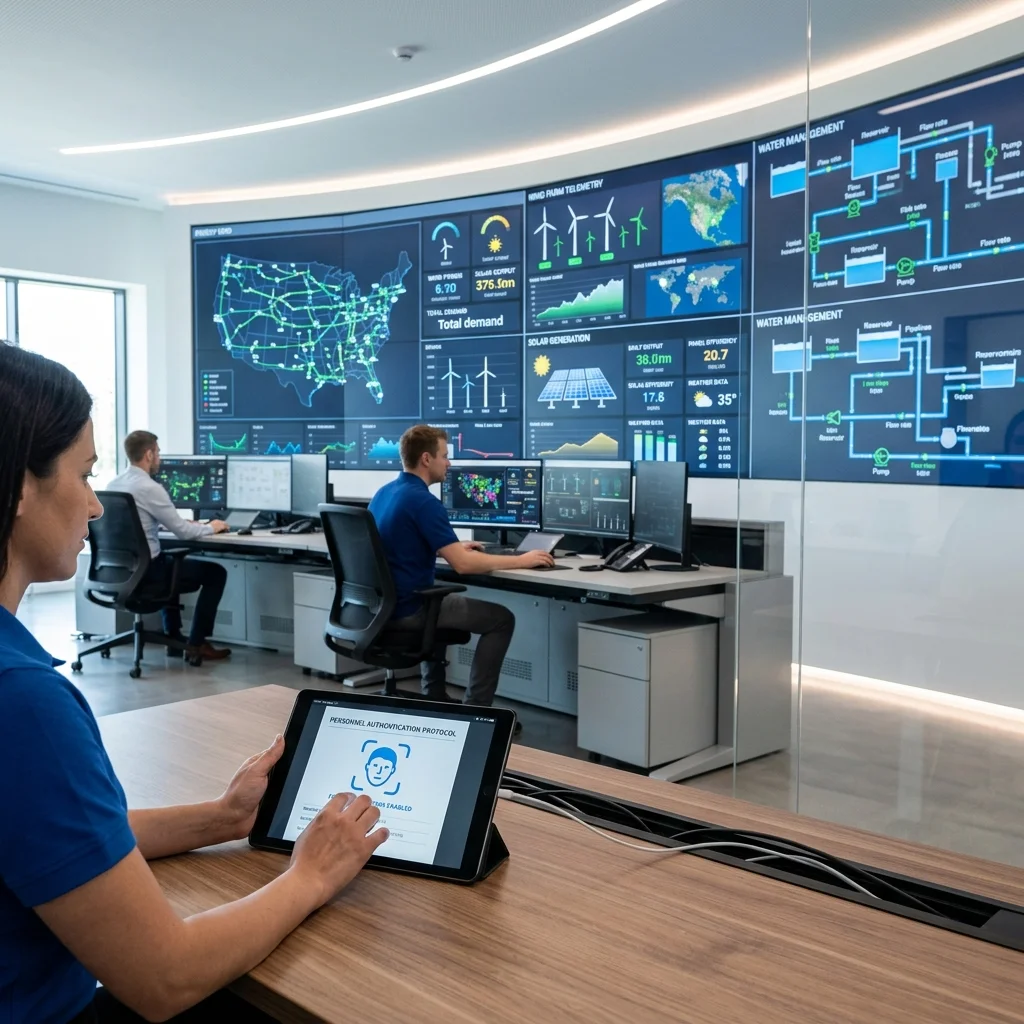
GULF has implemented a Smart Operation System that covers the full production lifecycle—from fuel procurement and generation to post-production disposal and emissions management. The system collects real-time data from sensors on turbines, boilors, cooling systems, and grid connections. This data is aggregated into a central Operations Command Center where a small team can monitor multiple power plants simultaneously. Alarms, performance metrics, and efficiency ratios are displayed on large screens, enabling rapid response to anomalies.
Accelerating Renewable Energy Integration
A key strategic goal is to increase the share of clean electricity from renewable sources within the existing generation portfolio. GULF is not simply building new solar farms or wind parks in isolation; it is retrofitting existing gas-fired plants to operate more flexibly, allowing them to complement intermittent renewables. The company is also investing in hybrid systems that pair solar PV with battery storage, and exploring green hydrogen as a long-term option. This renewable energy push is directly aligned with ESG mandates from investors and regulators.
Advanced Water Management: Doing More with Less
Water is a critical resource for thermal power plants, used for cooling and steam generation. GULF’s Advanced Water Management System uses real-time monitoring of water quality, flow rates, and consumption patterns to minimize net freshwater withdrawal. Closed-loop cooling towers, condensate recovery, and greywater reuse have reduced water intensity at several facilities by more than 20%. The system also ensures compliance with local and international safety standards, which is increasingly important as water scarcity becomes a material risk for energy companies.
Predictive Maintenance: Machine Learning Meets Heavy Industry
Perhaps the most technically sophisticated operational innovation is Predictive Maintenance powered by Machine Learning (ML). Traditional maintenance follows fixed schedules—overhaul a turbine every 5,000 hours, for example. But this approach is wasteful: some components are replaced too early, while others fail before their scheduled service. GULF’s ML models analyze vibration data, temperature trends, and acoustic signatures to forecast when a specific bearing or valve is likely to fail. The system sends alerts weeks in advance, allowing maintenance teams to order parts and plan shutdowns during low-demand periods. The result is a significant reduction in unplanned downtime, lower spare parts inventory, and extended asset life.
IU Load Switching: Smarter Grid Management
On the grid side, GULF participates in the IU (Interruptible User) Load Switching program, which allows the company to reduce electricity consumption on demand when the grid is stressed. By automatically shifting loads from high-demand to low-demand periods—for example, running water pumps at night instead of during peak hours—GULF not only lowers its own electricity costs but also helps stabilize the national grid. This load flexibility reduces the need for peaking power plants, which are often the most carbon-intensive. It is a win-win for the company, the grid operator, and the environment.
[IMAGE: An industrial plant scene with overlaid digital analytics: a turbine is highlighted with lines and data points showing temperature, vibration, and predicted failure date. Below, a water management dashboard shows flow rates and recycling percentages.]
---
Business Innovations: Investing in Tomorrow’s Technology
The third pillar extends beyond GULF’s own operations. The company has established a corporate venture capital arm and strategic investment unit that actively deploys capital into external startups and technology providers. The goal is not just to generate financial returns, but to gain early exposure to disruptive technologies that could transform the energy sector.
Strategic VC: A Portfolio of Climate Tech
GULF’s investments span areas such as advanced battery storage, carbon capture and utilization, grid analytics software, and electric vehicle charging infrastructure. For example, the company has backed a Thai startup developing low-cost solid-state batteries for stationary storage, and a Singapore-based firm that uses AI to optimize renewable energy trading on wholesale markets. By taking equity stakes in these companies, GULF secures early access to innovations that can later be deployed at scale within its own portfolio. It also gains a window into emerging technology trends that could reshape the competitive landscape.
Why It Matters: The Economic Logic
The hidden economic logic behind these business innovations is that they create a virtuous cycle. The venture investments generate technology insights that feed back into the operational and workplace pillars. For instance, a startup’s predictive analytics tool might be piloted in one of GULF’s power plants, and if successful, rolled out across the fleet. Similarly, a digital workplace platform developed by a portfolio company could be adopted by GULF’s HR department. This cross-pollination multiplies the return on each investment.
Aligning with ESG and Long-Term Supply Chain Resilience
From a strategic perspective, GULF’s innovation ecosystem is designed to position the company for long-term supply chain and competitive advantage. As the global economy moves toward net-zero, traditional utilities face pressure to decarbonize, digitize, and decentralize. By investing in renewable energy, predictive maintenance, and digital workplace tools, GULF is systematically reducing its carbon intensity and operating costs simultaneously. The company is also building resilience against climate risks—such as water scarcity, extreme weather events, and carbon pricing—by embedding flexibility and real-time monitoring into its core processes.
[IMAGE: A futuristic investment flow diagram: on the left, logos of startup companies in battery, AI, and EV charging; arrows flow into a central GULF logo; on the right, icons representing new technologies being deployed in power plants, office buildings, and grid control rooms.]
---
Conclusion: An Interconnected System, Not a Collection of Projects
The most important takeaway from GULF’s innovation journey is that these three pillars are not isolated initiatives. They form an interconnected ecosystem where data flows from the workplace to the operational control room, and insights from venture investments influence strategic decisions. The paperless office feeds into predictive maintenance by ensuring asset history is digitally accessible. The facial recognition system shares infrastructure with the safety app’s real-time location tracking. The renewable energy investments create new load patterns that are optimized by the smart grid software. Every piece reinforces the others.
For industry observers, the lesson is clear: adapting to the digital and ESG era requires more than installing solar panels or buying a new software suite. It demands a holistic approach that rethinks how people work, how assets are managed, and how capital is deployed into future technologies. GULF’s model offers a blueprint—one that other energy firms in Southeast Asia and beyond would do well to study.
The company has not transformed overnight. But by systematically building out its innovation ecosystem across workplace, operational, and business dimensions, GULF is demonstrating that a traditional utility can become a data-centric, low-carbon enterprise. And that, in a rapidly changing world, may be the most sustainable competitive advantage of all.
[IMAGE: A wide-angle photo of a control room with multiple screens showing energy grid data, wind turbines, and solar panels. A tablet in the foreground displays a digital document and a facial recognition icon. Clean, bright, high-tech atmosphere with no text.]
``
Keywords

Layla Ibrahim
Technology Reporter covering fintech, AI, and startup ecosystems in the Gulf.