Gulf Tech Transformation 2026: How AI, Blockchain, and Sustainability Are Reshaping Traditional Industries
By 2026, 85% of Gulf businesses with 50+ employees will have adopted AI, blockchain will save the UAE $3 billion annually in document processing, and mandatory sustainability reporting for large firms will create a 30% premium for green goods. This article uncovers the hidden economic logic behind these trends: technology is not just modernizing traditional sectors—it is enabling national workforce goals (Emiratization, Saudization), building a trust economy through provenance verification, and turning sustainability into a profitable differentiator. Through case studies like a Dubai textile firm that grew sales 40% via AI, a car wash that cut water use 60%, and blockchain halal certification savings, we show how Gulf states are engineering a triple transformation—digital, social, and environmental—that redefines traditional industries.
Layla Ibrahim
Editorial Analyst
Gulf Tech Transformation 2026: How AI, Blockchain, and Sustainability Are Reshaping Traditional Industries
By 2026, the Gulf economies will reach a tipping point where technology, nationalization, and sustainability converge—reshaping traditional industries from textiles to car washes. The numbers tell a story of rapid, structural change: 85% of businesses with 50 or more employees across the region will have adopted artificial intelligence; blockchain-based document processing will save the UAE $3 billion annually; mandatory environmental, social, and governance (ESG) reporting for large firms will create a 30% premium for green goods; and the twin nationalization drives of Emiratization and Saudization will have pushed local workforce participation in private-sector jobs to record levels.
These metrics are not isolated tech trends. They represent a triple transformation—digital, social, and environmental—that is sweeping through the Gulf’s traditional industries. The core thesis is simple: technology is not replacing tradition; it is enabling trust, personalization, and compliance at scale, while simultaneously advancing national workforce goals. In a region where family-run businesses have dominated sectors like textiles, hospitality, and logistics for generations, the shift is profound but pragmatic. This article unpacks the hidden economic logic behind the numbers, drawing on real-world case studies from Dubai to Riyadh.
[IMAGE: Infographic showing three pillars (Digital, Social, Environmental) with example stats: 85% AI adoption, $3B blockchain savings, 30% green premium, and Emiratization/Saudization targets.]
AI in Traditional Industries: Personalization at Scale
Walk into Ahmed Al-Mansoori’s textile firm in the heart of Dubai’s historic Deira district, and you still see the wooden counters his grandfather installed in the 1950s. But behind them, a new system hums. In 2024, after years of resistance, Al-Mansoori adopted an AI-powered predictive customer analytics platform. By early 2025, the company had recorded a 40% increase in sales.
“We worried that technology would make our business impersonal,” Al-Mansoori explains, standing beside bolts of handwoven fabric. “Instead, our AI system has actually enhanced personal connections. It remembers every customer’s preferences—fabric type, color, quantity, even the occasion they shopped for—across generations. When a young man walks in to buy a wedding kandura, we can ask, ‘Your father bought the same cut six years ago—would you like something similar?’ That level of continuity would be impossible without data.”
Al-Mansoori’s story is emblematic of a broader shift. By 2026, Gulf technology innovation trends show that 85% of firms with 50 or more employees in the region have implemented some form of AI. The adoption is not limited to large corporations. Even small, traditional businesses are finding cost-effective applications that improve customer loyalty and operational efficiency.
Consider another example: Dubai Home Car Wash, a small business that once relied on manual scheduling and high water usage. In 2025, the company deployed an AI-driven scheduling and water-monitoring system. The result: a 60% reduction in water consumption per wash, directly cutting operational costs. For a business operating in a water-scarce environment, that is not just a green credential—it is a competitive margin advantage.
AI adoption Gulf 2026 is particularly visible in retail, hospitality, and logistics—sectors long dominated by family-run enterprises. Predictive analytics helps textile firms like Al-Mansoori’s anticipate seasonal demand for specific patterns. In restaurants, AI recommends menu adjustments based on local ingredient availability and customer sentiment. In Jeddah’s bustling wholesale markets, AI-powered inventory systems reduce food waste by up to 25%.
The social dimension is equally important. Emiratization and Saudization policies, which have set national workforce targets for 2026, are being supported by AI tools that streamline training and skill matching. In Saudi Arabia, for example, the Saudi Vision 2030’s human capital development programs now use AI to identify skills gaps and recommend customized upskilling modules for local employees in traditional sectors. A textile sales assistant can learn data-driven merchandising through a mobile platform that adapts to her pace. The result: national workforce goals are achieved not by replacing workers, but by augmenting them.
[IMAGE: Split image: left – a 1970s textile shop with wooden counters and fabric rolls; right – a modern AI dashboard showing customer profiles, purchase history, and sales trend graphs.]
Blockchain: The Trust Infrastructure for a $2.3 Billion Problem
While AI drives personalization, blockchain is building the region’s new trust infrastructure. The scale of the problem is staggering. Counterfeit luxury goods alone cost the Gulf economy an estimated $2.3 billion annually. Halal certification fraud, fake real estate titles, and document forgery add billions more. The UAE Blockchain Strategy 2021, which set ambitious targets for 2026, is now delivering measurable outcomes.
By 2026, blockchain UAE savings will reach $3 billion per year, according to government estimates. Document processing costs, a major expense for both public and private sectors, are down 50%. Over 400 million fewer printed documents clutter desks—and landfills—each year. More strikingly, the system has saved 77 million work hours that would have been spent on verification, approvals, and manual data entry.
The impact on traditional industries is tangible. Take halal certification—a critical requirement for food, cosmetics, and pharmaceutical exports from the Gulf. Small and medium-sized enterprises (SMEs) often face cross-border compliance costs that erode margins. By 2026, blockchain-based halal tracking has reduced those costs by 40%. A consignment of dates from Saudi Arabia can now be traced from farm to port, with every inspection and certificate recorded immutably. Buyers in Malaysia or Indonesia can verify authenticity in seconds. The result: smaller producers can compete with larger players, and the region’s $200 billion halal economy gains credibility.
In the luxury goods sector, blockchain provenance tracking has become a standard for high-end watches, handbags, and even carpets. A handwoven Persian rug from a Dubai souk now carries a digital twin that records its origin, materials, and ownership history. This addresses the $2.3 billion counterfeit market directly. Traditional textile merchants who once relied solely on reputation are now using blockchain as a sales differentiator—willing to charge a premium because trust is verifiable.
Real estate, another traditional pillar of Gulf economies, has also transformed. Title deeds, rental contracts, and maintenance records are increasingly stored on blockchain. In Abu Dhabi, the Department of Municipalities and Transport reports a 70% reduction in property dispute cases since 2023, thanks to transparent land registries. This trust infrastructure enables faster transactions and attracts foreign investment—particularly relevant as GCC e-commerce growth accelerates. Online property marketplaces now integrate blockchain verification, reducing the risk of fraud in cross-border purchases.
The implications go beyond cost savings. Trust becomes a tradable asset. When a consumer can instantly verify that a product is sustainably sourced, ethically produced, and authentic, they are willing to pay a premium. That 30% green premium for sustainable goods, mandated by ESG reporting requirements for large firms, is not just a compliance cost—it is a market opportunity. Traditional businesses that adopt blockchain can capture that premium by proving their provenance.
[IMAGE: Diagram showing blockchain workflow: a product (e.g., a carpet) scanned at each stage—farm, loom, dyehouse, export—with a final QR code showing verified chain. Labels: “Halal certification”, “Luxury provenance”, “Real estate title”.]
Sustainability as the Third Pillar: From Compliance to Competitive Edge
Mandatory ESG reporting for large companies in the UAE and Saudi Arabia, phased in from 2024, is the regulatory force driving the sustainability premium. By 2026, any company with over 50 employees in the Gulf must disclose carbon footprint, water usage, and waste metrics. This has created a ripple effect down the supply chain. Suppliers to large firms—including small textile factories, car washes, and logistics providers—must now meet sustainability criteria to retain contracts.
The result is a market where green goods command a 30% price premium, and traditional industries are reconfiguring their operations to capture it. Dubai Home Car Wash’s AI-driven water reduction is not just an efficiency gain—it is a marketing asset. The company now labels its services as “water-neutral,” attracting environmentally conscious clients willing to pay extra. Similarly, Al-Mansoori’s textile firm sources organic cotton and uses blockchain to verify its supply chain, tapping into a growing segment of eco-conscious luxury buyers.
Sustainability is also deeply tied to national workforce goals. Emiratization and Saudization 2026 targets require companies to hire and train local talent. Green jobs—such as sustainability auditors, waste reduction managers, and carbon accountants—are among the fastest-growing categories, offering careers for nationals who previously may not have considered traditional sectors. A car wash that uses AI to conserve water is not just saving resources; it is creating a role for a local technician to manage the system, aligning with government employment targets.
The convergence of AI, blockchain, and sustainability is reshaping even the oldest trades. In the pearl diving industry of Bahrain—a tradition dating back millennia—AI-powered underwater drones now map oyster beds while blockchain records each pearl’s harvest date and natural origin. Buyers pay a premium for “traceable pearls” that come with digital certificates. The traditional craft is not lost; it is augmented.
The Economic Logic: Why This Matters for the Gulf’s Future
The triple transformation underway by 2026 is not a random collection of tech experiments. It is a calculated economic strategy. The Gulf states have long recognized that their oil-based economies need diversification. But diversification does not mean abandoning tradition; it means modernizing it.
For the region’s roughly 200,000 family-owned businesses—many in sectors like textiles, food processing, and construction—the path forward is clear: adopt AI to personalize customer relationships, use blockchain to build trust and reduce fraud, and embed sustainability to access premium markets. These technologies also create jobs for nationals, aligning with Emiratization and Saudization goals. The GCC e-commerce growth, projected to exceed $50 billion by 2026, further accelerates the need for digital trust and personalization.
The data backs this up. Businesses that adopt at least two of these three technologies—AI, blockchain, and sustainability certification—are reporting 15–25% higher revenue growth compared to peers, according to a 2025 McKinsey Gulf survey. The premium for early adopters is real.
Looking Ahead: Tradition with a Digital Heart
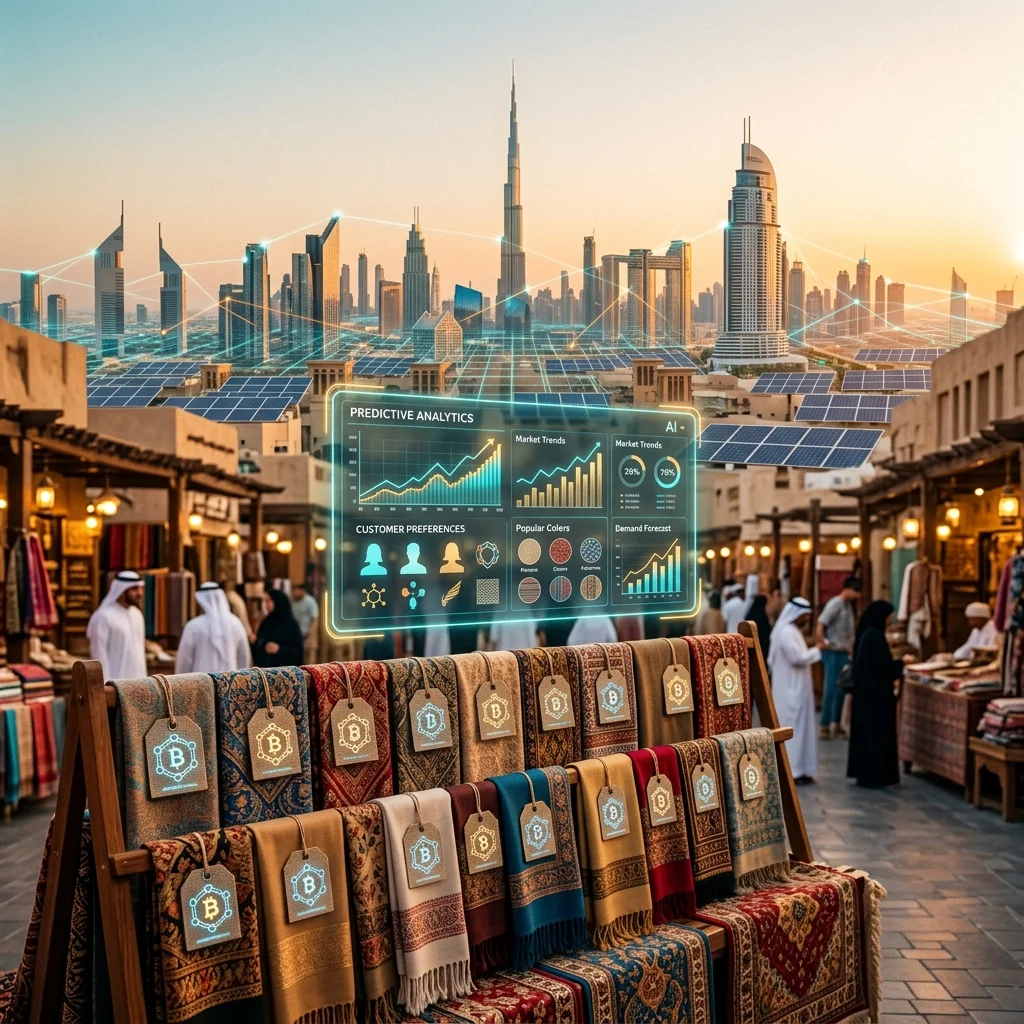
As the sun sets over Dubai’s skyline—solar panels glinting on rooftops, digital grids connecting landmarks—the transformation is visible at every level. A young Emirati woman manages a textile showroom using an AI dashboard that predicts which fabrics her customers will want next season. A Saudi logistics company uses blockchain to verify the halal status of every food shipment leaving Jeddah port. A family-run car wash in Sharjah has cut its water bill by 60% and now sells its services to eco-conscious corporate clients.
These are not isolated anecdotes. They represent the new normal in the Gulf by 2026. Technology is not replacing tradition; it is giving tradition a digital heart. And in doing so, it is engineering a triple transformation—digital, social, and environmental—that will define the region’s economic identity for decades to come.
[IMAGE: A seamless blend of old and new: In the foreground, a traditional Arabian textile display with woven fabrics, but each fabric tag contains a small holographic blockchain certification icon. Above, a transparent AI interface shows predictive analytics graphs and customer preferences. In the background, the Dubai skyline with solar panels on rooftops and a faint digital grid connecting landmarks. Warm amber and teal tones. No text, no watermark.]
Keywords

Layla Ibrahim
Technology Reporter covering fintech, AI, and startup ecosystems in the Gulf.