Beyond the Hype: The Hidden Economic Engine of AI Influencers and Synthetic Podcasters
While headlines focus on the novelty of AI influencers and synthetic podcasters, the real story is the emergence of a new, scalable economic model. This analysis moves beyond surface-level monetization to explore the underlying infrastructure-as-a-service (IaaS) for digital personas, the shifting cost structures of content creation, and the long-term implications for human labor, intellectual property, and audience trust. We examine how this trend isn't just about replacing humans but creating a parallel, automated media economy with its own unique rules, risks, and revenue streams that challenge traditional entertainment and marketing paradigms.
Layla Ibrahim
Editorial Analyst
Beyond the Hype: The Hidden Economic Engine of AI Influencers and Synthetic Podcasters
Introduction: The Tip of the Monetization Iceberg
A report from The Meridiem on April 10, 2026, documented the phenomenon of AI influencers and synthetic podcasters generating revenue (Source 1: The Meridiem, April 10, 2026). This data point is not an isolated novelty but a visible indicator of a deeper structural shift in media production. The central inquiry is whether this trend represents a transient fad or the foundational layer of a new, parallel content economy. The thesis of this analysis is that the monetization of these digital entities is merely the output of a more significant systemic transformation. This transformation redefines the cost structures, supply chains, and value propositions underlying entertainment and marketing.
Deconstructing the Revenue Streams: More Than Ad Dollars
The reported revenue generation is a composite of several interlocking models. Direct brand partnerships and advertising represent the most visible layer, mimicking traditional influencer marketing. More structurally significant are subscription models granting exclusive access to an AI persona’s expanded content or interactions, and licensing fees for synthetic voices and personalities. The economic advantage lies in the operational model: after the initial development phase, the marginal cost of scaling content output to a global audience, 24 hours a day, approaches zero. This contrasts sharply with the high, upfront capital expenditure required for research, development, and computational training. This framework gives rise to the concept of "Digital Persona Assets" (DPAs). A DPA is a licensable, amortizable intellectual property portfolio—comprising voice prints, behavioral algorithms, and visual models—that can be deployed, scaled, or leased independently of human biological limits.
The Hidden Supply Chain: Infrastructure for Synthetic Stars
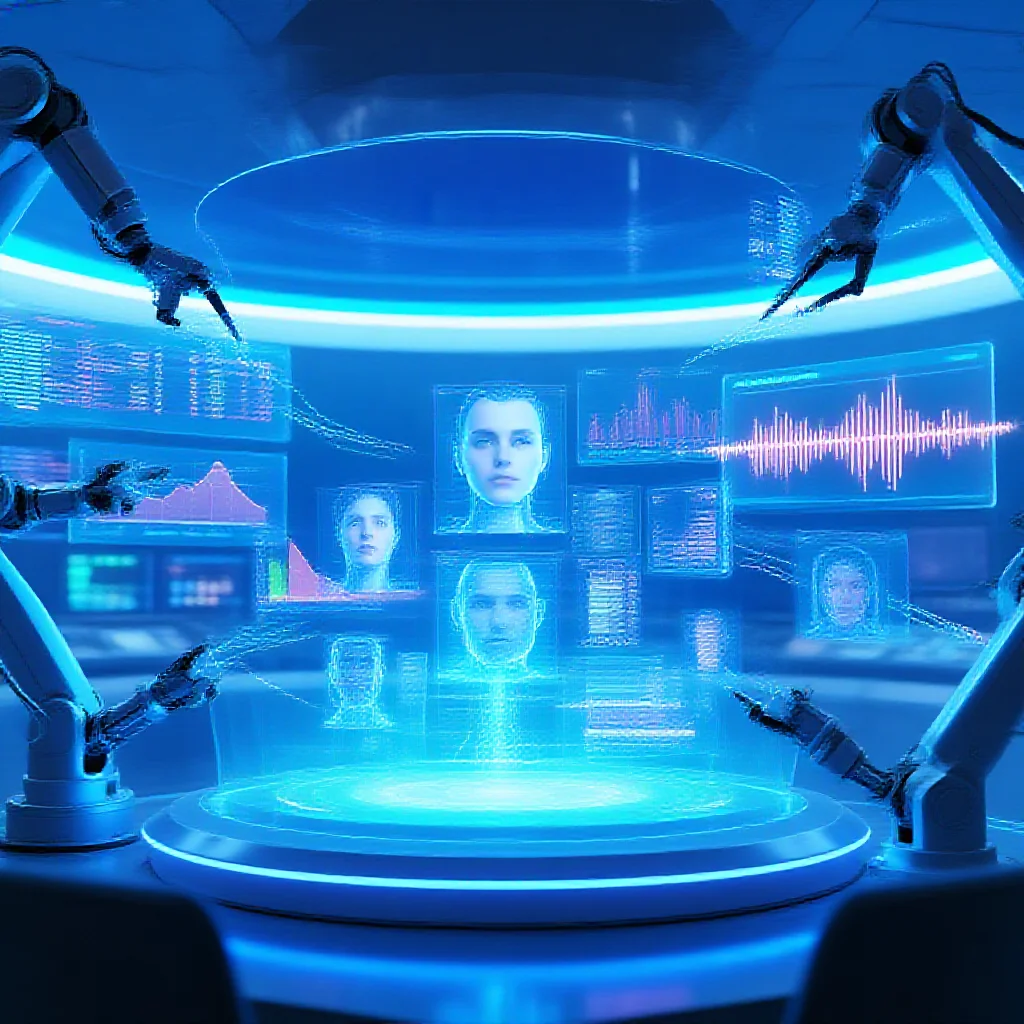
The creation and maintenance of a viable synthetic entity depend on a specialized, often opaque supply chain. This infrastructure includes cloud compute providers who rent processing power for model inference and training, AI model specialists who refine voice synthesis and visual generation, and data labelers who annotate datasets to instill behavioral realism. Legal services are required to navigate the nascent framework of synthetic rights and liabilities. The primary economic beneficiaries in this model are frequently not the entities presenting the AI "talent," but the infrastructure-as-a-service (IaaS) and platform companies that provide the essential tools. This creates a concentration risk; the stability and scalability of the entire synthetic media economy are contingent on the reliability, pricing, and policies of a small number of underlying technology providers.
The Human Displacement vs. Augmentation Paradox
The narrative of direct human job displacement is incomplete. A more nuanced analysis reveals a shift in labor requirements. While certain front-facing creative roles may be reduced, new hybrid positions emerge. These include persona managers who oversee narrative continuity and audience engagement for synthetic beings, AI ethicists tasked with defining and enforcing behavioral boundaries for digital entities, and emotional continuity writers who script long-term character arcs. This shift also alters marketable traits. The traditional premium on human "authenticity" may face devaluation against a new premium offered by synthetic entities: "perfect consistency," predictable output, and absolute scalability without fatigue or controversy.
Long-Term Implications: Trust, IP, and the Attention Economy
The proliferation of persuasive synthetic media carries profound implications. The erosion of baseline audience trust is a primary risk, as the provenance of any digital persona becomes inherently uncertain. This necessitates the development of new verification standards and could fragment media ecosystems into "verified-human" and "synthetic" categories. Intellectual property frameworks are destabilized. Current laws are ill-equipped to handle ownership of AI-generated personalities trained on amalgamated human data, leading to complex disputes over derivation and originality. Finally, the attention economy faces saturation from infinitely scalable synthetic competitors, potentially driving down the value of generic content while increasing the value of verifiably human, imperfect, or experiential media.
Conclusion: The New Rules of a Parallel Media Economy
The monetization of AI influencers and synthetic podcasters is not merely an extension of existing media practices. It signals the establishment of a parallel, automated media economy with distinct operational rules. This economy is characterized by decoupled production costs from scale, the assetization of digital personas, and a redefined role for human labor within the creative supply chain. The long-term viability of this model will be determined not by technological capability, which will advance, but by the resolution of systemic challenges: establishing sustainable economic models for infrastructure providers, constructing legal frameworks for synthetic IP, and managing the recalibration of audience trust in an increasingly synthetic digital landscape. The market prediction is the co-existence of human and synthetic media, but governed by increasingly divergent economic and regulatory principles.
Keywords

Layla Ibrahim
Technology Reporter covering fintech, AI, and startup ecosystems in the Gulf.