Beyond the Cloud: Why Kepler''s Orbital GPU Cluster Signals a New Era in Space-Based Computing
Kepler Communications has launched the world's first commercially accessible, orbital 40-GPU compute cluster, marking a pivotal shift from terrestrial cloud infrastructure to space-based processing. This move is not merely a technical feat but a strategic play in the emerging 'orbital edge computing' market. It addresses critical latency and data sovereignty challenges for AI, Earth observation, and real-time analytics. This article analyzes the hidden economic logic behind moving compute power to orbit, explores the nascent supply chain for space-hardened hardware, and questions whether this is a niche solution or the foundation for a new layer of the global digital economy. We examine the regulatory hurdles, the long-term implications for data governance, and the potential to unlock entirely new classes of applications that are impossible from the ground.
Layla Ibrahim
Editorial Analyst
Beyond the Cloud: Why Kepler's Orbital GPU Cluster Signals a New Era in Space-Based Computing
Introduction: From Cloud to Orbit – Computing's Next Frontier
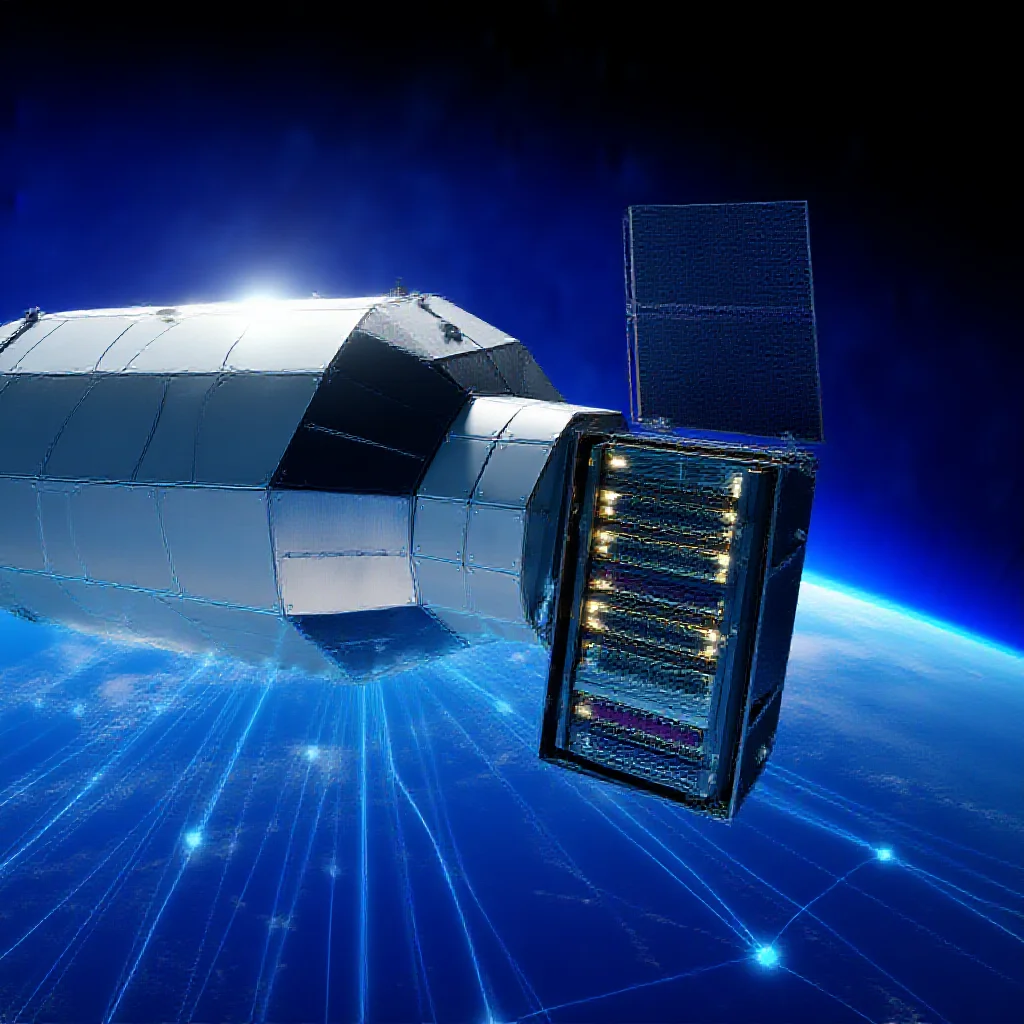
The historical trajectory of compute architecture has followed a path of progressive decentralization: from centralized mainframes to distributed cloud data centers, and further to terrestrial edge nodes. A new, radical phase has now been initiated. On April 13, 2026, Kepler Communications opened a compute cluster containing 40 GPUs for commercial business use, with the defining characteristic that the hardware is located in orbit (Source 1: [Primary Data]). This is not an experimental payload but a commercially accessible infrastructure. The launch of this orbital GPU cluster represents a pivotal shift, marking the operational beginning of what industry analysts term "orbital edge computing." This move transitions the concept from theoretical research to a deployable service, challenging the fundamental premise that significant processing power must remain terrestrially bound.
An illustrative timeline showing the evolution of compute locations from centralized data centers to the edge and now to orbit.
The Hidden Economic Logic: Why Put GPUs in Space?
The economic rationale for incurring the extreme cost of launching and maintaining hardware in space is not rooted in raw compute power, which remains cheaper on Earth, but in strategic positional advantage. The business case is built on three pillars.
First is Latency Arbitrage. For applications like real-time analysis of Earth observation imagery, the bottleneck is the downlink. Transmitting terabytes of raw sensor data to the ground for processing introduces delay. An orbital compute cluster co-located with or near sensor satellites can perform AI inference—identifying objects, classifying changes, detecting anomalies—and downlink only the valuable insights, slashing latency from hours to seconds. This enables true real-time decision-making for disaster response, security monitoring, and agricultural management.
Second is Data Sovereignty & Jurisdictional Bypass. Data processed in orbit exists, temporarily, in a jurisdictionally ambiguous domain. For entities handling sensitive data—whether for national security, proprietary environmental monitoring, or confidential corporate intelligence—processing information in space before it touches any nation's ground station offers a novel form of data control and regulatory bypass. It creates a neutral processing zone, a factor with significant geopolitical and commercial implications.
Third is the emergent 'Orbital Edge' Business Model. Kepler is not merely selling GPU cycles; it is selling a unique positional service. The value proposition shifts from cost-per-flop to cost-for-position, creating a new market segment defined by physical location relative to data sources and consumers in space and on Earth.
A diagram comparing the data pipeline for ground-based processing vs. orbital processing of satellite imagery, highlighting latency savings.
Deep Audit: Deconstructing the 'Space-Hardened' Supply Chain
The deployment of a 40-GPU cluster in Low Earth Orbit (LEO) is a severe engineering challenge that reveals a nascent, specialized supply chain. Commercial off-the-shelf (COTS) GPUs are not designed for the orbital environment.
The primary constraints are radiation, thermal management, and power. Galactic cosmic rays and solar particles can cause bit flips and latch-up events, permanently damaging sensitive semiconductors. Solutions involve a combination of radiation-hardened by design (RHBD) components, shielding, and sophisticated error-correcting code (ECC) memory. Thermal management is equally critical; without convection, waste heat must be dissipated solely through radiation, requiring advanced materials and heat-spreader designs. Power must be meticulously managed, drawn from solar panels and batteries with high efficiency to maximize compute performance per watt.
The supply chain for such hardware is a hybrid. It involves niche vendors like Cobham Gaisler (RHBD processors) and BAE Systems, alongside heavily modified commercial components from NVIDIA or AMD. The long-term industry impact hinges on demand scalability. If orbital computing remains a niche for a handful of satellites, it will stay a boutique, high-cost custom integration field. However, if constellations of compute nodes are deployed, it could spur dedicated product lines from major semiconductor and subsystem manufacturers, driving down costs and standardizing space-grade compute modules.
A detailed cross-section graphic of a hypothetical orbital compute module, showing radiation shielding, specialized cooling loops, and redundant power systems.
Fast Analysis: Timeliness and Market Verification
Kepler's announcement is a verifiable milestone within a broader, accelerating trend. The company's capability is underpinned by its existing expertise in operating a communications satellite constellation for IoT data backhaul. This move represents a logical vertical integration, adding high-value compute services to its data transport layer.
The competitive landscape is forming. While Kepler is first to offer a commercially accessible, dedicated orbital GPU cluster, other entities are on parallel tracks. Amazon Web Services (AWS) has its Aerospace and Satellite Solutions division, actively working to extend its cloud ecosystem into space. Other satellite operators, particularly those with large imaging constellations like Planet or Maxar, have intrinsic incentives to develop onboard processing. The market is in a validation phase where initial use cases will determine its trajectory.
Probable first adopters are in sectors where latency and data sovereignty provide decisive advantage. Geospatial intelligence contractors and government agencies are primary candidates for real-time change detection and object tracking. Scientific research missions, such as those analyzing atmospheric data or astronomical observations in real-time, represent another early market. Telecommunications operators may eventually use orbital nodes for network function virtualization, optimizing data routing in space.
A competitive landscape matrix comparing Kepler's offering with potential competitors on axes of compute specialization, orbital assets, and cloud integration.
Conclusion: Niche Experiment or Foundational Layer?
The activation of Kepler's 40-GPU cluster is a definitive proof-of-concept for orbital edge computing. Its immediate future is as a high-value, niche solution for applications where latency and data sovereignty outweigh the premium cost of space-based infrastructure. The technical and economic barriers to widespread adoption remain substantial.
The long-term implication, however, is more profound. If the cost of access to orbit continues to fall and the reliability of space-hardened compute improves, orbital processing could evolve into a foundational layer of the global digital economy. It would become the indispensable edge layer for a space-based internet of things, for real-time planetary-scale analytics, and for applications not yet conceived. The primary obstacles are no longer merely technical but involve evolving regulatory frameworks for data processed in space, sustainable practices for orbital debris management from proliferating constellations, and the development of interoperable standards for this new domain. Kepler's cluster is the first node in a potential network that could redefine where and how the world's data is processed.
Keywords

Layla Ibrahim
Technology Reporter covering fintech, AI, and startup ecosystems in the Gulf.