Gulf Tech 2025: From Innovation Labs to Agentic AI – The Middle East''s New Economic Logic
A deep-dive into PwC Middle East's 2025 report reveals that the Gulf is not just adopting technology but building a self-sustaining innovation infrastructure. Beyond AI and robotics, the critical trend is the rise of dedicated Innovation Labs as R&D hubs for economic diversification. This article explores how agentic AI, immersive experiences, and physical robotics are reshaping competitiveness, while highlighting the hidden bottleneck of Arabic data scarcity. We embed verified PwC insights to show how these trends form a coherent market strategy rather than isolated fads.
Layla Ibrahim
Editorial Analyst
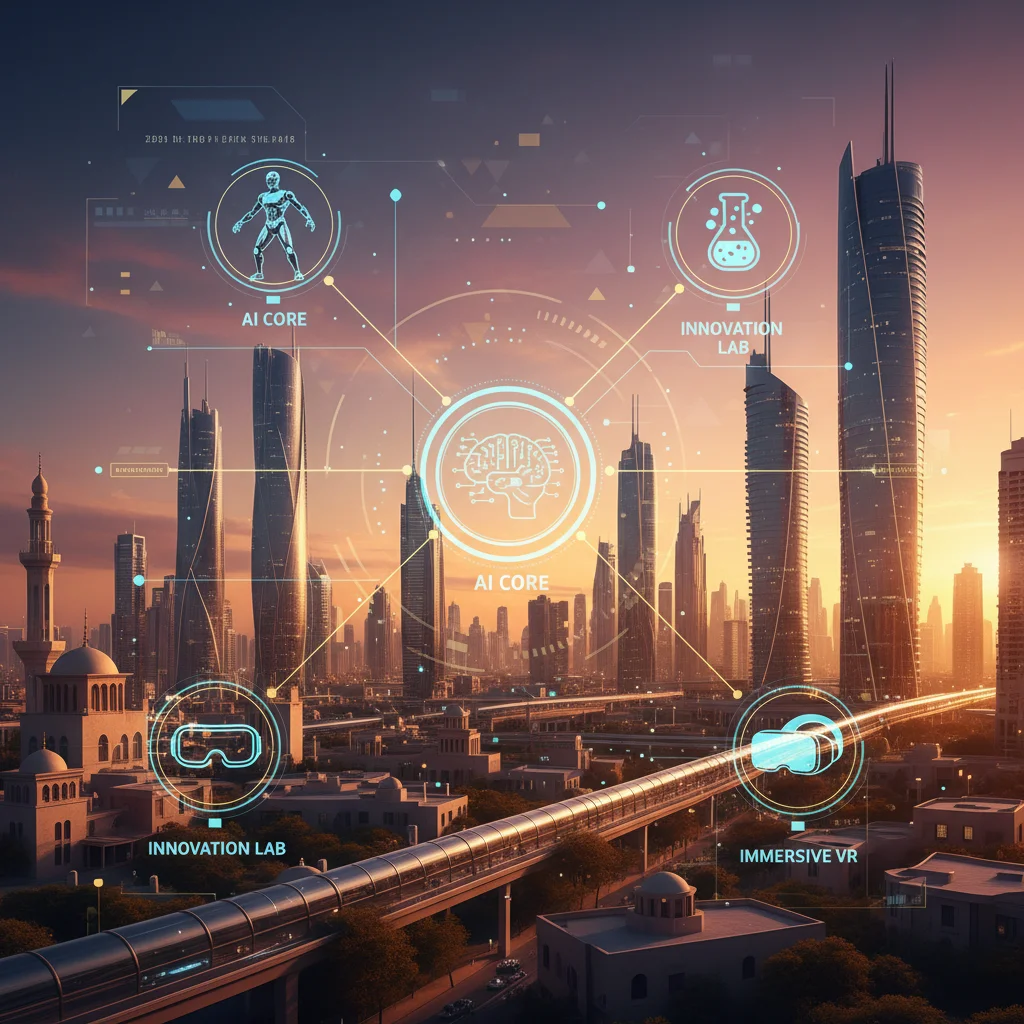
Gulf Tech 2025: From Innovation Labs to Agentic AI – The Middle East's New Economic Logic
Date: April 2025
Source Analysis: PwC Middle East, "Emerging Technology Trends in the Middle East 2025"
Authors: Shean Malik, Sami Al-Shatri
---
Introduction: The Hidden Engine Behind Gulf Tech Growth
The Middle East's technology acceleration cycle has entered a structural phase shift. According to PwC Middle East's April 2025 report, the region's adoption of emerging technologies is no longer driven by speculative hype or brand-building exercises. Instead, it reflects a calculated economic calculus: diversification away from hydrocarbon dependency through the systematic institutionalization of innovation capacity (Source 1: PwC Middle East, "Emerging Technology Trends in the Middle East 2025," published April 9, 2025).
The report identifies four interlocking technological trends—innovation labs, artificial intelligence, immersive technologies, and advanced robotics—that collectively form a coherent market strategy. The critical insight is not that Gulf states are purchasing technology, but that they are constructing the infrastructure to generate it domestically. This distinction separates the current phase from previous waves of technology adoption in the region.
The central finding from PwC's analysis: organizations in the Middle East are being explicitly advised to establish their own research and development teams to maintain a competitive edge. This represents a strategic departure from the region's historical role as a technology consumer toward becoming a co-creator of technological solutions.
---
Trend 1: Innovation Labs as the New R&D Muscle
Innovation labs are the foundational layer of this transformation. PwC defines these entities as "spaces where organizations explore new ideas, experiment with technology, and solve business challenges" (Source 1). The operative mechanism is "agile experimentation, driven by continuous research, iterative design, and development" (Source 1: Direct quote from PwC report).
The strategic significance of innovation labs extends beyond their immediate prototyping function. They serve as institutional immune systems against technological obsolescence. By establishing dedicated R&D infrastructure, Gulf organizations can test emerging technologies in controlled environments without disrupting core business operations. This risk-containment architecture enables faster iteration cycles than traditional corporate R&D models.
The regional specificity lies in the economic rationale. Gulf economies, historically reliant on energy exports, face a compressed timeline for diversification. Innovation labs compress the learning curve by creating safe failure zones where local talent can acquire technical competencies. PwC's explicit recommendation that organizations "establish their own research and development teams" (Source 1) signals a structural shift from outsourcing innovation to internalizing it.
This trend carries measurable implications for the Gulf's labor market. The demand for local R&D personnel will increase, while the premium on technology management skills will rise relative to pure technology consumption skills. Organizations that fail to build internal innovation capacity will face widening competitive disadvantages as the technology adoption cycle accelerates.
---
Trend 2: The Agentic AI Leap – From Content to Context
PwC's report traces artificial intelligence through three evolutionary stages: prediction, generation, and now agentic systems. The current phase represents a fundamental shift in AI's operational logic. "Agentic AI marks a shift in the AI landscape where models are moving beyond content creation and are responding to real-world contexts" (Source 1: Direct quote from PwC report).
The distinction is consequential. Predictive AI forecast outcomes; generative AI created content; agentic AI makes autonomous decisions based on environmental inputs. This progression transforms AI from a passive analytical tool into an active system capable of executing complex workflows without continuous human supervision.
For Gulf economies, agentic AI's potential applications are structurally aligned with national development priorities. Smart city management—traffic optimization, energy grid balancing, logistics coordination—requires precisely the kind of real-world contextual responsiveness that agentic AI provides. The technology could automate functions that currently consume significant public sector resources.
However, a critical bottleneck emerges from the data environment. The scarcity of Arabic datasets and the complexity of diverse dialect variations complicate the development of regionally effective AI systems (Source 1). Agentic AI trained primarily on English-language or Western-context data will underperform when deployed in Arabic-speaking, culturally distinct environments. This creates a dependency risk: if Gulf states import agentic AI systems without local data adaptation, the technology may fail to achieve its theoretical performance potential.
The strategic response is clear. Investment in Arabic language corpora, dialect-specific training datasets, and culturally calibrated training protocols must accelerate in parallel with AI deployment. Without this foundational data infrastructure, agentic AI in the Gulf will remain a technology in search of context rather than a context-responsive system.
---
Trend 3: Immersive AI – Where Reality Meets Personalization
Immersive AI represents the convergence of virtual and augmented reality with artificial intelligence. PwC's report states that "Immersive AI transforms headsets into intelligent and interactive environments across sectors like education and tourism" (Source 1: Direct quote from PwC report).
The technical innovation lies in the interactive dimension. Unlike static virtual reality experiences, immersive AI creates environments that respond to user behavior, preferences, and real-time inputs. This personalization capability differentiates it from earlier VR/AR applications that offered fixed content irrespective of user interaction patterns.
The Gulf's specific application vectors are twofold. In education, immersive AI can address the region's skills gap by providing adaptive training environments that adjust to individual learning speeds and styles. In tourism—a cornerstone of post-oil diversification strategies—immersive AI can create differentiated visitor experiences that extend beyond physical site visits into virtual exploration of historical and cultural narratives.
The economic logic aligns with demographic realities. The Gulf's young, digitally native population is predisposed to adopt immersive technologies. Early deployment in tourism and education creates testing grounds that can later be scaled to healthcare, real estate, and retail sectors. The technology's success, however, depends on content localization. Immersive AI experiences developed in Western markets and exported to the Gulf will lack the cultural specificity required for deep engagement.
---
Trend 4: Physical AI and Robotics – From Factory Floors to Service Sectors
Advancements in AI, hardware, and software are enabling robots to perform tasks previously beyond their capabilities. PwC notes that "Physical AI allows machines to perceive, understand, and perform complex actions in the physical world" (Source 1). This represents a convergence of machine learning with mechanical engineering, creating systems that can navigate unstructured environments.
The Gulf's deployment vector for physical AI differs from manufacturing-heavy East Asian models. Given the region's service-oriented economy, robotics applications are more likely in hospitality, healthcare, logistics, and construction. Physical AI systems can address labor market constraints by automating routine service tasks while augmenting human workers in complex procedures.
The operational advantage for Gulf organizations is the ability to leapfrog legacy robotics infrastructure. Unlike industrialized economies with decades-old automation systems, Gulf organizations can implement physical AI as greenfield deployments. This reduces integration complexity and allows optimization for specific use cases from the outset.
The constraint, however, is talent availability. Physical AI requires expertise spanning robotics engineering, AI model training, sensor integration, and systems integration. The Gulf's current talent pipeline in these disciplines is insufficient for rapid scaling. PwC's recommendation for establishing internal R&D teams becomes particularly acute in this context, as imported robotics systems require local adaptation and maintenance.
---
The Structural Challenge: Arabic Data Scarcity as a Systemic Risk
Across all four trends, a unifying constraint emerges: the scarcity of Arabic datasets and the complexity of dialectical variations. This is not a peripheral issue but a structural bottleneck that could limit the Gulf's technology transformation (Source 1).
Arabic data scarcity affects each trend differently. Innovation labs require local data to design regionally relevant solutions. Agentic AI requires Arabic-language training data for contextual responsiveness. Immersive AI requires culturally specific content libraries. Physical AI requires environment-specific operational data for task learning.
The consequence of failing to address this bottleneck is technological dependency. Gulf organizations will continue importing AI and robotics systems trained on non-Arabic, non-Gulf data. These systems will underperform relative to their theoretical capabilities, creating a persistent productivity gap.
The strategic response requires coordinated investment across multiple domains: government-sponsored Arabic language corpora, university-led dialect mapping initiatives, private sector data-sharing consortia, and regulatory frameworks that incentivize data collection while protecting privacy. Without this infrastructure, the Gulf's technology ambitions will be constrained by a data environment that cannot support the systems being deployed.
---
Market Predictions and Strategic Outlook
Based on the PwC analysis and current adoption trajectories, three market predictions emerge for the 2025-2027 period.
First, innovation lab proliferation will accelerate. Organizations that establish internal R&D capacity will demonstrate measurable competitive advantages in time-to-market for new technology deployments. The premium on Gulf talent with innovation lab experience will increase, driving wage inflation in technology management roles.
Second, agentic AI deployment will face a two-speed adoption pattern. Sectors with strong existing data infrastructure—banking, telecommunications, logistics—will adopt agentic AI rapidly. Sectors requiring Arabic-language contextual understanding—government services, education, healthcare—will lag due to data scarcity constraints.
Third, immersive AI in education and tourism will become the Gulf's distinctive technology export. The region's ability to create culturally specific, high-production-value immersive experiences positions it as a potential global leader in this niche. However, success depends on content localization investments that are currently underfunded relative to hardware procurement.
The underlying structural shift is clear: the Gulf is moving from technology adoption to technology generation. Innovation labs, agentic AI, immersive AI, and physical robotics are not isolated trends but components of an integrated strategy for economic diversification. The critical variable determining success is not the speed of technology deployment but the quality of the data and talent infrastructure supporting it. Organizations that recognize this distinction will capture the asymmetric returns of the Gulf's technological transformation. Those that treat these trends as procurement exercises will find themselves permanently behind the innovation curve.
Keywords

Layla Ibrahim
Technology Reporter covering fintech, AI, and startup ecosystems in the Gulf.