Samsung''s Bixby Bet: How a Callable Agent Architecture Signals a Strategic Pivot in the AI Assistant War
Samsung's announcement that Bixby is transitioning from a research project to a production-ready service, coupled with the release of a 'Callable Agent Architecture, is more than a technical update. It reveals a fundamental strategic shift. This analysis argues that Samsung is abandoning the futile quest to build a monolithic, all-knowing AI like its rivals. Instead, it is positioning Bixby as an open, federated orchestrator'—a hub designed to connect users to a universe of specialized third-party AI agents. This move targets the enterprise and developer ecosystem, aiming to create a new platform for AI-powered device functionality and services, thereby monetizing its vast hardware footprint in a way pure software players cannot easily replicate.
Layla Ibrahim
Editorial Analyst
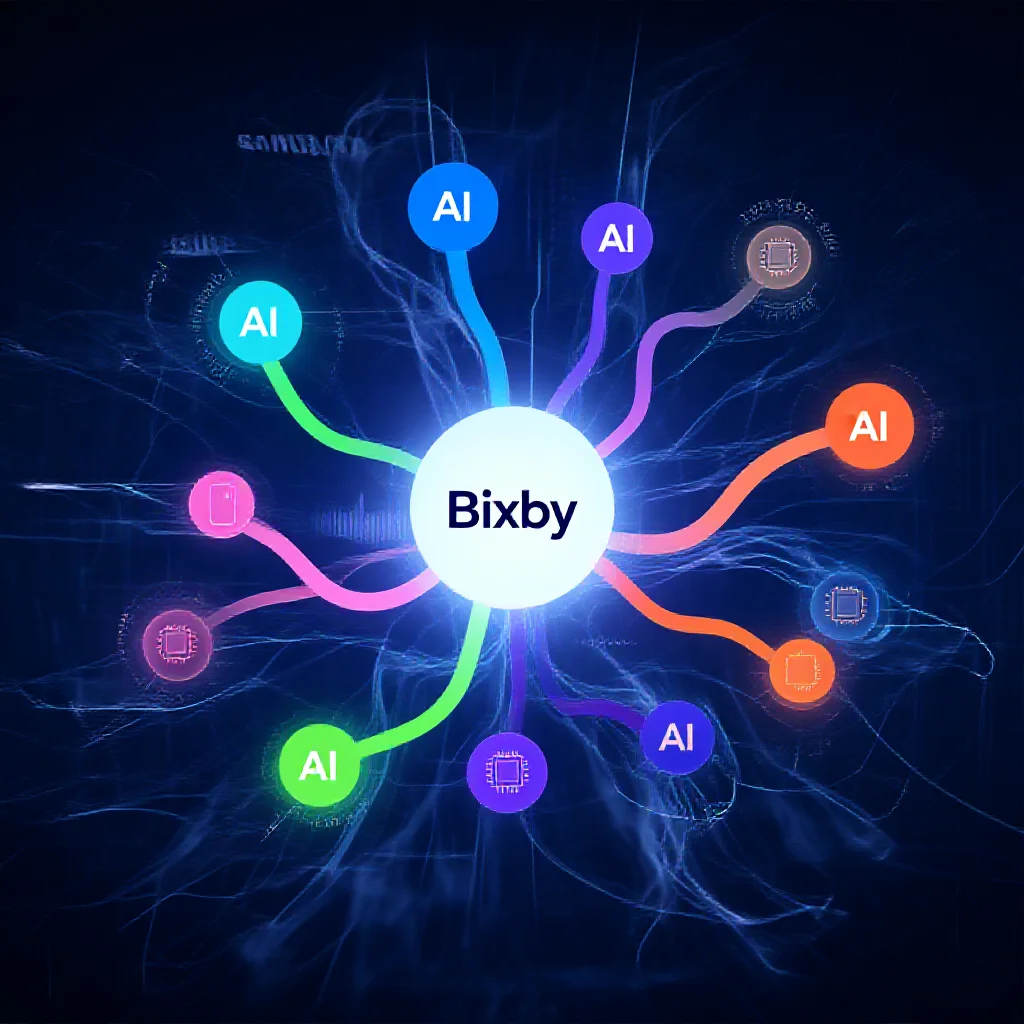
Samsung's Bixby Bet: How a Callable Agent Architecture Signals a Strategic Pivot in the AI Assistant War
Subtitle: An analysis of the economic logic and platform strategy behind Samsung's shift from a monolithic assistant to an open orchestrator.
On April 8, 2026, Samsung Electronics announced a significant transition for its virtual assistant, Bixby. The technology was formally moved from a research project to a production-ready service. Concurrently, the company released a "Callable Agent Architecture" designed to enable third-party developers to create specialized AI agents that can be invoked by Bixby (Source: Samsung Developer Documentation). This technical announcement represents a fundamental strategic pivot. Analysis indicates Samsung is abandoning the pursuit of a monolithic, all-knowing artificial intelligence in favor of positioning Bixby as an open, federated orchestrator. This strategy leverages Samsung's hardware scale to create a new platform for AI-powered device functionality, targeting enterprise and developer ecosystems in a manner not easily replicable by pure software competitors.
Beyond the Press Release: Decoding Samsung's 'Production-Ready' Gambit
The declaration of Bixby as "production-ready" signifies a shift in intent from research and development to commercialization and scaling. This transition implies a commitment to stable application programming interfaces, developer support, and, critically, a clear path to monetization. It contrasts with the historical trajectory of Bixby as an in-house research endeavor often perceived as lagging behind competitors.
This move also functions as a tacit admission of the competitive landscape. The "walled garden" approach of assistants like Apple's Siri or Google Assistant, which rely on their respective companies' vast data and service ecosystems, has proven difficult for a hardware-focused entity like Samsung to challenge directly. The release of the Callable Agent Architecture is therefore not merely a feature addition. It constitutes a foundational platform shift, redefining Bixby's core purpose from being the intelligence itself to becoming the system that discovers, accesses, and coordinates external intelligence.
!A split image showing a laboratory beaker on one side and a factory assembly line on the other.
The Orchestrator Strategy: Why Federated AI Beats a Monolithic Brain
The strategic logic behind this pivot is rooted in economic and technological trends. The primary strength of Samsung is its immense hardware footprint across smartphones, televisions, appliances, and wearables. The orchestrator model leverages this scale to build a software platform that third-party agent developers must integrate with to reach a pre-installed, global user base. This inverts the traditional challenge of acquiring users for a new platform.
Market patterns further validate this approach. General-purpose voice assistants have largely failed to evolve beyond simple commands and queries into agents of true, complex utility. This has created a market opening for specialized AI agents capable of executing multi-step tasks in specific domains, such as travel planning, financial analysis, or specialized enterprise workflows. Under the new architecture, Bixby's role is re-imagined as the default conductor for a symphony of these specialized agents across the Samsung device ecosystem. The assistant becomes the unified interface, while the cognitive labor is distributed across a federated network of best-in-class services.
The Developer Play: Building an Ecosystem Where Google and Apple Can't
The Callable Agent Architecture explicitly targets developer communities that broader platforms may underserve. The strategy focuses on niche verticals where deep, domain-specific expertise is required. Specialized agents for healthcare diagnostics support, industrial IoT maintenance, or advanced financial portfolio management could become Bixby's unique selling proposition, moving competition away from consumer trivia and into high-value professional workflows.
Samsung's potential competitive moat lies in deep integration with its proprietary technologies. The architecture can be coupled with Samsung Knox for enhanced security, Tizen OS for smart appliances and televisions, and the broader Galaxy ecosystem for seamless cross-device agent invocation. This integrated hardware-software stack is a compelling lure for enterprise developers requiring secure, reliable, and deeply embedded AI functionality.
The long-term implications extend to the semiconductor supply chain. A future populated by diverse, specialized AI agents favors chip architectures optimized for efficient, distributed AI workloads rather than solely for raw, centralized computational power. This aligns with the interests of Samsung's chip design (Samsung LSI) and manufacturing (Samsung Foundry) divisions, incentivizing optimization for the very agent-based model Bixby now promotes.
!A network diagram showing a central hub connected to various industry-specific icons.
Verification and Context: Placing the Announcement in the Broader AI Landscape
Technical verification of this strategy is found in Samsung's official developer portal. The released documentation for the Callable Agent Architecture details how developers can register their agents, define capabilities, and handle invocation requests from the Bixby platform (Source: developer.samsung.com). This confirms the move from a closed system to an open, extensible framework.
Contextual analysis places Samsung's maneuver within a broader industry trend toward agentic ecosystems. Microsoft's Copilot Studio allows for the creation of custom copilots, and numerous open-source agent frameworks are in development. Samsung's differentiating angle is its device-centricity. While others build ecosystems in the cloud or within productivity software, Samsung's platform is intrinsically linked to physical device interaction—from phones and watches to refrigerators and industrial panels. This creates a distinct use case layer focused on ambient, context-aware computing in the real world.
Neutral Market and Industry Predictions
The transition of Bixby to an orchestrator model will likely catalyze three market developments. First, a new segment of middleware and tooling will emerge to facilitate the development, testing, and deployment of callable agents for the Samsung ecosystem. Second, competition will intensify in vertical-specific AI agent markets, as developers now have a major, hardware-backed distribution channel beyond traditional app stores. Third, rival consumer hardware manufacturers may be compelled to respond with similar open agent architectures, potentially leading to standardization efforts or interoperability alliances, lest they cede the high-value AI agent platform layer to Samsung.
The ultimate measure of success for this strategic pivot will not be Bixby's ability to answer general knowledge questions, but its adoption rate by enterprise developers and its frequency of use as a routing mechanism for high-value transactions and workflows. By conceding the battle to build the singular, omnipotent AI and instead focusing on becoming its most indispensable switchboard, Samsung has charted a pragmatic course in the ongoing AI assistant war.
Keywords

Layla Ibrahim
Technology Reporter covering fintech, AI, and startup ecosystems in the Gulf.