Tech Trends 2026: From AI Experimentation to Industrial Impact – The Acceleration of Physical Intelligence
AI adoption is accelerating at an unprecedented rate—from decades to months—creating a compounding cycle of better technology, more data, lower costs, and broader experimentation. But the real shift in 2026 is moving beyond digital interfaces into the physical world. As Amazon deploys its millionth robot and BMW lets cars drive themselves through factories, organizations must rebuild their entire infrastructure, processes, and operating models. This article explores the hidden economic logic behind these trends, the shrinking half-life of knowledge, and what it takes to turn AI experiments into lasting industrial impact.
Layla Ibrahim
Editorial Analyst
Tech Trends 2026: From AI Experimentation to Industrial Impact – The Acceleration of Physical Intelligence
The arc of technological adoption has bent sharply upward. Where previous breakthroughs required decades to reach critical mass, artificial intelligence is compressing that timeline into mere months. The telephone took half a century to connect 50 million users; the internet accomplished the same feat in seven years. A leading generative AI tool, by contrast, crossed 100 million users in just two months—and now serves more than 800 million weekly active users, roughly 10 percent of the global population. This is not a linear acceleration but a paradigm shift in how quickly new capabilities embed themselves into the fabric of work and life.
According to Deloitte’s Tech Trends 2026 report, this compression has created an unprecedented challenge for organizations: the window to study a new technology now shrinks faster than institutions can learn. As one unnamed CIO put it, “The time it takes us to study a new technology now exceeds that technology’s relevance window.” The implication is stark—businesses that rely on traditional evaluation cycles risk making decisions about tools that are already obsolete. The only viable response is to rewire how organizations experiment, scale, and embed intelligence into their core operations.
[IMAGE: A timeline infographic comparing adoption curves of telephone, internet, and generative AI, with logarithmic scale to emphasize the exponential speedup.]
The Compounding Flywheel: How Innovation Accelerates Itself
The speed of adoption is not an isolated phenomenon—it is the visible expression of a deeper self-reinforcing cycle. Better technology enables more applications, which generate more data, which attract more investment, which drives down infrastructure costs, which fuels further experimentation, which in turn produces better technology. This compounding flywheel—what researchers call the “intelligence cycle”—is now spinning faster than any previous industrial feedback loop.
Consider the economics of AI startups. Data from venture capital benchmarks shows that AI-native companies scale from $1 million to $30 million in revenue five times faster than comparable SaaS companies. The reason is structural: each new deployment generates proprietary data that improves model performance, creating a durable competitive moat. Meanwhile, the cost of compute and inference continues to decline, with some estimates placing the price of a single LLM inference call at less than a tenth of what it cost two years ago.
But this flywheel also shortens the half-life of knowledge in the AI domain—from years to months. Techniques that were state-of-the-art in early 2024 are now baseline; architectures that defined the frontier of robotics in 2025 are already being superseded. Organizations that fail to adopt continuous learning models—both for their algorithms and their human workforce—risk not just falling behind but becoming structurally obsolete. The economic logic is unforgiving: the gap between experimenters and those who achieve real industrial impact widens with every turn of the flywheel.
[IMAGE: A circular diagram showing the flywheel: better tech → more apps → more data → more investment → lower costs → more experimentation → better tech.]
Organizational Overhaul: Rebuilding for the AI Era
The compounding effect of rapid AI adoption creates a hidden trap: legacy infrastructure, siloed processes, outdated security models, and rigid IT operating models cannot support intelligence at scale. Companies that attempt to graft AI onto existing systems find that the seams break—data pipelines fail, latency kills real-time decisions, and governance frameworks collapse under the weight of autonomous decision-making.
Organizations must therefore rebuild from the ground up. This is not a marginal upgrade but a fundamental re-architecting of the technology stack. Data fabrics replace traditional warehouses; real-time inference layers sit alongside batch processing; autonomous decision nodes replace static business rules. Security models shift from perimeter-based to identity- and behavior-based, because autonomous agents cannot be constrained by the same boundaries as human users.
The deep entry point is an economic one: the logic of modernization moves from optimizing existing workflows to re-architecting the entire value chain. Supply chains become AI-native, predicting disruptions before they occur. Customer experience becomes hyper-personalized, driven by models that update in real time. Product development cycles shrink from quarters to weeks, as generative design tools iterate on thousands of prototypes simultaneously. Delaying this modernization is not merely a missed opportunity—it is a direct subtraction from future competitiveness, because the compounding flywheel for early movers only accelerates.
[IMAGE: A before/after comparison of a traditional IT stack vs. an AI-native architecture with embedded data fabrics, real-time inference layers, and autonomous decision nodes.]
AI Goes Physical: Robotics and Autonomous Systems
The most transformative trend of 2026, however, is the movement of AI beyond digital interfaces into the physical world. For years, AI’s impact was largely confined to screens—chatbots, recommendation engines, image generators. But the economics of intelligence have now shifted enough to make physical AI viable at industrial scale.
Amazon has already deployed more than one million robots across its fulfillment network, and the latest generation of systems operates with near-human dexterity. In Germany, BMW is running production lines where vehicles drive themselves autonomously through assembly stages, guided by AI vision systems that detect micro-defects invisible to the human eye. These are not pilot projects; they are operational realities in factories that produce millions of units annually.
What makes this shift possible is the convergence of three trends: cheaper sensors, cloud-connected compute, and foundation models for robotics. The same transformer architectures that power language models are now being adapted to control robot manipulators, navigate dynamic environments, and learn from human demonstration. The result is a new category of “physical AI”—systems that combine perception, reasoning, and actuation in a single feedback loop.
The implications extend far beyond manufacturing. Warehouses are becoming autonomous ecosystems where inventory decisions, picking routes, and packaging optimizations are all handled by AI agents. Agriculture is deploying robots that identify weeds with 95 percent accuracy and apply herbicide only where needed, reducing chemical use by 80 percent. Healthcare is experimenting with robotic assistants that can transport supplies, disinfect rooms, and even assist in surgery with sub-millimeter precision.
Yet the infrastructure to support physical AI at scale is still nascent. Factories need 5G or private LTE networks with ultra-low latency; logistics hubs require dense sensor arrays and edge compute nodes; safety standards for human-robot collaboration are still being written. The companies that invest in this infrastructure today are building the railroads of the coming decade.
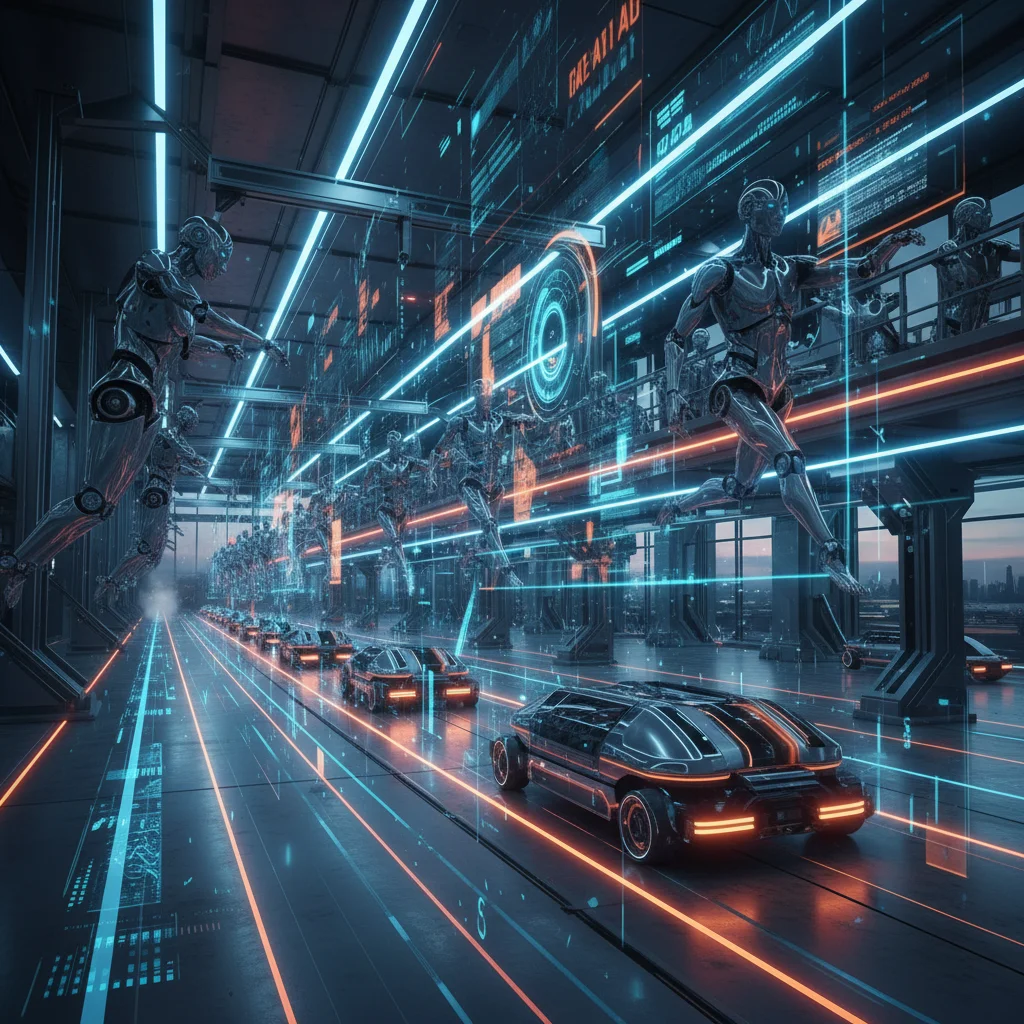
[IMAGE: A hyper-realistic futuristic factory interior where autonomous humanoid robots and self-driving transport pods move in sync. Digital holographic data streams overlay the machinery, symbolizing the fusion of AI intelligence with physical operations. The lighting is cool blue and neon orange, with a sense of dynamic efficiency.]
The New Economics of Industrial Automation
The shift to physical AI is driven by a hidden economic logic: the marginal cost of intelligence is approaching zero, while the marginal benefit of automating physical tasks grows with labor shortages and supply chain complexity. In logistics, a single autonomous forklift can replace three shifts of human operators, paying for itself within 18 months. In electronics assembly, AI-guided robots achieve defect rates below 10 parts per million—a level unattainable by human hands.
But the real economic breakthrough is the ability to reprogram physical systems as easily as updating software. Traditional industrial robots required weeks of reprogramming by specialized engineers for each new task. Modern physical AI systems can learn a new task from a single demonstration, or from a text prompt describing the desired outcome. This flexibility collapses the time and cost of retooling, making automation viable for high-mix, low-volume production—the last frontier of manual labor.
The compounding effect appears again here: each physical AI deployment generates operational data that improves the base model, which can then be deployed across thousands of sites. Tesla’s factory in Fremont, for instance, runs a single neural network that controls all of its humanoid robots; improvements made on one line propagate automatically to every other line. This reduces the cost per deployment over time, creating a natural monopoly for early adopters.
[IMAGE: A chart showing the declining cost of robot reprogramming over time, from weeks of manual coding to minutes of demonstration learning, with cost per deployment dropping by an order of magnitude.]
The Half-Life of Knowledge and the Learning Imperative
As knowledge in AI and robotics decays ever faster, organizations face an existential question: how do you build a workforce that can keep up? The concept of “knowledge half-life”—the time after which half of what you know becomes outdated—has shrunk in AI from an estimated five years in 2020 to less than 18 months in 2026. Certifications earned today will be irrelevant before they expire.
The response cannot be simply more training. Companies must adopt learning models that are continuous, embedded, and adaptive. Some of the most forward-thinking organizations are creating “internal AI academies” that run month-long sprints for engineers and business leaders, teaching them to design, deploy, and govern AI systems. Others are rotating employees through autonomous operations where they train robots by demonstration, effectively turning every worker into a data generator.
The skills that matter are shifting from “how to build AI” to “how to ask the right questions of AI,” how to validate outputs, and how to manage the boundary between automated and human decisions. This is a fundamental change in job design—not replacement, but augmentation with a steep learning curve.
[IMAGE: A graph showing the declining half-life of technical knowledge in AI from 5 years (2020) to 18 months (2026), with an overlay of investment in continuous learning by top-performing companies.]
Experimentation as a Core Capability
Given the speed of change, the old model of “study, plan, pilot, scale” is dead. The new model is “experiment, learn, deploy, iterate.” Deloitte’s Tech Trends 2026 report emphasizes that the difference between leaders and laggards is not the size of their AI budget but their ability to run thousands of small, cheap experiments in parallel.
Leading organizations allocate a fixed percentage of their IT budget—often 10 to 15 percent—to “perpetual experimentation.” They maintain internal marketplaces where teams can spin up AI sandboxes in minutes, test hypotheses, and kill failed efforts without stigma. They measure not just deployment success but “learning velocity”—how quickly the organization converges on effective solutions.
This experimental mindset extends to infrastructure. Instead of building a single massive AI platform, forward-looking firms are creating modular, composable stacks that allow each business unit to choose its own tools while maintaining governance rails. The result is an organization that adapts at the same pace as the technology it uses.
[IMAGE: A diagram showing an internal AI marketplace where teams can provision sandboxes, share models, and track experiment results, with a velocity dashboard showing time-to-insight.]
Conclusion: From Experimentation to Industrial Impact
The story of 2026 is not about a single technological breakthrough; it is about the maturation of a compounding cycle that turns AI experimentation into lasting industrial impact. The speed of adoption has compressed evaluation cycles to near zero. The flywheel of better tech, more data, and lower costs creates an accelerating advantage for those who can ride it. Organizational overhaul is no longer optional—it is a prerequisite for survival. And the movement of AI into the physical world is rewriting the economics of every industry that touches atoms, not just bits.
The question is no longer whether AI will transform industry, but who will be transformed by it. Leaders are already rebuilding their infrastructure, retraining their workforce, and embracing experimentation as a core competency. Those who wait for the technology to stabilize will find, as the CIO warned, that the window has already closed.
In an era where knowledge decays faster than you can acquire it, the only sustainable advantage is the ability to learn faster than the world changes. For most organizations, that will require not just new technology, but a new identity.
Keywords

Layla Ibrahim
Technology Reporter covering fintech, AI, and startup ecosystems in the Gulf.