Beyond Translation: How Webtoon''s AI Default Reshapes Creator Economics and Global Content Flow
Webtoon's decision to make its AI-powered 'Creator Localization' tool the default setting for all creators is not merely a technical upgrade; it's a strategic pivot with profound implications. This move signals a fundamental shift from a platform-centric, top-down localization model to a creator-empowered, bottom-up globalization engine. By lowering the cost and friction of multi-language publication to near zero, Webtoon is effectively weaponizing its creator base to achieve market saturation and data acquisition at an unprecedented scale. This analysis explores the hidden economic logic behind the default setting, the long-term risks of homogenized cultural translation, and how this tactic positions Webtoon to dominate the global comics supply chain by turning every creator into an unwitting data contributor for its AI models.
Layla Ibrahim
Editorial Analyst
Beyond Translation: How Webtoon's AI Default Reshapes Creator Economics and Global Content Flow
Opening: A Strategic Pivot, Not a Feature Update
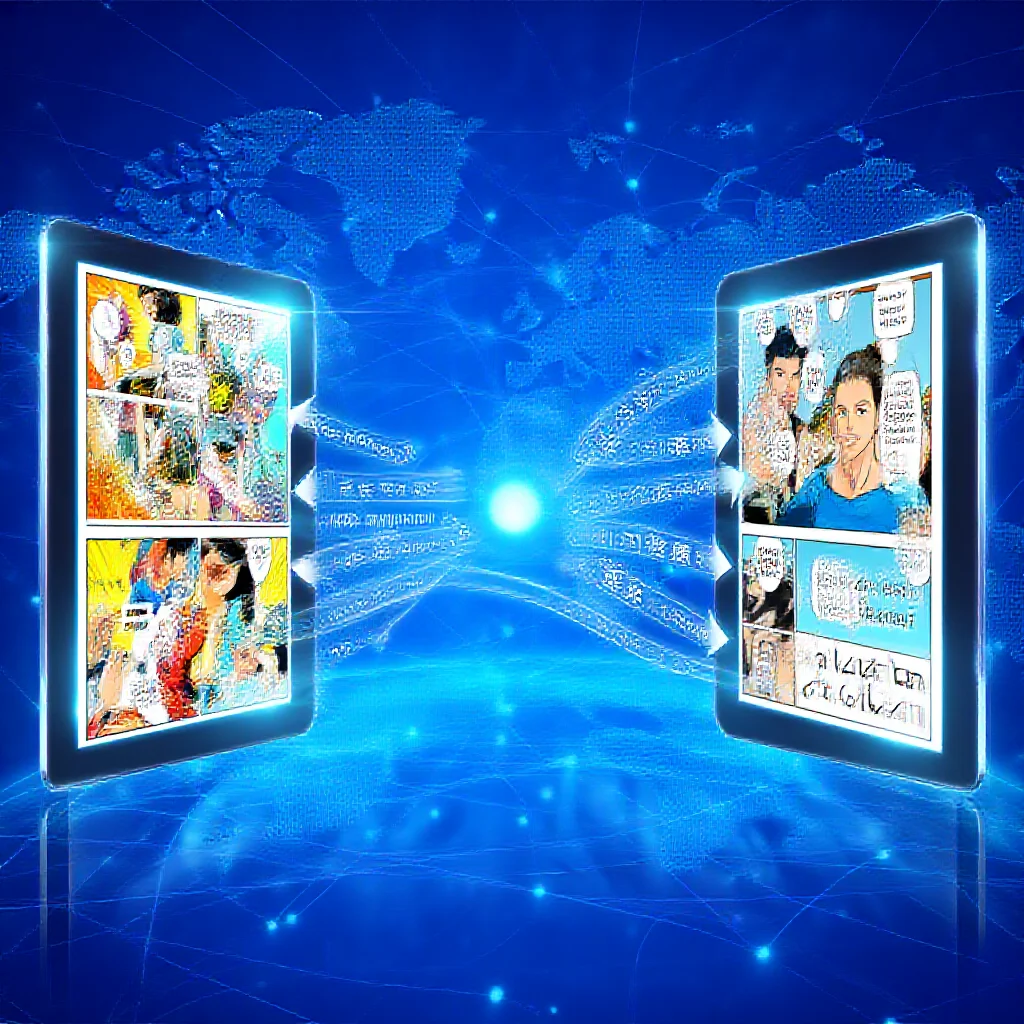
On March 26, 2026, Webtoon reconfigured the fundamental workflow for digital comic creation. The platform’s AI-powered “Creator Localization” tool transitioned from an optional beta feature to the default setting for all creators (Source 1: [Timeline Data]). This technical adjustment mandates an automated process where newly uploaded comics are instantly translated into English, Spanish, French, German, Japanese, and Chinese (Source 2: [Facts Data]). The operational change is minimal—a single toggle in the backend—but its strategic implications are profound. This move represents a calculated shift from a platform-managed, top-down localization model to a creator-driven, bottom-up globalization engine. The analysis that follows examines the economic logic, strategic advantages, and inherent cultural risks embedded in this default setting.
The Default Toggle: A Silent Revolution in Creator Workflow
The strategic significance lies not in the tool’s existence, but in its activation state. Shifting from an “opt-in” beta to a universal “default-on” setting is a masterclass in frictionless adoption. It removes decision fatigue, technical hesitation, and procedural delay for the creator. The comparative model is stark: traditional comic localization involves agenting, licensing, professional translation, and regional publishing, a cycle spanning months or years. Webtoon’s system compresses this to near-instantaneous global publication.
This default integration fundamentally alters the creator’s role. Publication is now intrinsically multi-lingual. The time-to-global-market, a critical competitive metric, approaches zero. The March 26, 2026, implementation date marks the inception of an operational paradigm where a creator in Seoul or São Paulo can, with a single upload, theoretically address audiences across six major linguistic markets simultaneously. The barrier to global distribution has been computationally dismantled.
The Hidden Economic Engine: Data Acquisition and Market Preemption
Beneath the facade of creator empowerment operates a sophisticated dual-purpose engine. The primary axis is not cost-saving for individual creators, but large-scale data acquisition and market preemption for Webtoon.
First, every comic panel processed by “Creator Localization” serves as training data. Millions of creator-translated panels, alongside their source material, refine the platform’s proprietary AI models. This creates a self-improving moat: more usage yields better translations, which drives further adoption, generating even more training data. Competitors lacking this scale of continuous, domain-specific input cannot replicate the model’s efficacy.
Second, the strategy enforces a “platform-as-a-pipeline” doctrine. By making globalization the default, Webtoon guarantees a constant, massive flow of new content into all key international markets. This flood saturates audience attention and starves nascent local competitors of oxygen. The platform’s value proposition shifts from hosting content to controlling the entire global comics supply chain. Each creator becomes an unwitting contributor to this system, providing both content and the data required to optimize its worldwide dissemination.
The Double-Edged Sword: Empowerment vs. Cultural Homogenization
The economic and strategic benefits are counterbalanced by significant cultural and creative risks. The long-term implication of AI-default translation is the potential homogenization of narrative voice. Machine translation algorithms optimize for clarity, speed, and grammatical conformity, often at the expense of cultural nuance, idiomatic humor, and stylistic peculiarity. There is a measurable risk that diverse global narratives will be flattened into a standardized “platform dialect” that privileges certain linguistic structures.
This introduces an ethical and creative tension. While access is democratized, the underlying AI may inadvertently shape global comic aesthetics by how it interprets and reconstructs dialogue, puns, or cultural references. Furthermore, an accountability gap emerges. When translation errors or cultural insensitivities occur at scale due to an automated, default tool, liability is ambiguous. The platform provides the tool as a baseline service, while the creator, who may lack proficiency in the target languages, bears the public-facing responsibility for the published work. This decoupling of creation from localized expression is a novel challenge in digital content ecosystems.
Conclusion: Neutral Market and Industry Predictions
The default activation of “Creator Localization” will accelerate Webtoon’s volume-based dominance in key markets. Competitors will be forced to respond with similar AI-integrated tools or differentiate by emphasizing high-touch, curator-led localization for premium content. The market will likely bifurcate: a high-volume tier dominated by AI-enabled, rapid-fire content distribution, and a niche tier focusing on culturally-specific, manually-translated works.
The quality of AI translations will improve asymptotically, but will plateau at a level sufficient for mass-market consumption, not literary nuance. Regulatory scrutiny may eventually focus on transparency, requiring platforms to disclose the use of AI translation to readers. The most significant prediction is structural: Webtoon’s move formalizes the creator not just as an artist, but as a primary node in a global data network, where each upload fuels both immediate content libraries and long-term algorithmic advantage. The economics of webcomics have been permanently recalibrated around the default setting.
Keywords

Layla Ibrahim
Technology Reporter covering fintech, AI, and startup ecosystems in the Gulf.