DMCC’s New Acceleration Initiative: How Dubai’s Free Zone Is Redefining SME Support in the Gulf
DMCC has launched a targeted acceleration initiative designed to help its ecosystem of over 26,000 member businesses reduce operating costs, improve cash flow, and strengthen growth prospects. This article unpacks the economic logic behind the move, explores its implications for Dubai’s competitiveness as a global trade hub, and examines how the initiative may reshape SME support models across Gulf free zones. Drawing on insights from a Gulf Business report, we provide both a fast analysis of the immediate impact and a deeper audit of the long-term market patterns.
Sarah Al-Qasimi
Editorial Analyst
DMCC’s New Acceleration Initiative: How Dubai’s Free Zone Is Redefining SME Support in the Gulf
The Dubai Multi Commodities Centre (DMCC) has unveiled a targeted acceleration initiative designed to provide direct operational and financial relief to its ecosystem of more than 26,000 member companies. The move, reported by Gulf Business just hours ago, comes at a moment when small and medium-sized enterprises across the Gulf face mounting pressure from global inflation, tightening liquidity, and post-pandemic adjustment. The initiative focuses on three core pillars: reducing operating costs, improving cash flow, and strengthening growth prospects. By bundling these services into a single membership package, DMCC is signaling a strategic shift in how free zones compete — not merely on tax holidays or real estate, but on dynamic, life-cycle support for the businesses they host.
[IMAGE: DMCC headquarters in Dubai with a busy trading floor atmosphere, showing traders and professionals working at desks with digital screens displaying commodity prices.]
The Core Axis: Why DMCC Is Investing in Business Acceleration
At first glance, the initiative looks like a standard corporate retention program. But the hidden economic logic runs deeper. For years, free zones in the Gulf have competed primarily on headline incentives — zero corporate tax, 100% foreign ownership, simplified visa processes. As these benefits become table stakes across the region, differentiation has narrowed. DMCC’s pivot to service-based differentiation marks a recognition that the next competitive frontier lies in operational enablement, not just regulatory convenience.
By bundling financial, logistical, and advisory support, DMCC aims to create a sticky ecosystem where member companies are less likely to relocate to a competing free zone. The acceleration initiative likely leverages digital platforms for cash-flow management — such as faster invoicing cycles, supply chain financing, and automated compliance tools — to reduce administrative burdens that disproportionately affect SMEs. For example, a small trading firm that previously spent days reconciling payments and meeting documentation requirements may now access streamlined digital workflows that cut those costs by 20–30%.
Technology trends underpin this strategy. The rise of embedded finance, artificial intelligence for document processing, and blockchain-based trade finance has made it feasible for free zones to offer these services at scale. DMCC’s move is therefore not just a tactical response to economic headwinds; it is a structural adaptation to a digital-first business environment. Other Gulf free zones — from Abu Dhabi’s ADGM to Doha’s QFC — will be watching closely. If this initiative succeeds, it could become a blueprint for a new generation of free zone value propositions that move beyond static real estate offerings toward dynamic, life-cycle support models.
[IMAGE: Infographic comparing traditional free zone benefits (tax exemption, 100% ownership, visa support) vs. DMCC’s new bundled acceleration services (cost reduction tools, cash flow management, advisory, digital compliance).]
Deep Entry Point: How This Initiative Strengthens Dubai’s Trade Supply Chains
DMCC is not just any free zone. It is a critical node in global commodity supply chains, particularly in gold, diamonds, tea, and other high-value goods. Over 26,000 member companies operate within its ecosystem, forming a tightly interlinked network of traders, logistics providers, financiers, and service firms. The acceleration initiative’s focus on improving cash flow and reducing operating costs has direct implications for the resilience and velocity of these supply chains.
When member companies experience better cash flow — through faster payment cycles, access to working capital, or lower overhead — the entire network benefits. Settlement cycles shorten, reducing counterparty risk across the chain. A gold refiner that pays its suppliers more quickly can negotiate better terms, while a logistics firm with lower compliance costs can pass on savings to its trading partners. This creates a compounding effect: improved liquidity at the micro level translates into higher trade volumes and lower transaction friction at the macro level.
Moreover, by lowering the barrier to entry for small traders and logistics providers, DMCC is effectively increasing the depth and diversity of its trading ecosystem. Smaller players that previously struggled with the upfront costs of compliance, documentation, and working capital can now participate more actively. Over time, this could boost the overall liquidity flowing through Dubai’s commodity corridors, reinforcing the emirate’s position as a resilient trade hub even amid regional volatility or global supply chain disruptions.
The long-term impact extends beyond individual company balance sheets. A healthier, more efficient member base makes the entire DMCC ecosystem more attractive to global investors and multinational buyers. This virtuous cycle — more efficient members attract more business, which in turn attracts more members — is precisely the kind of network effect that free zones strive to cultivate. The acceleration initiative is thus a strategic investment in the supply chain infrastructure of Dubai itself.
[IMAGE: A flow diagram showing DMCC member companies interconnected in a supply chain, with arrows indicating improved cash flow and reduced costs moving from a central DMCC hub to nodes representing traders, logistics firms, and financiers.]
Dual-Track Analysis: Fast Reaction vs. Industry Deep Audit
A full understanding of this initiative requires looking at both its immediate tactical impact and its longer-term strategic implications.
Fast analysis: The immediate lifeline
For member businesses operating in today’s high-cost, low-liquidity environment, the acceleration initiative offers tangible near-term relief. Companies struggling with inflation-driven input costs or post-pandemic cash crunches gain immediate access to cost-cutting tools — whether through reduced administrative fees, automated compliance workflows, or preferential rates on trade finance. The cash flow improvement component is particularly relevant for SMEs that often face delayed payments from larger buyers or erratic revenue cycles. By providing faster invoicing, supply chain financing, and perhaps even direct working capital advances, DMCC addresses the single biggest pain point for small traders: running out of cash before the next sale.
This fast-track response also sends a strong signal to the broader Gulf business ecosystem. DMCC is telling current and prospective members that it understands their operational realities and is willing to invest in their survival and growth. In a competitive landscape where free zones often appear as passive landlords, this active, service-oriented stance differentiates DMCC in a meaningful way.
Slow analysis: Reshaping the competitive landscape
Looking ahead two to three years, the initiative could fundamentally alter competitive dynamics among Gulf free zones. As DMCC sets a new baseline for what members can expect from their host zone, others will be forced to respond. Free zones that continue to offer only real estate and basic regulatory services may find themselves losing high-value tenants to DMCC or similar models that emerge in response.
Furthermore, the data generated by these digital acceleration services could become an asset in itself. By tracking member companies’ cash flow patterns, trade volumes, and operational bottlenecks, DMCC could offer increasingly personalized advisory services, identify emerging market opportunities, and even predict which members are at risk of financial distress. This data-driven approach to SME support is still rare in the Gulf, but it aligns with global trends in ecosystem management.
However, challenges remain. The success of the initiative will depend on execution — whether DMCC can deliver seamless digital tools, whether the cost reductions are deep enough to materially change member economics, and whether the advisory support is genuinely useful rather than generic. If execution falls short, the initiative could be dismissed as a marketing exercise rather than a genuine operational upgrade.
On a broader scale, the initiative may influence how policymakers across the Gulf think about free zone regulation. Traditional free zone models have been criticized for encouraging low-value, transshipment-heavy trade rather than deep local value creation. By focusing on cash flow and cost reduction for real operating businesses, DMCC is subtly steering its ecosystem toward more substantive economic activity — one that generates jobs, builds supply chain resilience, and fosters long-term local investment.
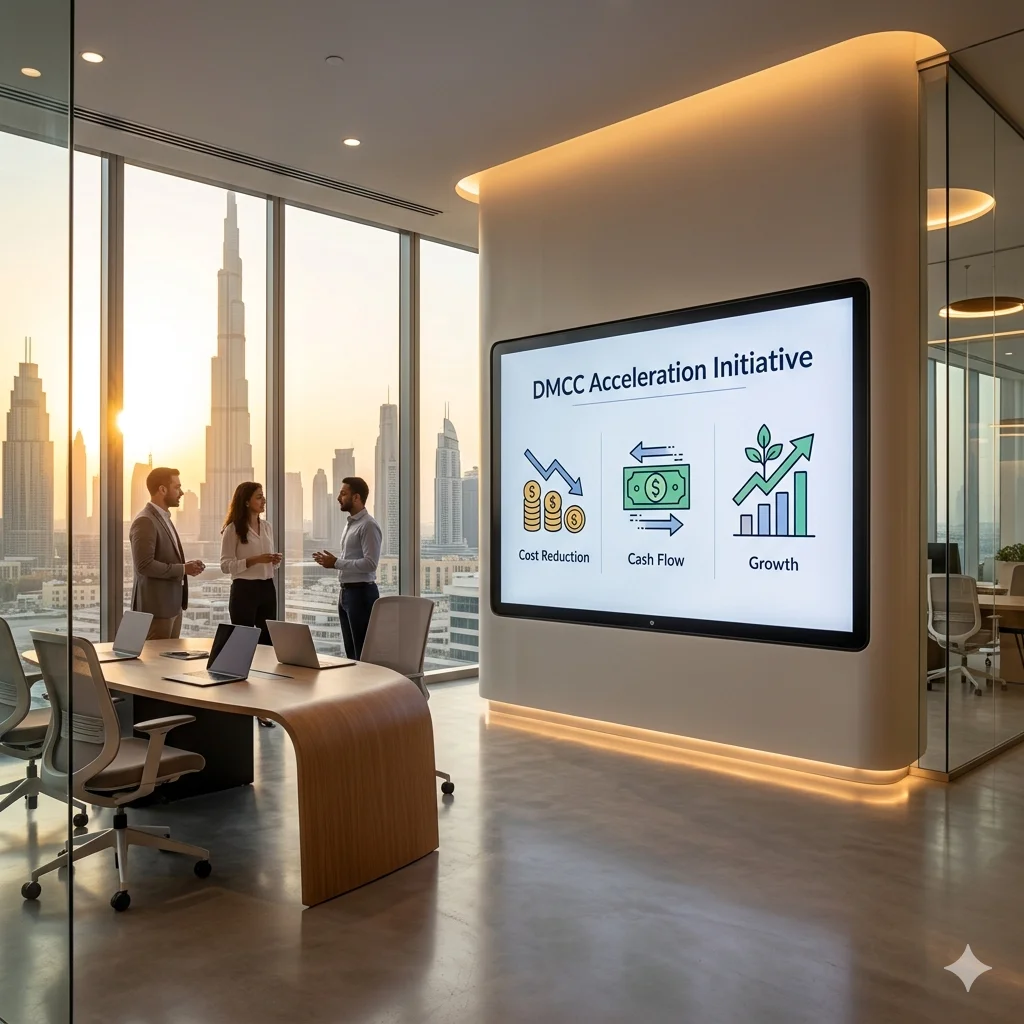
[IMAGE: A futuristic, clean office environment in Dubai's business district with a large digital screen displaying 'DMCC Acceleration Initiative' and icons representing cost reduction, cash flow, and growth. In the background, the Dubai skyline with the Burj Khalifa. No text other than the title on the screen, no watermarks. Style: professional, modern, high-tech, with warm golden light.]
Conclusion: A New Benchmark for Free Zone Competitiveness
DMCC’s acceleration initiative represents more than a temporary cost relief package. It is a strategic bet that the future of free zone competition lies in service bundling, digital enablement, and life-cycle business support — not just tax incentives and square footage. For SME members, the immediate benefits of reduced operating costs and improved cash flow are welcome in a time of economic strain. For the broader Gulf business ecosystem, the initiative sets a precedent that could reshape how free zones define their value proposition.
As the initiative rolls out in the coming months, the key metrics to watch will be member retention rates, the speed of adoption of digital tools, and the volume of trade flowing through DMCC’s ecosystem. If the numbers show measurable improvements in cost efficiency and cash conversion cycles — as reported in the Gulf Business story — other free zones will have little choice but to follow suit. For Dubai, this move reinforces its status as a commercial hub that adapts proactively to global economic shifts. For SMEs across the Gulf, it offers a hopeful sign that the institutions meant to support them are finally beginning to think beyond rent and licenses, and toward genuine operational partnership.
[IMAGE: A row of small company office doors inside a DMCC co-working space, with each door featuring a different company logo, suggesting a diverse and active SME community.]
Keywords

Sarah Al-Qasimi
Chief Editor leading investigative reports on Gulf business and policy.