The Four Innovation Platforms Reshaping Gulf Economies: From Fintech to Last-Mile Delivery
The Gulf Cooperation Council (GCC) is undergoing a strategic pivot from oil dependency to a knowledge-based economy, driven by four distinct innovation platforms: adapters, in-house incubators, trend hunters, and technology leaders. This article explores how companies like Tabby, Majid Al Futtaim, Chalhoub Group, Noon, and Sun and Sand Sports exemplify these models, leveraging regional R&D investments (UAE 1.2% GDP, Saudi USD 4.2 billion in telecom) to create a multi-speed innovation ecosystem. From Shariah-compliant fintech to AI-powered last-mile logistics, these platforms are reshaping retail, finance, and supply chains, positioning the GCC as a global testbed for emerging technologies. The report offers deep insights into market dynamics, policy impact, and the underlying economic logic of diversification.
Sarah Al-Qasimi
Editorial Analyst
The Four Innovation Platforms Reshaping Gulf Economies: From Fintech to Last-Mile Delivery
Introduction: From Oil Rents to Innovation Dividends
For decades, the Gulf Cooperation Council (GCC) economies—Saudi Arabia, the UAE, Qatar, Kuwait, Oman, and Bahrain—relied on hydrocarbon exports as their primary economic engine. That era is giving way to a strategic pivot toward knowledge-based growth, driven by deliberate policy shifts and private-sector experimentation. In 2021, the UAE allocated 1.2% of its GDP to research and development, while Saudi Arabia injected USD 4.2 billion into telecommunications infrastructure—figures that reflect a government-level commitment to building a multi-speed innovation ecosystem.
At the heart of this transformation lie four distinct innovation platforms: adapters, in-house incubators, trend hunters, and technology leaders. These models are not mutually exclusive; rather, they operate in parallel, each addressing different market realities and risk appetites. From Shariah-compliant fintech to AI-powered last-mile logistics, the GCC is emerging as a global testbed for emerging technologies, where local adaptation meets global ambition. This article examines how these platforms interact with government investment, consumer trends, and infrastructure development to create a resilient, diversified economic model.
[IMAGE: A map of the GCC with glowing nodes representing major cities and innovation hubs, connected by data streams.]
The Four Innovation Platforms: A Strategic Taxonomy
Innovation Adapters: Localizing Global Models
The adapter model takes proven global business concepts and tailors them to regional regulatory, cultural, and infrastructural realities. A prime example is Tabby, the Dubai-based "Buy Now, Pay Later" (BNPL) platform. While BNPL services originated in markets like Australia and the United States, Tabby adapted its offering for the Gulf by ensuring Shariah compliance—interest-free installment plans that align with Islamic finance principles. It also integrated deeply with local e-commerce ecosystems, including Shopify and the Saudi platform Salla, making it a default payment option for millions of consumers.
Adaptation extends beyond compliance. Tabby’s success stems from understanding Gulf consumer behavior: high smartphone penetration, a preference for deferred payments, and trust in established retail partners. By localizing a global fintech innovation, the company captured a market that traditional credit cards had only partially served. This platform demonstrates that innovation need not be invented locally to create value—it just needs to be re-engineered for local context.
In-House Incubators: Fostering Intrapreneurship and External Partnerships
The in-house incubator model sees established conglomerates building structured vehicles to identify, invest in, or acquire startups that complement their core businesses. Majid Al Futtaim, the Dubai-based retail and real estate giant, exemplifies this approach. Through its corporate venture arm, the company actively scouts for startups in areas such as smart retail, sustainable construction, and digital payments. Rather than developing all technology internally, Majid Al Futtaim partners with young companies, providing them with capital, access to physical assets, and distribution networks.
This model reduces the risk of disruptive competition: instead of being displaced by a nimble fintech or logistics startup, the conglomerate brings that startup into its orbit. For the GCC, where family-owned holding companies dominate retail, real estate, and hospitality, the in-house incubator offers a path to innovation without sacrificing control. It also aligns with national diversification goals—startups backed by such incubators often receive follow-on funding from government sovereign wealth funds.
[IMAGE: Four icon graphics representing each platform: puzzle piece (adapter), lightbulb inside a gear (incubator), magnifying glass (trend hunter), and rocket (tech leader).]
Trend Hunters: Capturing Emerging Consumer Behaviors
Trend hunters operate at the frontier of consumer shifts, using data analytics, cultural observation, and accelerator programs to identify nascent opportunities before they become mainstream. Chalhoub Group, the luxury retail powerhouse across the Middle East, established The Greenhouse, a tech-accelerator program that invests in early-stage beauty, fashion, and tech-driven startups. The program does not just write checks—it provides mentorship, retail floor access, and insights into Gulf consumer preferences honed over six decades.
Through The Greenhouse, Chalhoub has backed companies specializing in augmented reality try-ons, sustainable packaging, and direct-to-consumer beauty brands. This platform allows a legacy retailer to stay ahead of trends like conscious consumerism and Gen Z’s digital-first shopping habits without disrupting its core luxury operations. For the wider GCC innovation ecosystem, trend hunters like Chalhoub serve as early-warning systems, identifying which global consumer movements will gain traction in the region.
Technology Leaders: Building Proprietary Solutions
The most capital-intensive innovation platform is the technology leader, where companies develop proprietary solutions using artificial intelligence, the Internet of Things (IoT), and automation. Noon, the Saudi-backed e-commerce giant, and Sun and Sand Sports, a leading sports retailer, both illustrate this model. Noon has invested in warehouse robotics, AI-driven demand forecasting, and autonomous delivery vehicles to compete with global players like Amazon. Similarly, Sun and Sand Sports deploys drones for inventory management, self-driving rovers for last-mile parcel delivery, and electric fleets to meet sustainability targets.
These investments are costly and require long time horizons, but they build moats that are difficult for competitors to replicate. Technology leaders also benefit from government infrastructure programs—Saudi Arabia’s USD 4.2 billion telecom investment, for example, enables the low-latency connectivity required for autonomous vehicles and real-time IoT sensors. In a region where logistics costs earlier eroded margins, proprietary technology is now a competitive advantage rather than an expense.
Government Catalysis: R&D Spending and Digital Infrastructure
While private-sector innovation platforms drive execution, government policy sets the enabling conditions. The UAE’s 1.2% R&D-to-GDP ratio, though modest compared to South Korea or Israel, represents a strategic reallocation of oil revenues into fintech, smart cities, healthcare, and agritech. The country’s AED 10 billion (USD 2.7 billion) "Advanced Technology Research Council" and the Dubai Future Foundation’s accelerators create direct funding channels for startups aligned with these platforms.
Saudi Arabia’s telecom investment of USD 4.2 billion is equally critical. The Kingdom’s Vision 2030 explicitly targets digital infrastructure as a foundation for economic diversification. High-speed 5G networks, fiber-optic backbone expansion, and data center development enable the IoT and cloud-based business models that underpin technology leaders like Noon. Moreover, the Public Investment Fund (PIF) acts as a mega-investor, backing everything from electric vehicle manufacturing (Lucid) to logistics (Maersk’s regional hub).
Expo 2020 Dubai, held from October 2021 to March 2022, served as a launchpad for demonstrating these innovation platforms to a global audience. The event featured dedicated pavilions for fintech, mobility, and sustainability, where companies like Tabby and Noon showcased their latest tech. The legacy infrastructure—District 2020, a smart city development—continues to host startups and R&D labs, ensuring the innovation momentum persists.
[IMAGE: A photo of the Expo 2020 Dubai site with futuristic pavilions and digital displays, surrounded by green spaces.]
Retail and E-commerce Transformation
The four innovation platforms converge most visibly in retail and e-commerce, where the GCC market is undergoing a structural shift. According to Euromonitor International, the region’s e-commerce penetration doubled between 2019 and 2023, driven by pandemic-era adoption and sustained investment in logistics. Fintech adaptation—led by Tabby and competitors like Tamara and Spotii—removed the friction of upfront payments, converting hesitant offline shoppers into online regulars.
In-house incubators like Majid Al Futtaim’s venture arm invested in omnichannel retail technologies: heat-mapping sensors in Carrefour stores, AI-powered inventory management, and virtual storefronts for the metaverse. These technologies blur the line between physical and digital retail, allowing conglomerates to maintain their dominant market share while embracing digital transformation.
Meanwhile, trend hunters like Chalhoub’s The Greenhouse identified that Gulf consumers, particularly in the 18-35 age bracket, increasingly favor direct-to-consumer brands with strong social media identities. The accelerator invested in startups like "Siiuu," a sneaker resale platform, and "Dana," a clean beauty brand, scaling them across GCC markets. This platform ensures that even traditional luxury retail remains relevant in an era of brand disintermediation.
The Last-Mile Innovation Race
Perhaps no area better illustrates the region’s multi-speed innovation ecosystem than last-mile delivery. The GCC’s urban density, high car ownership, and extreme summer heat create unique challenges—and opportunities—for logistics. Technology leaders are pushing the envelope with autonomous solutions. Noon’s "Noon Express" now delivers parcels via self-driving rovers in select Dubai communities, while Sun and Sand Sports has tested drones for delivering sports equipment to customers in gated compounds.
These deployments rely on the regulatory sandboxes created by governments. Dubai’s Roads and Transport Authority (RTA) launched a dedicated framework for drone delivery, while Saudi Arabia’s Communications and Information Technology Commission (CITC) authorized trial flights for autonomous aerial vehicles. The UAE’s 1.2% R&D spend funded a robotics lab at Khalifa University that prototypes last-mile robots tailored to the Gulf environment—heat-resistant batteries, sand-proof sensors, and algorithms optimized for the region’s road networks.
But technology leaders are not the only players in last-mile innovation. Adapters like Tabby enable delivery by allowing customers to split payments across installments, reducing abandoned carts at checkout. Trend hunters identified that consumers demand same-day delivery even for non-essential items, prompting retailers to invest in micro-fulfillment centers located in residential neighborhoods. The result is a layered last-mile ecosystem where each innovation platform addresses a different constraint—cost, speed, convenience, or sustainability.
[IMAGE: A drone carrying a small package flying over a residential villa in Dubai, with palm trees and modern architecture in the background.]
Challenges and Future Outlook
Despite the progress, several challenges could slow the diversification trajectory. First, R&D spending in the GCC remains low by global benchmarks—South Korea spends 4.6% of GDP on R&D, the US 3.5%. While 1.2% (UAE) and 0.6% (Saudi Arabia) represent significant increases from a decade ago, sustaining this trend through oil price volatility is uncertain. Second, the region still relies heavily on expatriate talent for high-skill tech roles; developing local STEM graduates through education reform will take years.
Third, regulatory fragmentation across the six GCC states can impede scaling. A fintech company approved in the UAE must undergo separate licensing in Saudi Arabia, even though the two markets share economic ties. The Gulf Cooperation Council’s efforts to harmonize digital regulations have progressed slowly, though the recent launch of the GCC Digital Economy Framework signals renewed political will.
Nevertheless, the outlook remains positive. The four innovation platforms are self-reinforcing: adapters create market-ready solutions, incubators nurture future leaders, trend hunters identify new opportunities, and technology leaders push the frontier. Government investment in infrastructure and regulation provides the foundation. According to Euromonitor International’s report on "GCC Innovation Hubs and Economic Diversification," the region’s digital economy could contribute USD 500 billion to GDP by 2030, up from approximately USD 180 billion in 2023.
Conclusion
The Gulf Cooperation Council is no longer just an oil-exporting region; it is a laboratory for innovation platforms that balance global best practices with local adaptation. From Tabby’s Shariah-compliant BNPL to Chalhoub’s trend-hunting accelerator, from Majid Al Futtaim’s corporate incubator to Noon’s autonomous delivery fleets, these platforms demonstrate that diversification is not a single strategy but a portfolio of approaches operating at different speeds. The UAE’s R&D spending and Saudi Arabia’s telecom investment provide the policy backbone, while private-sector experimentation fills in the details.
As the GCC continues to invest in knowledge-based industries, the rest of the world will watch closely—not just for oil prices, but for the fintech, logistics, and retail innovations that emerge from this unique multi-speed ecosystem. The transition from oil rents to innovation dividends is underway, and the four platforms are its engines.
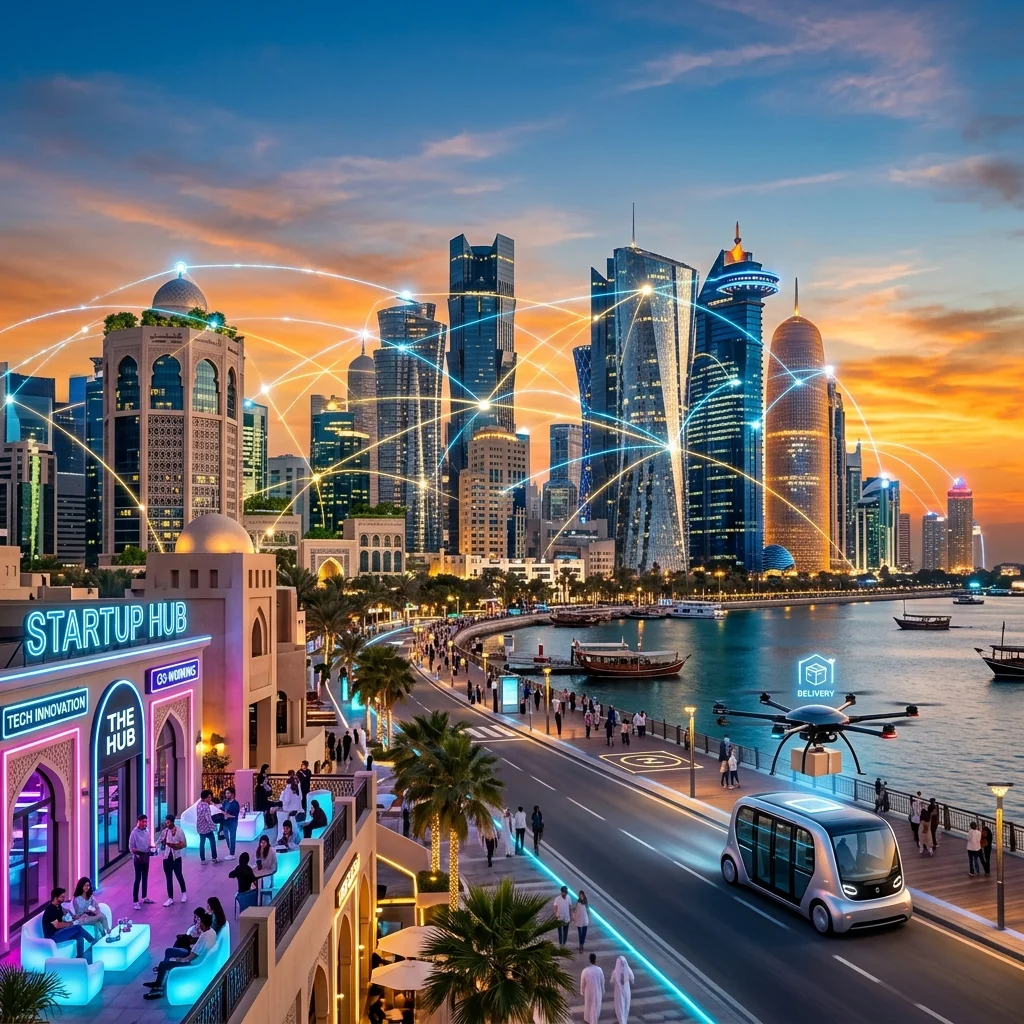
[IMAGE: A futuristic city skyline at sunset with glowing digital network nodes connecting buildings, drones, autonomous vehicles, and green rooftops—a photorealistic blend of tradition and technology.]
Keywords

Sarah Al-Qasimi
Chief Editor leading investigative reports on Gulf business and policy.