Gulf Business Report: How a Niche Media Powerhouse Shapes GCC Decision-Makers
This article unpacks the strategic positioning of Gulf Business magazine and Gulfbusiness.com, a hybrid print-digital media outlet targeting the GCC’s elite decision-makers. With a print circulation of 28,000 and 250,000 monthly unique online visitors, the publication bridges traditional authority and digital reach. Published by Saudi Arabia’s Motivate Media Group, it aligns with Vision 2030’s need for informed policymaking and corporate leadership. We explore the hidden economic logic behind its dual-track model, the evolving supply chain of business intelligence in the region, and why this media property remains a vital channel for influence in the Gulf’s fast-transforming economy.
Sarah Al-Qasimi
Editorial Analyst
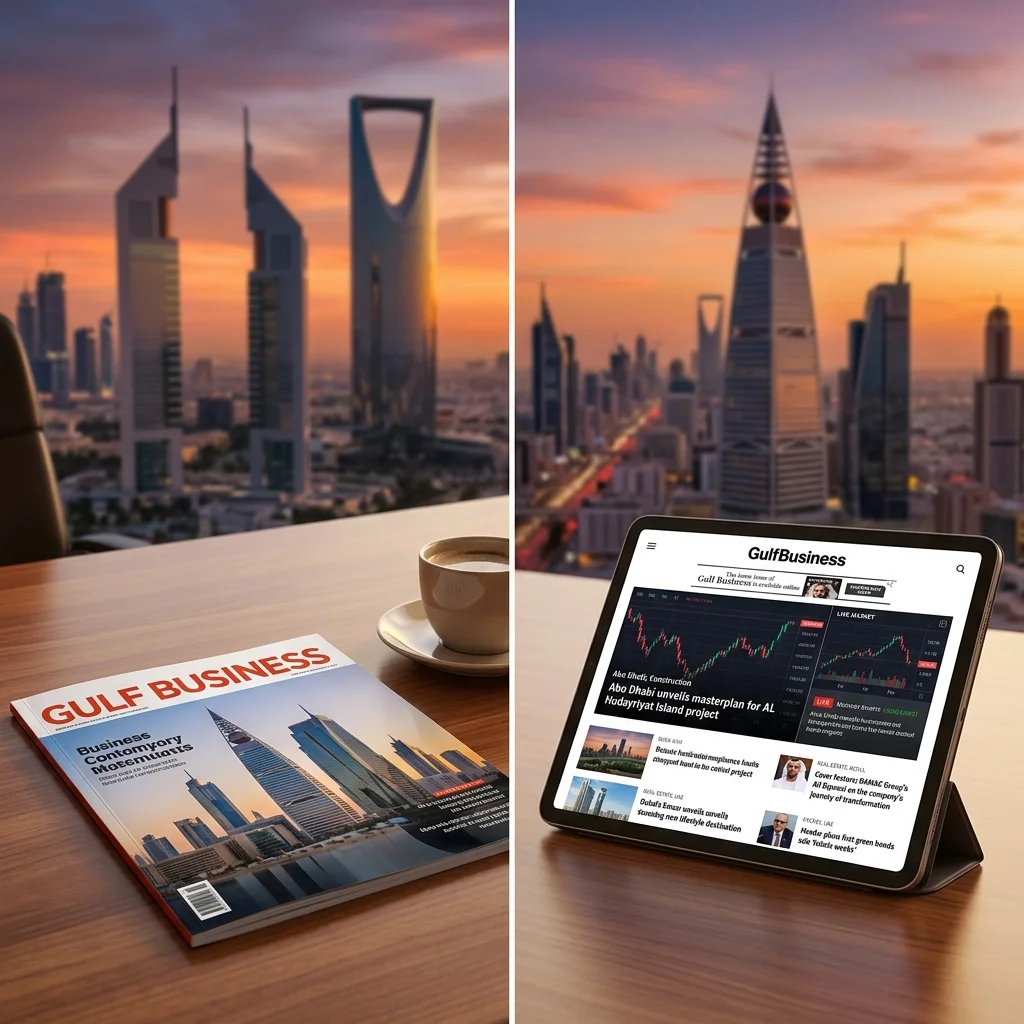
Gulf Business Report: How a Niche Media Powerhouse Shapes GCC Decision-Makers
Introduction: The Quiet Authority in GCC Business News
The Gulf Cooperation Council (GCC) is in the midst of its most profound economic transformation in decades. From Saudi Arabia’s Vision 2030 to the UAE’s “We the UAE 2031” and Qatar’s National Vision 2030, every member state is racing to diversify away from hydrocarbons, attract foreign direct investment, and build knowledge-based economies. In this environment, decision-makers—government ministers, sovereign wealth fund executives, corporate board members—require more than breaking news. They need curated analysis that contextualises policy shifts, market trends, and geopolitical risks.
Enter Gulf Business, a monthly magazine and its digital counterpart Gulfbusiness.com. With a print circulation of 28,000 and 250,000 monthly unique online visitors, the publication occupies a curious space. It is not a mass-market daily newspaper; nor is it a wire service. Instead, it positions itself as a trusted intermediary between the region’s elite and the intelligence they use to make capital allocation and policy decisions. The question worth unpacking is: how does a relatively modest print run translate into outsized influence over a digital audience that is ten times larger? And why does this hybrid model matter for anyone trying to understand or reach the GCC’s decision-making class?
[IMAGE: A montage of GCC city skylines (Dubai, Riyadh, Doha) overlaid with Gulf Business covers.]
The Hybrid Model: Print Prestige Meets Digital Scale
At first glance, 28,000 print copies might seem unremarkable for a regional business magazine. But circulation numbers alone miss the point. Gulf Business is distributed to C-suites, government ministries, diplomatic missions, five-star hotel executive lounges, and private aviation terminals across the GCC. Each copy is likely read by multiple people, and its physical presence in corridors of power confers a sense of permanence and authority that digital scrolling cannot replicate.
Meanwhile, the online platform draws 250,000 unique monthly visitors—a figure that has grown steadily as the publication invested in SEO, a clean mobile interface, and daily updates. The digital audience is broader, includes younger professionals and expatriate executives, and extends beyond the GCC into global financial hubs such as London, New York, and Singapore. Yet the content strategy remains consistent: analysis over newsflashes, long-form features over clickbait.
The dual-track model mirrors the GCC’s own duality. The region respects printed tradition as a marker of legitimacy and trust, but it also demands the speed and accessibility of digital media. Gulf Business manages both by treating print as the prestige anchor—the quarterly cover story that lands on a minister’s desk—and digital as the amplification engine that drives daily conversation. This is not an either/or strategy; it is a two-layer funnel. Print builds credibility; digital extends reach.
[IMAGE: Infographic comparing print circulation (28,000) vs online unique visitors (250,000) with icons representing C-suite, government officials, and global professionals.]
Targeting the Decision-Making Class: Why Narrow Reach Equals High Impact
The key to understanding Gulf Business’s influence lies in the composition of its readership. The magazine explicitly targets corporate leaders, senior government officials, and high-net-worth individuals who influence or execute multi-million-dollar decisions. This is a niche audience by volume, but an extremely valuable one for advertisers, policymakers, and partners.
Content is deliberately calibrated for this group. Instead of covering every merger or quarterly earnings release, Gulf Business focuses on strategic analysis: sector deep-dives (e.g., Saudi giga-projects, UAE fintech regulation, Qatari LNG expansion), leadership interviews with CEOs and ministers, and geopolitical assessments that affect business conditions. A typical issue might feature a cover story on the future of Saudi tourism followed by a column on sovereign wealth fund allocation patterns.
The economic logic is straightforward: advertising and partnership value in business media is a function of readership quality, not quantity. A single decision-maker who controls a $10 billion portfolio is worth more than 10,000 casual browsers. Gulf Business understands this, and its rate card reflects the premium placed on access to that audience. Local banks, international consultancies, luxury brands, and government investment promotion agencies all use the platform to reach the people who sign off on contracts and policies.
There is anecdotal evidence that Gulf Business articles have been cited in ministerial briefing documents and boardroom strategy presentations. While hard to quantify, the publication’s longevity—decades of continuous operation under Motivate Media Group—suggests sustained trust among its readers.
[IMAGE: A boardroom meeting with a Gulf Business magazine on the polished table and a laptop displaying Gulfbusiness.com open to a market analysis article.]
Publisher Power: Motivate Media Group and the Saudi Advantage
Gulf Business is published by Motivate Media Group, a Dubai-based but Saudi-rooted media company with deep ties to the kingdom’s economic agenda. That geographic and strategic alignment is not incidental. As Saudi Arabia accelerates Vision 2030, demand for credible, regionally focused business intelligence has surged. Government entities, state-owned enterprises, and private companies all need a platform to communicate their narratives, showcase reforms, and attract partners.
Motivate Media Group has leveraged its position to position Gulf Business as a channel for thought leadership from Saudi and regional leaders. The magazine regularly features op-eds by ministers, central bank governors, and heads of major corporations. This access is a function of trust built over years, but it also creates a virtuous cycle: the more influential leaders contribute, the more the publication becomes a must-read for other decision-makers.
Compared to other regional business titles—such as Arabian Business, Zawya, or MEED—Gulf Business differentiates itself through its focus on the GCC as an integrated economic bloc rather than a collection of separate markets. It also benefits from Motivate’s broader portfolio, which includes lifestyle, luxury, and aviation magazines, allowing cross-promotion and bundled advertising deals. The publisher’s Saudi connection gives the title an insider perspective on the kingdom’s regulatory shifts, giga-project timelines, and sovereign fund strategies—topics of intense interest to investors globally.
[IMAGE: Photo of Motivate Media Group headquarters or a screenshot showing Gulf Business’s editorial team in a newsroom setting with Saudi flag and Vision 2030 branding in background.]
The Supply Chain of Business Intelligence: From News to Strategic Insight
Behind every issue of Gulf Business lies a carefully constructed supply chain of business intelligence. The process begins with a network of correspondents across the GCC, supplemented by data feeds from stock exchanges, central banks, and international organisations. Editorial teams then filter, cross-reference, and contextualise raw data into narratives that answer the question: “What does this mean for my business or policy decision?”
This value chain is evolving. Digital analytics now inform which topics resonate with the online audience, allowing editors to double down on high-interest subjects such as Saudi IPO pipelines or UAE real estate trends. Print stories are repurposed into digital formats, podcasts, and LinkedIn summaries, extending the shelf life of each piece of analysis. The publication also partners with research firms and consultancies to produce special reports on sectors like renewable energy, healthcare, and logistics—reports that often become reference documents for investors conducting due diligence.
Critically, Gulf Business does not simply aggregate news. It adds interpretive layers that mass-media outlets cannot afford to provide. A breaking story about a new Saudi regulatory framework might generate a headline everywhere, but Gulf Business will follow up with an interview with the regulator, a legal analysis, and a comparison with similar frameworks in the UAE or Qatar. That depth is what loyal readers pay for—with their attention and, indirectly, through the premium advertising that funds the operation.
[IMAGE: Flowchart showing the journey from raw data sources (stock exchanges, government releases, wire services) through editorial curation to final print and digital outputs, with icons for analysis, interviews, and special reports.]
The Economic Logic: Why 28,000 Copies Still Matter in a Digital Age
Some observers might argue that print is dying, and that a magazine with 28,000 circulation is a relic. That view misses the economic reality in markets where trust and exclusivity command a premium. For Gulf Business, print is not a mass-distribution channel; it is a signalling device. The act of placing a magazine in a minister’s office or a VIP lounge tells the reader that the publication has been vetted, that it carries institutional weight, and that its content is worth the time investment.
Digital, meanwhile, handles the volume. The 250,000 monthly unique visitors generate data, ad impressions, and subscription leads. The two revenue streams are interdependent: print advertisers often buy digital packages, and digital campaigns run alongside print features to reinforce brand messages. The cost structure also reflects this hybridity. Print production and distribution are expensive per copy, but the high-value audience offsets those costs. Digital distribution is cheap, but it requires constant investment in SEO, content management, and social media.
The hidden flexibility of this model became apparent during the COVID-19 pandemic, when physical distribution stalled but digital readership surged. Gulf Business was able to pivot quickly, producing daily newsletters and virtual roundtables, while keeping the print version alive for when boardrooms reopened. That resilience is attractive to advertisers who seek consistent reach across channels.
[IMAGE: Bar chart showing revenue split between print advertising, digital advertising, events/sponsorships, and subscriptions (hypothetical data), with arrows showing cross-channel bundling.]
How Gulf Business Aligns with Vision 2030’s Information Needs
Saudi Vision 2030 is not just an economic plan; it is a massive information project. The government needs to communicate reforms to domestic and international audiences, build investor confidence, and create a narrative of transformation. Independent yet sympathetic media outlets play a crucial role in that process. Gulf Business has carved a niche by covering Vision 2030’s pillars—tourism, entertainment, technology, manufacturing—with a mix of optimism and critical analysis.
For example, when the Kingdom announced the creation of the Sovereign Fund for Investment (PIF) giga-projects like NEOM and the Red Sea Project, Gulf Business provided detailed breakdowns of timelines, procurement processes, and potential economic spill-overs. These articles served as primers for foreign contractors, consultants, and financiers evaluating entry points. Similarly, when Saudi regulatory reforms were introduced—such as the New Companies Law or the relaxation of foreign ownership rules—the magazine offered legal and business perspectives that helped decision-makers adapt.
This alignment benefits both sides. The Saudi government gains a credible platform to disseminate its message; Gulf Business gains exclusive access and audience engagement. The relationship is not uncritical—the magazine has published pieces questioning the pace of privatisation or the challenges of human capital development—but it operates within a framework of constructive engagement that keeps readers informed without alienating its publisher’s home market.
[IMAGE: Visualisation of Vision 2030 pillars (quality of life, economic diversification, government effectiveness) next to Gulf Business’s recent cover stories on each topic.]
Conclusion: The Enduring Value of Curated Influence
In an era of information overload, the scarcest resource for decision-makers is not data—it is trust. Gulf Business has built a business model that capitalises on that scarcity. By combining a small, high-trust print circulation with a scalable digital presence, the publication delivers what its readers need: analysis that is accurate, context-rich, and relevant to their strategic decisions.
The GCC’s economic transformation is far from over. As new sectors emerge, regulatory landscapes shift, and global capital flows become more competitive, the demand for region-specific business intelligence will only grow. Gulf Business, backed by Motivate Media Group’s regional expertise and Saudi anchoring, is well-positioned to remain a vital channel for influence—not because it reaches the most people, but because it reaches the right people.
For anyone studying the Gulf’s media landscape or trying to engage its decision-makers, the lesson is clear: narrow reach, when targeted with precision and supported by a dual-track model, can produce outsized impact. And in the fast-transforming economy of the GCC, that impact translates directly into the flow of capital, policy, and strategy.
[IMAGE: A final composite image showing a hand holding a printed Gulf Business magazine next to a smartphone with the Gulfbusiness.com homepage, with the Gulf skyline fading into the background at dusk.]
Keywords

Sarah Al-Qasimi
Chief Editor leading investigative reports on Gulf business and policy.