Gulf Business Report: How Sanctions, Energy Shifts, and Capital Flows Are Rewiring Regional Trade
This article plan examines the Gulf’s evolving business landscape through the lens of trade rerouting, energy transition pressures, and capital reallocation. It uses a slow-analysis approach to uncover the deeper economic logic behind market adjustments: how supply chains are being localized, how logistics and financial corridors are adapting, and how policy uncertainty is reshaping investment behavior. The piece will verify claims through primary and secondary sources, then connect them to long-term implications for ports, free zones, banking, and industrial strategy across the Gulf.
Sarah Al-Qasimi
Editorial Analyst
Gulf Business Report: How Sanctions, Energy Shifts, and Capital Flows Are Rewiring Regional Trade
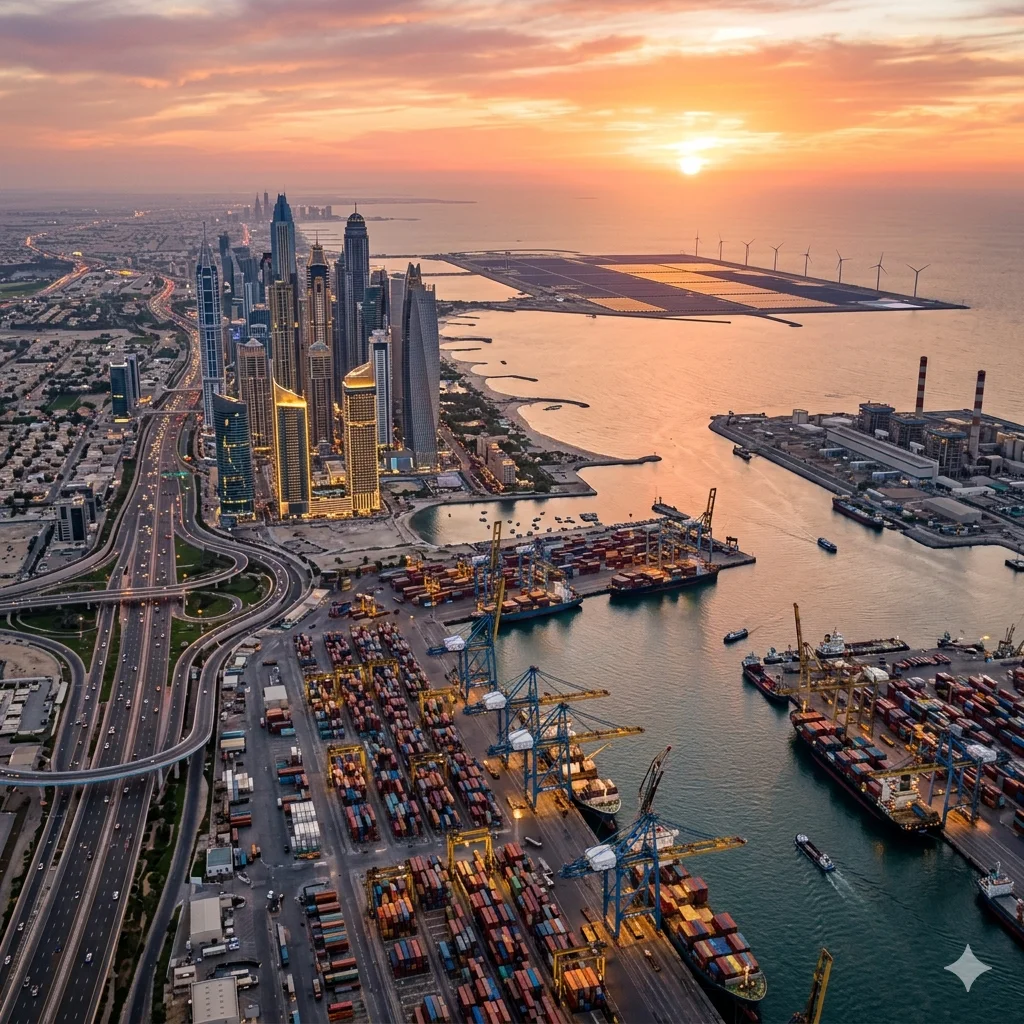
[IMAGE: A wide cinematic aerial view of a modern Gulf port city at sunset, with container ships, cranes, highways, financial district towers, desalination plants, and renewable energy infrastructure in the background, realistic editorial style, high detail, no text, no watermark]
The Gulf’s business landscape is changing in ways that are easy to miss if the focus stays on quarterly trade figures or one-off policy announcements. A more durable shift is under way: the region is increasingly operating as a strategic corridor for goods, capital, and energy. In practice, that means companies are not only using the Gulf as a market, but also as a rerouting point for supply chains, a financing base for cross-border activity, and a platform for industrial repositioning.
This matters because the logic behind the change is structural. Firms are optimizing for resilience, jurisdictional flexibility, and access to multiple markets at once. Governments are responding with infrastructure, special zones, and regulatory adjustments. Banks, ports, and logistics providers are adapting their own business models. The result is a Gulf economy that looks less like a simple commodity hub and more like a multi-layered trade system.
The first question: what is durable, and what is noise?
A slow analysis approach starts with verification. Some developments in the Gulf business report cycle are highly time-sensitive: a sanctions announcement, a shipping reroute, a sudden investment commitment, or a policy change affecting ownership rules. These can shift markets quickly, but they do not always explain the underlying trend.
More durable indicators tell a different story. These include port throughput, re-export volumes, banking activity, foreign direct investment composition, industrial land absorption, and the share of trade finance relative to standard corporate lending. For a serious assessment of the Gulf economy, those indicators matter more than headline growth alone.
Useful source checks should come early. Customs data can show whether trade rerouting is actually happening. Central bank releases can indicate whether financial activity is expanding in treasury, payments, or trade finance. Port authority statistics reveal whether transshipment and container volumes are rising. IMF and World Bank notes help frame broader regional risk. Company filings can show whether firms are shifting warehousing, procurement, or regional headquarters functions.
[IMAGE: Editorial dashboard with charts showing trade volumes, shipping routes, and capital inflows]
Trade rerouting is reshaping the supply chain story
Much of the discussion about Gulf trade focuses on import and export totals. That misses the more important question: is the region becoming a preferred buffer node in fragmented global supply chains?
There are several reasons this could be happening. When firms face sanctions risk, regional conflict, shipping disruption, or shifting tariff regimes, they tend to seek intermediate hubs that can store goods, consolidate shipments, and move inventory flexibly across borders. The Gulf is well positioned for this role because of its ports, free zones, air cargo capacity, and strong connectivity to Asia, Europe, and Africa.
The practical effects are visible beyond the dockside. Warehousing demand rises. Cold chain capacity becomes more valuable. Bonded logistics and transshipment services gain importance. Companies also place greater emphasis on inventory visibility tools and shorter delivery cycles. In other words, the supply chain becomes less centralized and more regionalized.
This is where the Gulf business report narrative often needs correction. Trade rerouting is not just about more ships or more containers. It is about the changing architecture of commercial risk. Suppliers want redundancy. Buyers want faster replenishment. Logistics operators want to capture value not only from movement, but from storage, sequencing, and compliance management.
Ports and free zones are becoming economic infrastructure, not just transit assets
The Gulf’s ports and free zones are no longer merely gateways. They are increasingly part of industrial strategy. Governments are using them to attract manufacturing, assembly, packaging, and regional distribution activity. That matters because it changes how value is captured.
If a port system only handles transit, it earns fees. If it anchors local processing, it also supports employment, land utilization, supplier networks, and tax-linked activity. This is why industrial land absorption in free zones is an important metric to monitor. It can indicate whether firms are doing more than rerouting goods — they may be embedding operations in the region.
Cold storage, pharmaceuticals, food processing, electronics distribution, and spare parts logistics are especially relevant. These sectors depend on reliable transport, customs efficiency, and predictable regulation. A stronger Gulf economy in this phase is not necessarily defined by more volume alone, but by deeper integration into regional production and inventory systems.
[IMAGE: Container terminal with trucks, warehouses, and digital logistics overlays]
Capital flows are following routes, not just returns
The same logic applies to capital. Financial institutions respond to uncertainty by favoring jurisdictions with stable rules and cross-border reach. In the Gulf, that has supported the rise of banking, custody, treasury, and trade finance activities that serve regional corridors rather than only domestic borrowers.
This is an important distinction. Traditional lending tracks local economic demand. Route-based finance follows commercial networks. That means banks may see faster expansion in wealth management, transaction services, structured trade finance, and corporate treasury solutions than in plain vanilla loan books.
Verification here should rely on bank earnings, sovereign fund disclosures, and market infrastructure reports. If deposit growth, fee income, and cross-border payment volumes are rising faster than standard credit activity, that would support the view that financial flows are becoming more corridor-oriented. The same is true if sovereign capital is increasingly deployed through strategic stakes, logistics partnerships, or industrial platforms rather than passive allocations.
Policy uncertainty also shapes behavior. When firms are unsure about sanctions exposure, compliance burdens, or access to external markets, they tend to route funds through institutions and jurisdictions that can handle complexity. That does not eliminate risk; it concentrates demand in places perceived as operationally reliable.
Energy transition pressure is testing the Gulf’s competitiveness
Oil and gas revenues still underpin public investment across much of the region. But the next phase of competitiveness is not only about extracting and exporting hydrocarbons. It is also about how the Gulf manages energy transition pressures while preserving industrial advantage.
This includes several layers. First, domestic energy pricing and infrastructure remain central to industrial policy. Second, the region is investing in renewables, grid upgrades, hydrogen, desalination efficiency, and lower-carbon industrial inputs. Third, large-scale capital allocation increasingly has to account for global expectations around emissions, technology adoption, and diversification.
The challenge is not that the Gulf is moving away from energy; it is that energy is becoming more complex as a policy and investment category. Investors want to know whether the region can maintain low-cost power, reliable logistics, and competitive industrial inputs while adapting to a lower-carbon world. That question affects everything from petrochemicals to aluminum to data centers.
A key implication is that energy transition is not just an environmental issue. It is a location decision. If a Gulf jurisdiction can offer affordable electricity, predictable regulation, and access to shipping routes, it can remain competitive for energy-intensive industries even as global standards change.
[IMAGE: Industrial complex with solar fields, power lines, desalination facilities, and LNG infrastructure]
Banking, regulation, and the changing geography of trust
One underreported effect of sanctions pressure and trade fragmentation is the changing geography of trust. Companies and banks are increasingly sorting jurisdictions not just by tax rate or growth rate, but by operational clarity. Can contracts be enforced? Can payments be cleared? Will compliance standards be interpreted consistently? Can goods move across borders without repeated friction?
This is where Gulf financial centers have gained strategic importance. Their appeal lies partly in regulatory modernization, partly in their ability to connect different markets, and partly in their role as intermediaries between global capital and regional trade. The stronger the policy uncertainty elsewhere, the more valuable these traits become.
That does not mean all Gulf markets benefit equally. Some are more specialized in logistics. Others are more finance-heavy. Others focus on industrial land, energy infrastructure, or free-zone development. But across the region, the direction is similar: institutions are adapting to a world where cross-border activity depends on legal and financial interoperability.
For investors, this changes how risk should be assessed. A bank’s trade finance exposure may matter more than its loan growth. A port’s hinterland connectivity may matter more than its headline container count. A free zone’s tenant mix may matter more than its occupancy rate. These are subtle metrics, but they are often the ones that reveal the true direction of change.
The long-term effect: a more localized but more connected Gulf
The paradox of the current Gulf business report cycle is that supply chains are becoming more localized even as the region becomes more globally connected. More firms want local stocking, local compliance support, and local financing. At the same time, they want access to multiple external markets, faster rerouting options, and diversified currency and logistics channels.
That combination favors the Gulf. It also raises the bar for policy execution. Governments need to keep customs systems efficient, logistics corridors predictable, and industrial land available. Banks need to deepen trade finance and payment infrastructure. Ports need to integrate with warehouses, airports, and manufacturing zones. Energy planners need to support both decarbonization and industrial competitiveness.
This is why the region should be understood as a corridor economy rather than a single-node market. Its value is increasingly in coordination: moving goods, structuring capital, and managing risk across jurisdictions. That makes it more resilient in some respects, but also more exposed to external shocks in trade, regulation, and energy markets.
Conclusion: the real story is in the system, not the headline
The most important changes in the Gulf economy are cumulative. Trade rerouting, capital reallocation, and energy transition pressures are not separate stories. They are interacting forces that are rewiring how the region participates in global commerce.
For now, the evidence points to a Gulf that is becoming more important as a strategic corridor. Whether that position strengthens will depend on how well ports, free zones, banks, and industrial planners respond to the demands of a more fragmented world. The headline numbers will continue to matter, but the deeper story is in the system around them.
In that sense, the Gulf’s next phase is less about volume and more about architecture: who controls the routes, who finances them, and who can adapt fastest when the rules change.
Keywords

Sarah Al-Qasimi
Chief Editor leading investigative reports on Gulf business and policy.