The Gulf''s Quiet Industrial Policy Revolution: Lessons from Decades of State-Led Diversification in a Resurgent Global Economy
While global economies rush back to industrial policy after years of neglect, the Gulf Cooperation Council (GCC) states never abandoned it. From Bahrain’s pioneering 1968 development plan to today’s ambitious national visions, Gulf governments have consistently used targeted interventions to diversify away from oil. This deep-dive article examines the hidden logic behind their approach—sector-based support rather than company bailouts, rules-based investment targets, and a clear separation of public and private spheres. It explores how these long-standing practices, informed by the need to mitigate rentier effects, position the Gulf as a unique laboratory for modern industrial policy. The analysis also draws on key recommendations from a 2025 policy paper, offering insights for global businesses, investors, and policymakers navigating shifting supply chains, climate goals, and protectionist trends.
Sarah Al-Qasimi
Editorial Analyst
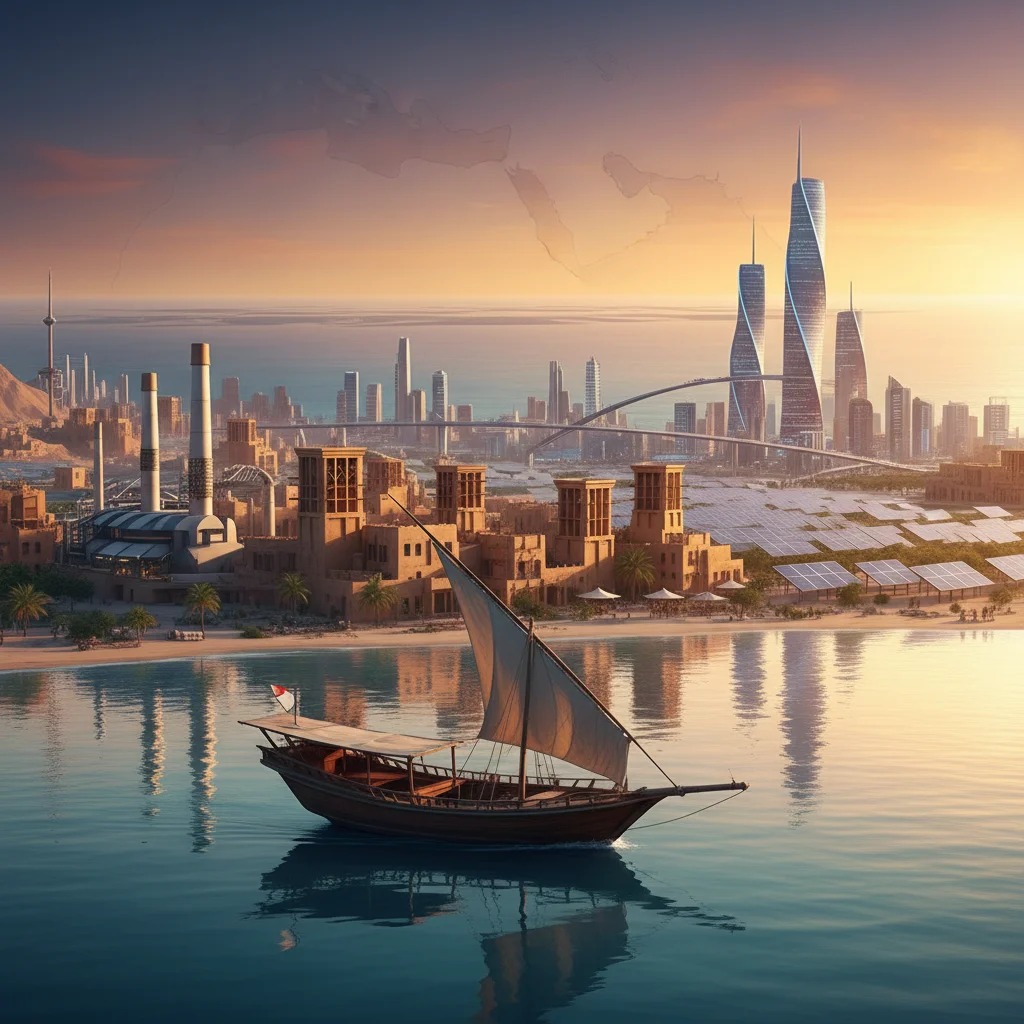
The Gulf's Quiet Industrial Policy Revolution: Lessons from Decades of State-Led Diversification in a Resurgent Global Economy
Introduction: Why the Gulf’s Industrial Policy Story Matters Now
Industrial policy is back in vogue. Across Europe, the United States, and Asia, governments are scrambling to rebuild domestic manufacturing capacity, secure supply chains, and accelerate the green transition. The COVID-19 pandemic exposed the fragility of global production networks; climate imperatives demand rapid industrial restructuring; and rising protectionism has made self-sufficiency a strategic priority. After decades of free-market orthodoxy, state intervention in industry is no longer taboo.
Yet the Gulf Cooperation Council (GCC) states never abandoned it.
While much of the world celebrated market liberalization, the governments of Saudi Arabia, the United Arab Emirates, Qatar, Kuwait, Oman, and Bahrain quietly maintained a tradition of state-led industrial planning that stretches back more than five decades. This consistency offers a unique, underappreciated case study for policymakers and business leaders navigating today's turbulent global economy.
The core insight is this: Gulf industrial policy has always been fundamentally about managing the "rentier effect" —the structural challenge of reducing dependence on oil rents by deliberately constructing alternative economic structures. It was never about temporary stimulus or saving failing companies. It was about long-term transformation.
As the global economy confronts the limits of laissez-faire approaches, the Gulf's experience provides valuable lessons on how to design industrial policy that works over decades, not election cycles.
[IMAGE: A world map with highlighted GCC region, overlaid with icons of supply chains, factories, and green energy, contrasting with traditional oil derricks fading in the background.]
Historical Roots: From Bahrain’s 1968 Plan to National Visions
The origins of Gulf industrial policy are often overlooked in global development literature, which tends to focus on East Asian "tiger economies" or Western postwar planning. Yet the first five-year development plan in the Gulf region was launched by Bahrain in 1968—a full decade before China's economic reforms and two decades before the Washington Consensus.
Bahrain, the smallest oil producer in the Gulf, recognized early that its hydrocarbon reserves were finite. The 1968 plan explicitly sought to build alternative economic sectors: aluminum smelting, ship repair, and financial services. Aluminum Bahrain (Alba), founded in 1971, remains one of the world's largest smelters and a testament to this early diversification strategy.
Throughout the 1970s and 1980s, other Gulf states adopted similar central planning frameworks. Saudi Arabia's first development plan (1970-1975) allocated massive resources to infrastructure, petrochemicals, and basic industries. The Saudi Basic Industries Corporation (SABIC), established in 1976, became a global chemicals giant through deliberate state backing. These efforts continued even as the rest of the world embraced privatization and deregulation in the 1980s and 1990s.
The 2020-2030 national vision documents—most prominently Saudi Vision 2030, but also UAE Vision 2021, Qatar National Vision 2030, and others—represent a second wave. These documents expand industrialization goals significantly, targeting not just heavy industry but also advanced manufacturing, technology, logistics, and digital services. They reflect a maturation of the original approach: from building basic capacity to fostering innovation ecosystems.
[IMAGE: Archival photo of a 1960s Bahraini development committee meeting alongside a modern digital dashboard of GCC industrial targets, showing continuity.]
Distinctive Approach: How Gulf Industrial Policy Differs from Western Trends
The Gulf model offers a distinct alternative to the industrial policy approaches now being adopted in Europe and North America. Several features set it apart:
Sector-based support, not company bailouts. Unlike OECD countries that have at times intervened to rescue specific companies (think Chrysler in 1979 or recent semiconductor subsidies in the U.S.), Gulf states focus on building entire industrial ecosystems. They establish sector development authorities, create industrial zones, and provide incentives for any company that meets defined criteria. This avoids the classic problem of "picking winners" while still providing strategic direction.
Rules-based investment targets. Rather than direct ownership or ad-hoc interventions, Gulf governments set clear local content requirements, technology transfer thresholds, and employment quotas that private sector firms must meet to qualify for support. These rules create accountability without the inefficiencies of central command. Saudi Arabia's "In-Kingdom Total Value Add" (IKTVA) program, launched in 2015, is a prime example: it requires foreign companies to invest locally in exchange for access to Saudi markets.
Clear separation of public and private spheres. State-owned enterprises (SOEs) in the Gulf operate in clearly defined strategic areas—energy, infrastructure, basic industries—while private firms are expected to lead in downstream activities, services, and innovation. This division reduces the crowding-out effect that often plagues state-led development. When Saudi Aramco builds a petrochemical complex, it creates opportunities for private manufacturers to use its inputs, rather than competing with them.
These features emerged organically from the region's specific constraints: small domestic markets, limited private sector capacity in early decades, and a need to manage rentier state dynamics by ensuring that oil wealth flows through productive channels rather than merely financing consumption.
Key Mechanisms: Rules-Based Investment and Sectoral Strategies
Understanding how Gulf industrial policy actually works requires examining the specific instruments deployed over decades.
Industrial zones and special economic zones have been a cornerstone. Jebel Ali Free Zone in Dubai (established 1985) revolutionized regional trade by offering 100% foreign ownership, zero corporate taxes, and streamlined customs. It attracted global logistics and manufacturing firms that gradually built local supply chains. The model has been replicated across the Gulf, from Saudi Arabia's King Abdullah Economic City to Oman's Duqm Special Economic Zone.
State-backed anchor projects create demand for local suppliers. When the UAE built its aluminum smelter (EGA) and developed its aviation hub, it simultaneously created markets for parts manufacturers, maintenance services, and logistics providers. This "anchor plus ecosystem" approach reduces the risk that private firms will invest in activities with uncertain demand.
Local content requirements have evolved from simple mandates to sophisticated programs. Saudi Arabia's IKTVA program now includes technology transfer tracking, supplier development initiatives, and workforce training components. Companies that invest in R&D within the kingdom receive preferential points in government procurement decisions.
Sovereign wealth funds play a dual role: they provide patient capital for long-term industrial projects and also invest globally to acquire technology and expertise that can be transferred back to the Gulf. The Public Investment Fund (PIF) of Saudi Arabia, the Abu Dhabi Investment Authority (ADIA), and the Qatar Investment Authority (QIA) are not passive investors; they actively seek deals that align with domestic industrial strategies.
These mechanisms work together in a coherent framework. They are not perfect—implementation challenges persist, and some programs have been slow to deliver results—but they represent a systematic approach that contrasts with the ad-hoc, reactive industrial policies now emerging elsewhere.
[IMAGE: Infographic showing four interconnected pillars: Industrial Zones, Anchor Projects, Local Content Programs, and Sovereign Wealth Funds, with arrows showing how each feeds into the other.]
Challenges and Adaptations: Lessons from Fifty Years of Trial and Error
The Gulf's industrial policy record is not without failures. Understanding these challenges is essential for drawing useful lessons.
Overreliance on expatriate labor has limited the development of indigenous human capital. While Gulf countries have made significant investments in education and training, the private sector still depends heavily on foreign workers for technical and managerial positions. This weakens the knowledge transfer that industrial policy is supposed to catalyze.
Dual economy problems persist. In several Gulf states, a high-productivity, high-wage public sector coexists with a less dynamic private sector. Young nationals often prefer government jobs (with greater job security and shorter hours) to private sector careers, limiting the talent pool available to emerging industries.
Regional coordination remains weak. Despite the GCC's institutional framework, member states have often pursued competing rather than complementary industrial strategies. Multiple aluminum smelters, steel plants, and petrochemical complexes have been built across the region, sometimes creating overcapacity rather than specialization.
Political economy constraints matter. Industrial policy inevitably creates winners and losers, and powerful interests (including established merchant families and tribal networks) can resist reforms that threaten their positions. The most successful Gulf industrial policies have managed these dynamics by creating new opportunities alongside challenging old ones.
Yet the region has demonstrated a remarkable capacity for adaptation. When initial diversification efforts in heavy industry encountered environmental and water scarcity constraints, Gulf states pivoted toward less resource-intensive sectors like finance, tourism, and technology. When early manufacturing localization efforts struggled with quality, governments invested in standards bodies and training institutions. This iterative approach—learn, adjust, persist—may be the most important lesson for other regions.
The Global Context: What Gulf Experience Offers a Protectionist World
As the global economy fragments along geopolitical lines, the Gulf's industrial policy experience becomes more relevant for several reasons.
Supply chain resilience is a shared goal. The GCC states have spent decades building redundant production capacity in strategic sectors. Their experience with securing supply chains during the 1990-91 Gulf War and subsequent regional disruptions offers practical lessons for countries now seeking to reduce dependence on concentrated sources of production.
Climate goals create new industrial opportunities. The Gulf is investing heavily in green hydrogen, solar energy, and carbon capture technologies—industries that align with both diversification goals and global climate targets. The region's ability to integrate environmental objectives into industrial strategy—rather than treating them as separate policy domains—offers a model for the "green industrial policy" now debated in Europe and the United States.
Protectionism demands a different response. Unlike the tariff-based protectionism of the 20th century, the Gulf approach has favored investment-based conditions. Rather than closing markets, Gulf states have opened them in exchange for local value creation. This "conditional openness" may be more effective than outright protection in an era of global supply chains.
Regional cooperation, though imperfect, offers templates. While the GCC has fallen short of full economic integration, its experience with coordination mechanisms—from common customs tariffs to joint infrastructure projects—provides insights for other regions seeking to balance national industrial priorities with collective benefits.
A 2025 policy paper from the Gulf Research Center distilled several key recommendations for global businesses and policymakers:
- Prioritize ecosystem building over company support. The goal should be to create conditions where multiple firms can thrive, not to prop up individual enterprises.
- Use rules-based rather than discretionary instruments. Clear, transparent criteria reduce corruption and improve private sector confidence.
- Invest in human capital alongside physical capital. Industrial policy fails without skilled workers.
- Embrace adaptive learning. No plan survives first contact with reality; mechanisms for feedback and adjustment are essential.
- Maintain long-term perspective. True diversification takes decades, not electoral cycles.
[IMAGE: A conceptual drawing showing a Gulf city skyline on the horizon, with supply chain arrows coming from multiple global directions converging at a modern factory complex in the foreground, labeled "Adaptive Ecosystem."]
Looking Ahead: The Gulf as a Laboratory for Modern Industrial Policy
The Gulf states are now entering a new phase of industrial development, one that will test the resilience of their approach. The energy transition poses both risks and opportunities: declining long-term oil demand threatens the region's primary revenue source, but the infrastructure and expertise built over decades position the Gulf to play a central role in new energy systems.
Advanced manufacturing is the next frontier. Saudi Arabia aims to become a hub for electric vehicle production, semiconductor manufacturing, and biotechnology. The UAE is building capacity in aerospace, artificial intelligence, and medical devices. Qatar is expanding its petrochemical diversification into specialty chemicals and plastics recycling.
These ambitions will require new policy tools. The Gulf states are experimenting with innovation incentives, startup funding mechanisms, and deeper integration of universities into industrial strategy. They are also exploring carbon border adjustment mechanisms and green certification schemes to maintain market access for their industrial products in a decarbonizing world.
The key question is whether the Gulf model can adapt to the demands of the Fourth Industrial Revolution. The heavy industry, logistics, and basic manufacturing that dominated earlier diversification phases required capital-intensive, scale-driven approaches. The industries of the future—software, services, biotechnology—demand different conditions: venture capital, intellectual property protection, regulatory flexibility, and talent mobility.
The Gulf has advantages in this transition: world-class infrastructure, strong fiscal positions, and leadership committed to change. But it must continue to evolve its policy frameworks. The separation of public and private spheres that worked for petrochemicals may need modification for technology startups. The rules-based investment models that attracted multinational manufacturers may need simplification for smaller, more agile firms.
For global businesses, the lesson is clear: the Gulf is not a passive market but an active, strategic actor in the reshaping of global industry. Companies that understand the logic of its industrial policy—and engage within its frameworks—will find significant opportunities. Those that expect to operate without contributing to local economic transformation will find doors closing.
For policymakers elsewhere, the Gulf experience offers both inspiration and caution. State-led industrial policy can work—but only when it is disciplined, consistent, and willing to learn from failure. The world is rediscovering industrial policy. The Gulf reminds us that it never left.
[IMAGE: Sunset over a modern Gulf city skyline with solar farms in the foreground and wind turbines on the horizon, symbolizing the transition from fossil fuels to diversified, sustainable industrial economy.]
Keywords

Sarah Al-Qasimi
Chief Editor leading investigative reports on Gulf business and policy.